The Extremely Large Telescope, one of the most ambitious optical infrastructures on the planet, suffered a critical loss of focusing capability that left engineers baffled. The cause was not a manufacturing defect or a software error, but contamination from micro-volcanic dust blocking the nanometric movement of the piezoelectric actuators. The solution came thanks to a digital twin of the adaptive mirror system.
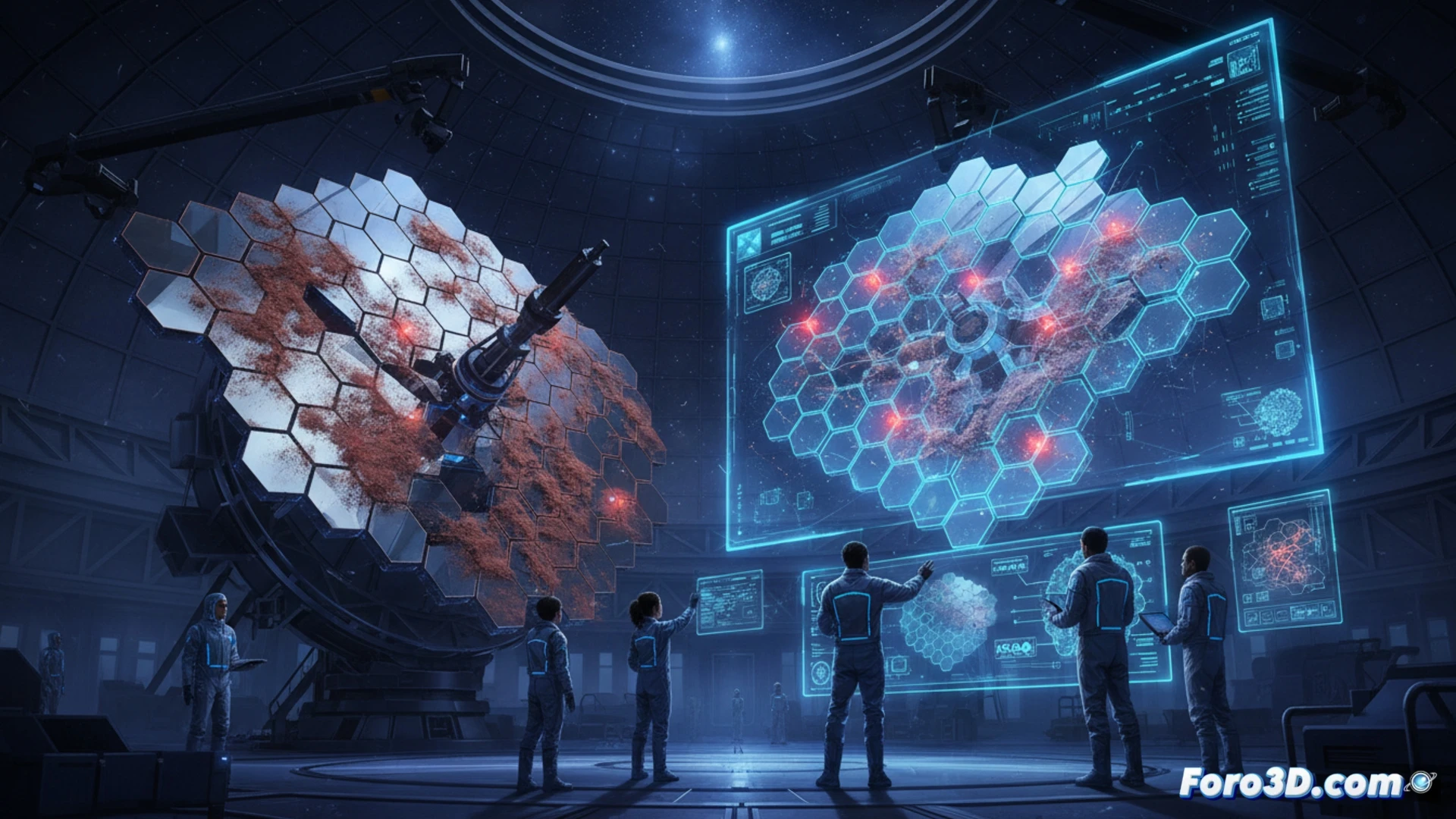
Workflow: scanning, modeling, and nanometric simulation 🔬
The diagnosis began with a precision scan using Leica Cyclone, which captured the three-dimensional geometry of the actuators with submillimeter accuracy. This point cloud was imported into SolidWorks to reconstruct the solid model of the system, including each mirror and its piezoelectric support. The digital twin was completed in MATLAB, where the dynamic behavior of the actuators under ideal and contaminated conditions was simulated. Comparison of the displacement curves revealed a systematic deviation of just 50 nanometers, consistent with the presence of volcanic silica particles trapped in the expansion joints.
Lessons for predictive maintenance of critical infrastructures 🛠️
This case demonstrates that digital twins are not just design tools, but living diagnostic systems. Without the virtual replica, the dust contamination would have been undetectable until the mirrors failed completely. The ability to simulate failures at the nanometric scale, combining optical scanning, mechanical modeling, and numerical analysis, allows anticipating breakdowns in extreme environments. For facilities such as telescopes, accelerators, or power plants, this methodology becomes insurance against the silent collapse of critical components.
How can a digital twin model the accumulation of volcanic dust on the mirrors of the Extremely Large Telescope to predict and mitigate critical losses of optical capability in real time
(PS: don't forget to update the digital twin, or your real twin will complain)