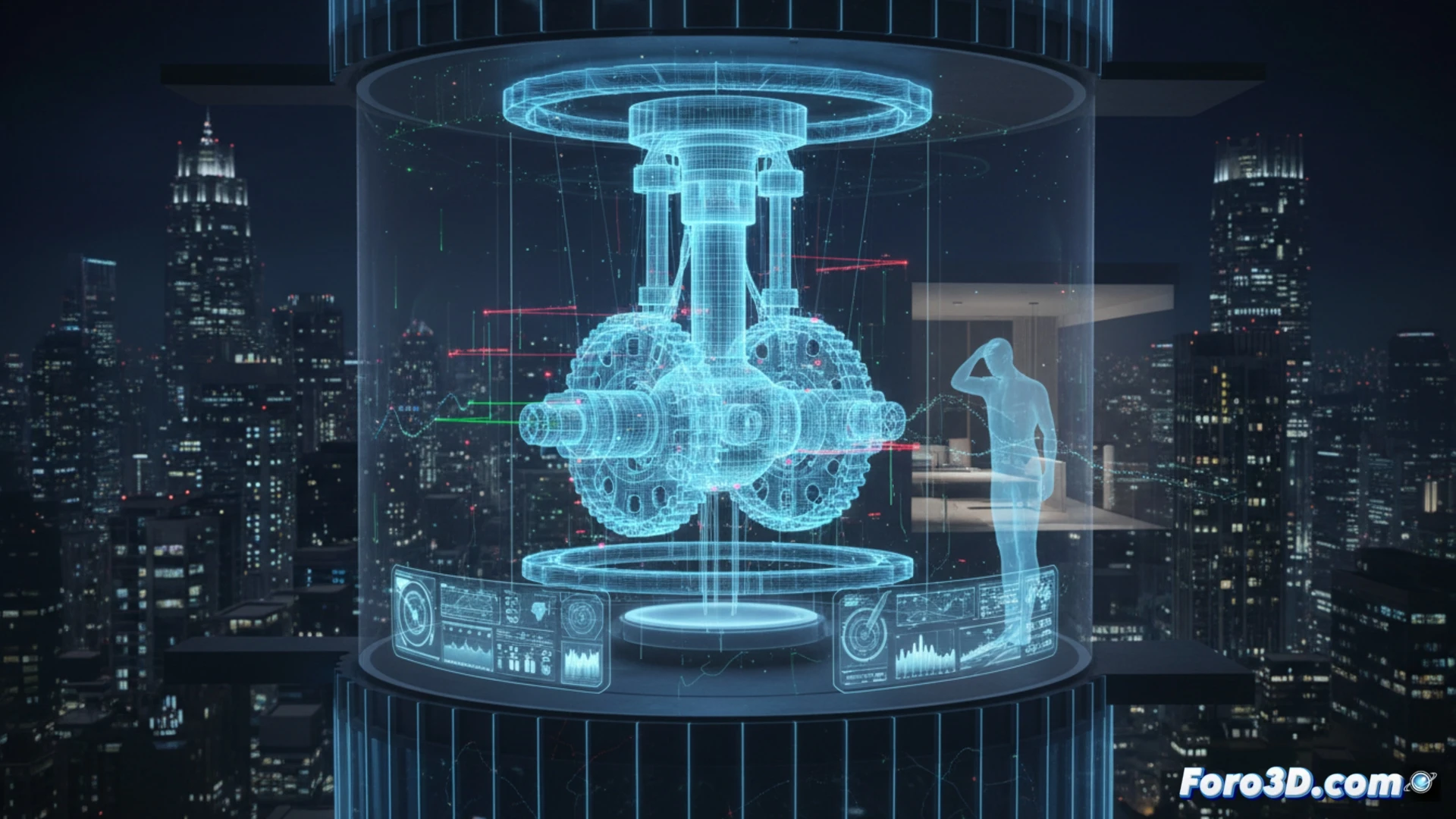
Residents of the Infinity Tower have reported recurrent dizziness during moderate wind episodes, a symptom suggesting an anomaly in the 800-ton tuned mass damper (TMD). To diagnose the problem without physically intervening in the structure, the engineering team has developed a digital twin of the system. This virtual model accurately replicates the pendulum, hydraulic pistons, and control electronics, allowing simulation of the tower's dynamic behavior under real wind loads.
Hybrid modeling in SAP2000 and LS-DYNA for nonlinear analysis 🏗️
The digital twin is built in two stages. First, a finite element model is generated in SAP2000 that captures the global structural response of the tower, including natural frequencies and vibration modes. This model is coupled with a detailed simulation of the TMD in LS-DYNA, where the hydraulic pistons are represented with nonlinear viscoelastic properties. In parallel, data from accelerometers and displacement sensors installed on the real pendulum are processed in MATLAB to extract vibration signals. The comparison between simulated and measured signals reveals a 12-millisecond phase shift in the digital controller's response, as well as hysteresis in the pistons that introduces nonlinearity into the damping.
Lessons for predictive maintenance of infrastructure 🔍
This case demonstrates the strategic value of digital twins in structural engineering. By synchronizing the virtual model with real-time sensor data, not only was the root cause of the dizziness identified (a delay in the control loop), but the phase shift correction could be simulated before physically implementing it. For the industry, this validates that a well-calibrated digital twin allows diagnosing incipient failures, optimizing the performance of critical systems, and planning predictive maintenance, avoiding costly interventions and ensuring occupant safety.
Considering that the digital twin managed to detect micro-phase shifts in the TMD that did not appear in the original structural plans, what calibration parameters of the virtual model allowed differentiating between normal environmental vibration and that which causes dizziness in residents?
(PS: My digital twin is currently in a meeting, while I am here modeling. So technically, I am in two places at once.)