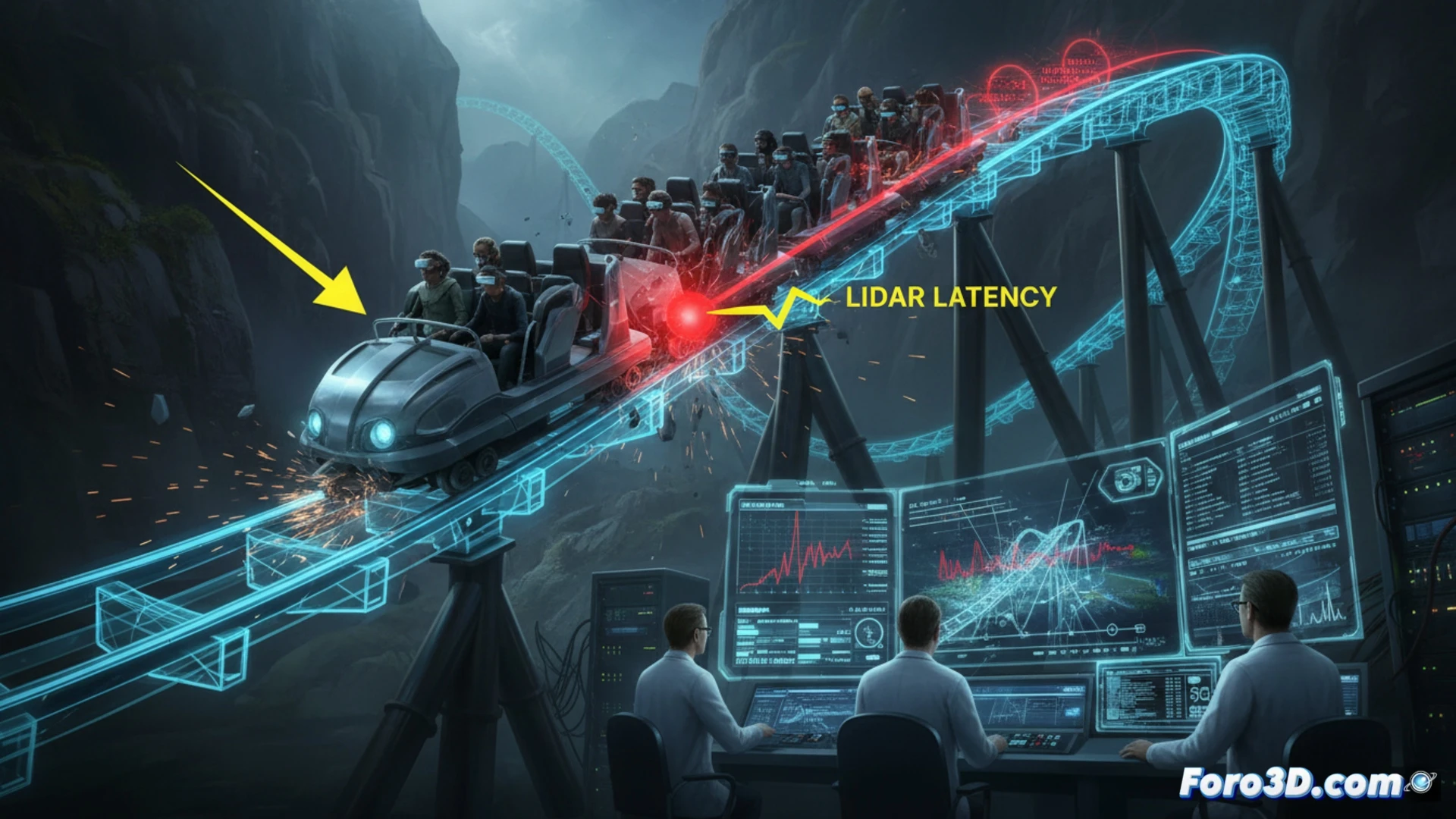
Last weekend, an incident on a hybrid augmented reality ride left several passengers with severe disorientation and a mild concussion following a braking sequence error. The subsequent analysis, far from being limited to physical inspection, relied on a digital twin of the track to uncover the root cause. The virtual replica, fed by system logs and 3D scans, identified a critical latency in LiDAR positioning that desynchronized the magnetic brakes from the vehicle's actual position.
Forensic diagnosis with Unity 3D and Solid Edge 🛠️
The investigation process began with high-precision scanning of the track using an Artec Studio scanner, capturing every millimeter of the metal structure and rails. This point cloud was integrated into Solid Edge to model the mechanical components and actuators of the braking system. Subsequently, the model was exported to Unity 3D, where the functional digital twin was built. By inputting the temporal logs from the control system, the real-time simulation exactly replicated the failure: a 47-millisecond delay in the LiDAR signal caused the magnetic braking command to execute when the car had already passed the activation point. The latency, imperceptible on standard monitors, became evident when overlaying the virtual trajectory onto the telemetry data.
Lessons for critical systems simulation ⚠️
This case underscores the importance of digital twins not only as design tools but as testbeds for physical cybersecurity and sensor reliability. Positioning latency, often overlooked in offline simulations, became a real risk factor. The theme park and robotics industry must incorporate network delay and sensor jitter models into their digital twins to anticipate these offsets. The technology did not fail due to a mechanical error, but due to a timing problem in the digital communication between the real world and its virtual shadow.
Considering that the incident originated from an undetected latency in the digital twin's LiDAR system, what real-time synchronization protocols should be implemented to ensure the virtual replica faithfully reflects the ride's physical state during emergency braking maneuvers?
(PS: My digital twin is currently in a meeting, while I'm here modeling. So technically, I'm in two places at once.)