The Svalbard seed vault, designed to withstand cataclysms, faces a silent threat: permafrost thaw. Water seepage is compromising the 3D-printed concrete seals. To combat this, a digital twin has been implemented that replicates every centimeter of the structure, using temporal laser scanning to detect micro-movements in the rock before they become catastrophic failures.
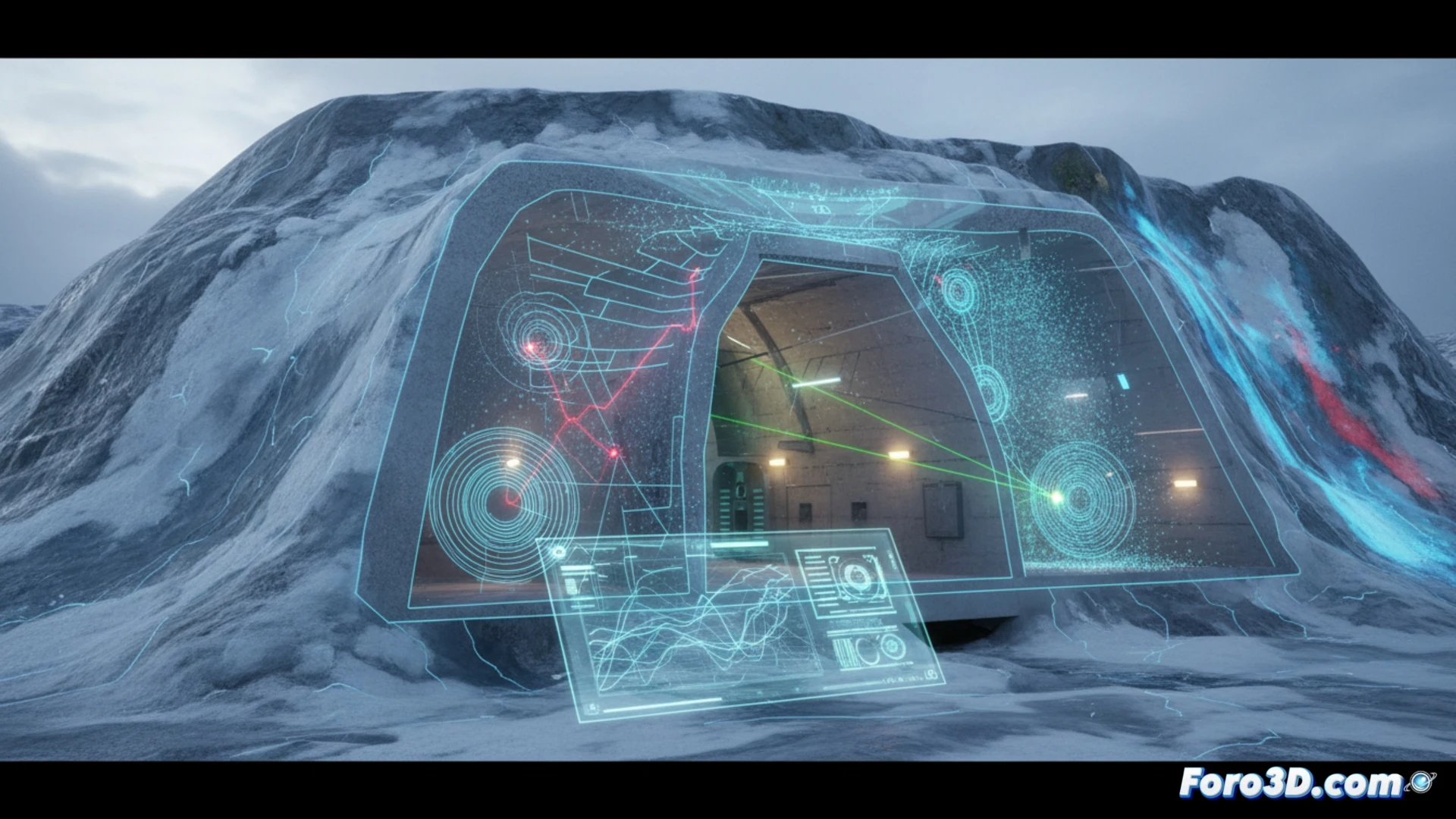
Workflow: from LiDAR to structural simulation model 🛠️
The process begins with high-precision LiDAR scanning that generates massive point clouds. These are processed in Leica Cyclone to align temporal scans, and then exported to CloudCompare. Here, change analysis (M3C2) quantifies millimeter-scale displacements at the rock-concrete interface. The data is integrated into SAP2000 to simulate structural behavior under thermal stresses. Finally, Twinmotion visualizes the digital twin in real-time, allowing engineers to virtually inspect critical zones and plan reinforcements without entering the vault.
Predictive monitoring as a new security layer 🔍
This case demonstrates that a digital twin is not just a static copy, but a living early warning system. By combining laser scanning with structural analysis software, raw data is transformed into preventive decisions. For critical infrastructure, this workflow turns the invisible (micro-movements) into an actionable risk map, redefining the safety standard in extreme environments.
How can a digital twin model of the Svalbard vault predict and mitigate in real-time the structural failures caused by permafrost thaw before they compromise its function as a global seed repository?
(PS: My digital twin is right now in a meeting, while I'm here modeling. So technically, I'm in two places at once.)