The aluminum industry faces a critical challenge: premature valve wear due to abrasive bauxite flow. A recent technical analysis has shown that the combination of 3D scanning and CFD simulation allows for precise identification of erosion zones. By comparing the digital twin with the actual part, engineers validated a predictive model that anticipates structural failures, optimizing industrial maintenance programs.
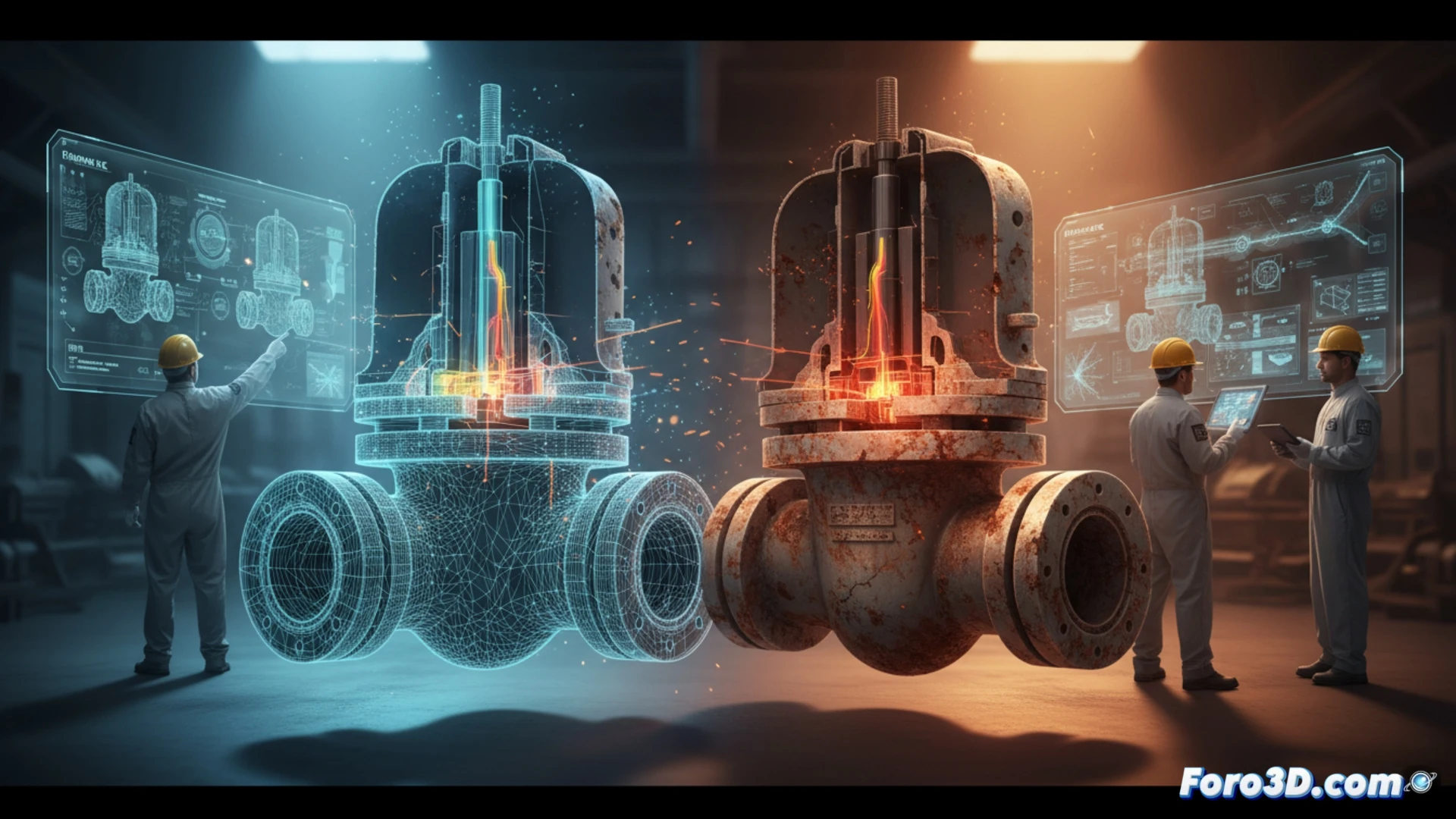
Validation of the CFD model through comparative 3D scanning 🛠️
The process began with the digitization of the worn valve using a high-precision scanner. The resulting point cloud was processed in MeshLab to clean noise and reconstruct the geometry. Subsequently, it was imported into Geomagic Control X to perform a differential analysis against the original CAD model, revealing material losses of up to 4.2 mm on the seat. In parallel, in SolidWorks Flow Simulation, the digital twin was recreated with real operating conditions, simulating the two-phase flow of bauxite and water. The simulation predicted exactly the same impact zones, demonstrating that the numerical model faithfully replicates physical erosion.
The digital twin as an industrial prediction tool 🔍
This case demonstrates that a digital twin is not just a static copy, but a virtual laboratory capable of anticipating failures. By calibrating the CFD model with real scanning data, it is possible to predict when a valve will reach its operational limit. For the process industry, this means moving from reactive to predictive maintenance, reducing unplanned downtime and extending the service life of critical components subjected to particle erosion.
How did the digital twin detect the hidden failure in the bauxite valve before an unplanned plant shutdown occurred?
(PS: My digital twin is currently in a meeting, while I am here modeling. So technically, I am in two places at once.)