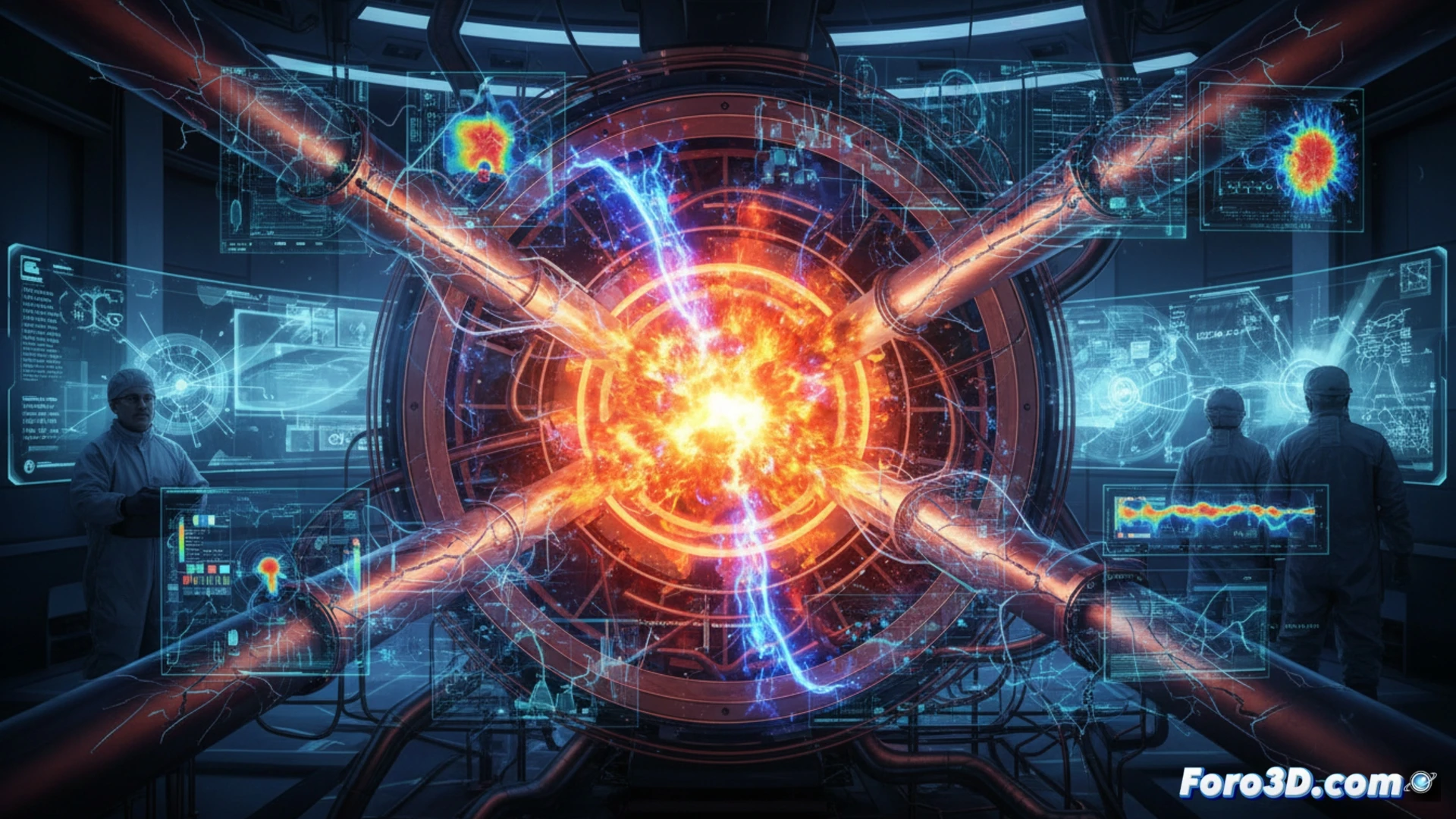
An explosion in an experimental fusion reactor has provided critical data for digital twin engineering. A breach in magnetic confinement caused massive thermal damage to the Tokamak walls. To understand plasma dynamics before the cooling system failure, engineers turned to an advanced metrology and simulation workflow, capturing every structural deformation with millimeter precision.
Technical Workflow: From Point Cloud to Thermomechanical Simulation 🔧
The process began with high-precision laser scanning using Leica Cyclone, generating a detailed point cloud of the reactor's deformed walls. This captured geometry was imported into Geomagic Control X for 3D metrology, comparing the post-explosion state with the original CAD design. Deformation data was transferred to Abaqus, where a nonlinear thermomechanical analysis was executed to reconstruct the sequence of events: the plasma leak, extreme heat transmission, and structural collapse. Finally, the model was integrated into NVIDIA Omniverse, allowing engineering and safety teams to collaborate in real-time on a faithful virtual replica of the incident.
The Predictive Value of Digital Twins in Failure Scenarios 💡
This case demonstrates that a digital twin is not only useful for monitoring operational systems but is also an essential forensic tool. By mapping deformations and simulating plasma behavior, hypotheses about the magnetic confinement failure could be validated. The ability to isolate variables and reproduce the accident in a safe virtual environment offers invaluable predictive value for redesigning cooling and shielding systems, preventing future catastrophic incidents in critical energy infrastructures.
How the thermal simulation of the digital twin was integrated to identify the root cause of the confinement breach before the tokamak explosion occurred
(PS: don't forget to update the digital twin, or your real twin will complain) 😉