Critical biological samples were arriving at their destination destroyed without any apparent cause. The hospital's pneumatic tube system generated pressure spikes that were lethal to organic material. To solve the mystery, the engineering team built an exact digital twin of the network, merging laser scanning data with BIM models. Computational fluid dynamics simulation revealed the truth: elbows with insufficient bend radius were acting as shockwave traps.
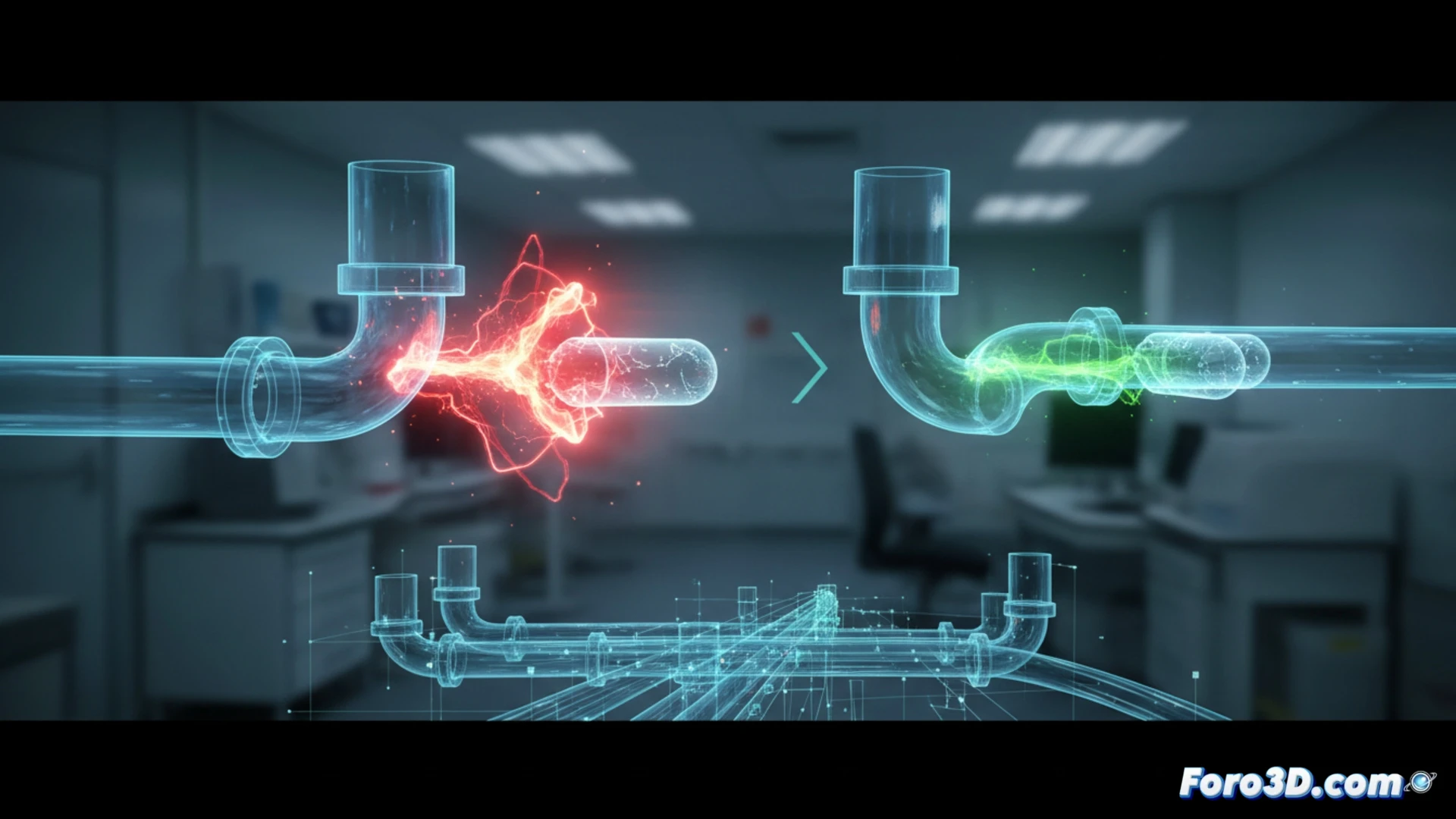
3D reconstruction and CFD simulation for fault diagnosis 🛠️
The process began with a laser scan of the entire infrastructure using Trimble RealWorks, capturing the actual geometry of each pipe, support, and joint. This point cloud was imported into Revit to generate a parametric BIM model, correcting deviations between the as-built plan and the physical installation. On this precise mesh, Autodesk CFD simulated the high-speed compressed air flow. The results showed that in elbows with a radius less than 1.5 times the pipe diameter, supersonic shockwaves formed that fragmented the samples. Unity allowed visualizing these turbulences in real-time, facilitating the identification of the seven critical points.
The predictive value of the virtual replica in healthcare environments 🏥
This case demonstrates that a digital twin is not just a static 3D model, but a testing laboratory for critical infrastructure. Without the simulation, the hospital would have replaced entire pumps and valves without solving the problem. The precise identification of the defective elbows allowed for a surgical redesign of the network with optimized bend radii. For the healthcare sector, this methodology turns reactive maintenance into predictive maintenance, saving lives by ensuring that every sample arrives intact for analysis.
How can a digital twin identify a mechanical failure point like excessive elbows in a pneumatic network, when physical sensors do not detect obvious anomalies in the transport of biological samples?
(PS: don't forget to update the digital twin, or your real twin will complain)