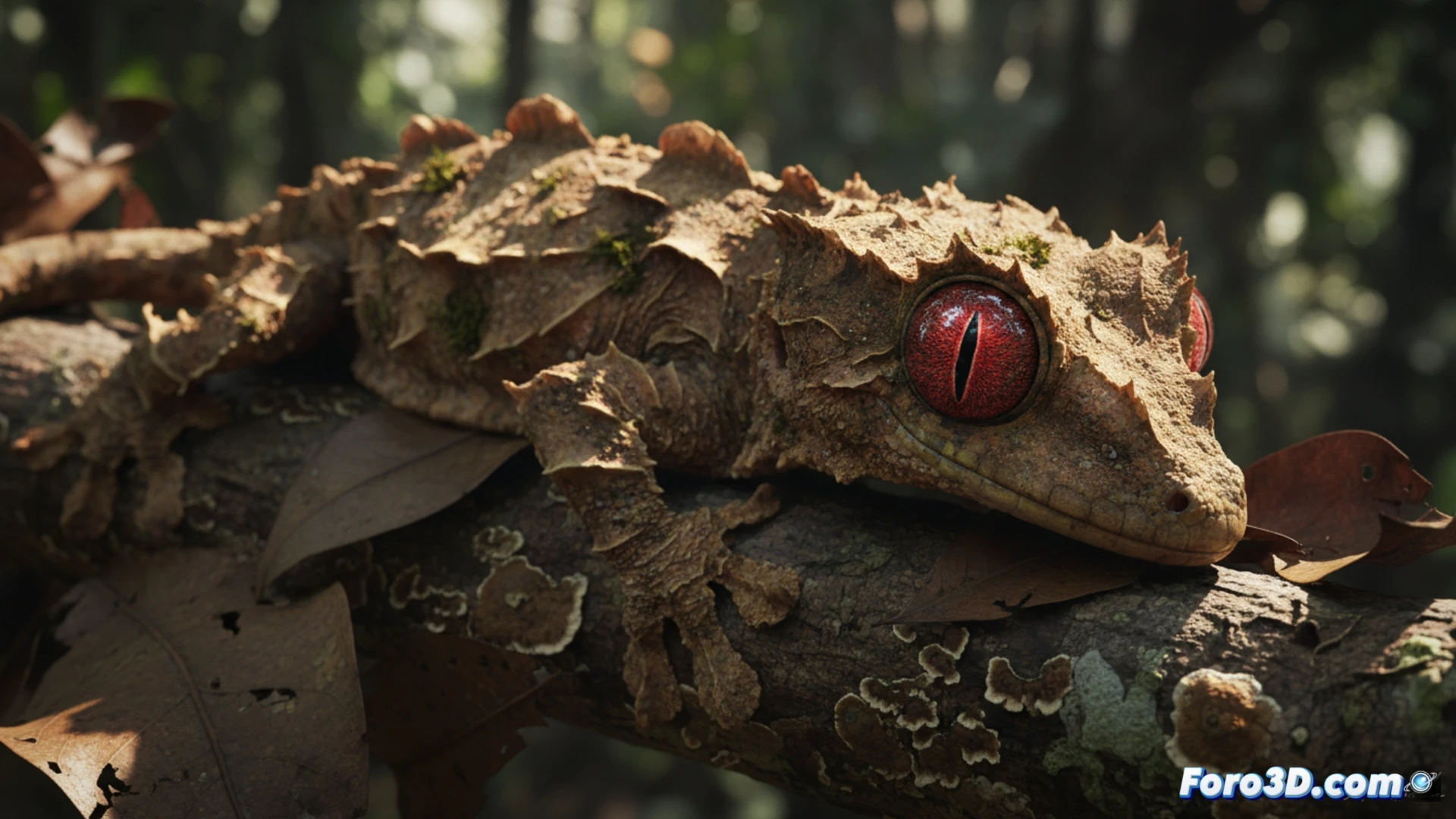
The recent description of the Red-Eyed Leaf-Tailed Gecko (Uroplatus garamaso) in Madagascar has captured the attention of the scientific community due to its extraordinary mimicry of dry leaves and its vibrant reddish eyes. For scientific visualization, this species represents a fascinating technical challenge: digitally capturing not only its geometry, but also the texture and reflectance that allow it to disappear into its environment. High-resolution photogrammetry emerges as the ideal tool to document this biological phenomenon. 🦎
Photogrammetry and bidirectional reflectance scanning 📸
The process to create an accurate digital twin of the Uroplatus garamaso requires a specialized workflow. First, a photogrammetry session is conducted with controlled cross-lighting, capturing between 200 and 400 images from all angles to reconstruct the polygonal mesh of its flattened body and leaf-like tail. Subsequently, a reflectance scan (BRDF) is applied to record how light interacts with the scales and skin folds, crucial for simulating its camouflage in virtual environments. The resulting model, with 8K or higher textures, allows biologists to study the microtopography of its skin without needing to handle the live animal, facilitating non-invasive research on its adaptive evolution.
Virtual conservation and immersive outreach 🌍
Beyond the laboratory, this 3D model has a direct impact on the conservation of the species. By integrating the gecko's digital twin into a virtual ecosystem of Madagascar, natural history museums can offer interactive experiences that showcase its cryptic behavior in real time. Visitors can rotate the model, illuminate it from different angles, and observe how the dry leaf pattern blends with the background, a practical lesson in evolutionary biology. This approach not only educates but also raises awareness about the fragility of endemic habitats, making 3D technology an ally in scientific outreach.
How can the microscopic skin structure of the Uroplatus garamaso be modeled in 3D to simulate its dynamic camouflage in a digital twin and validate hypotheses about its evolutionary effectiveness in different environments?
(PS: at Foro3D we know that even manta rays have better social bonds than our polygons)