The Urrao Antpitta (Grallaria urraoensis) represents a unique challenge for scientific visualization. Discovered in 2024 in the cloud forests of Colombia, this terrestrial bird is nearly impossible to observe directly due to its cryptic behavior. Its identification as a unique species was achieved thanks to its rhythmic song, a distinctive acoustic pattern. For researchers, capturing its morphology and behavior in a digital environment is now a priority, combining field data with three-dimensional modeling technologies.
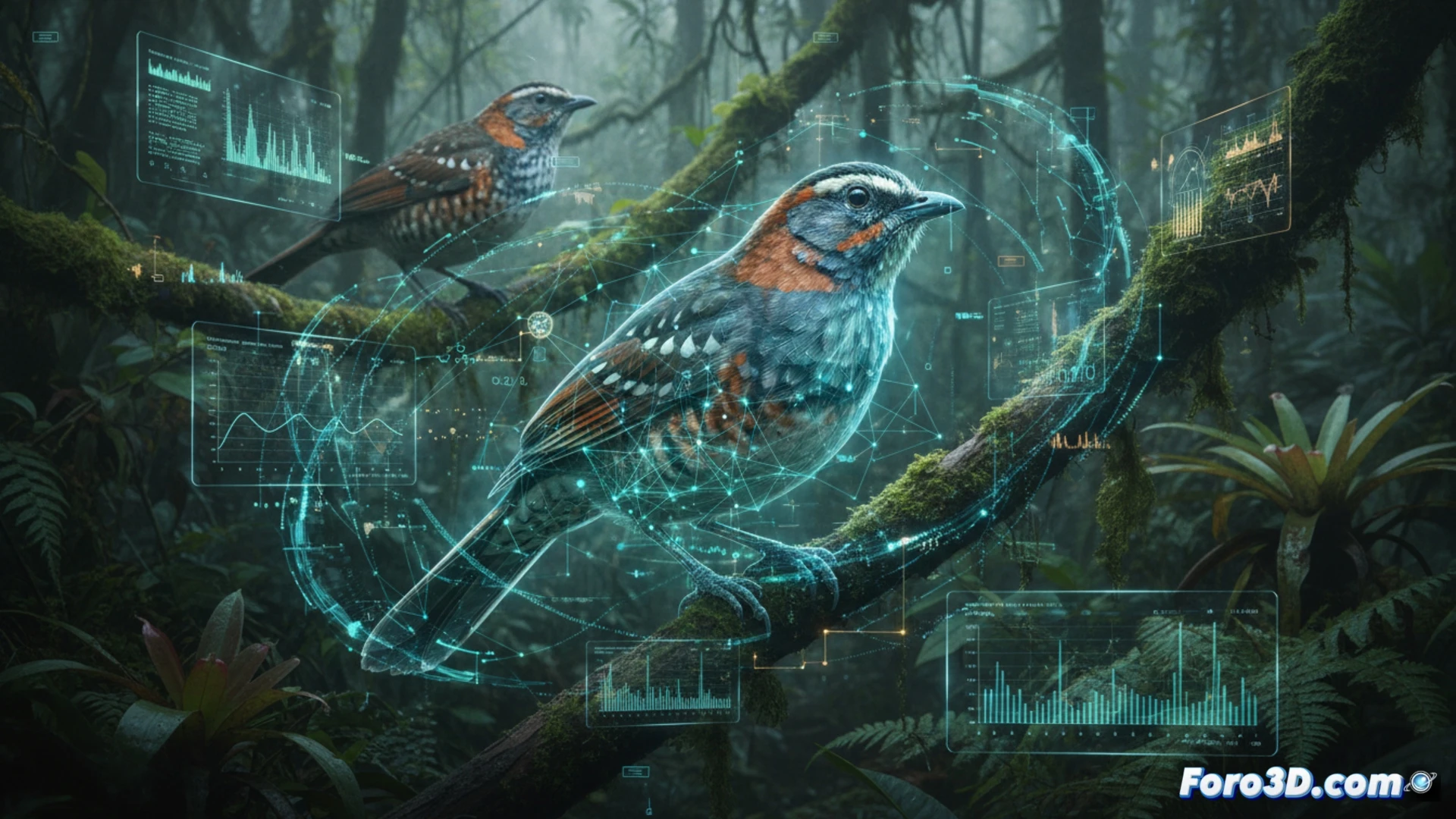
Photogrammetry, 3D spectrograms, and behavior animation 🐦
Creating a digital twin of the Urrao Antpitta requires a precise technical workflow. First, photogrammetry is used from museum specimens or high-resolution images to generate a base mesh of the plumage and anatomy. Then, field recordings of the rhythmic song are converted into 3D spectrograms, where frequency, time, and amplitude are represented as topographic surfaces in software like Blender or Houdini. Finally, the model is animated by integrating locomotion data from similar birds to simulate its elusive behavior, including beak movement synchronized with the song and stealthy movement through the understory.
Scientific visualization for cloud forest conservation 🌿
This approach not only satisfies technical curiosity but also has a direct impact on conservation. By rendering the cloud forest habitat with volumetric fog and dense vegetation, biologists can study the bird's camouflage in its environment. Sharing these models on interactive platforms allows ornithologists worldwide to analyze the song and morphology without disturbing the species. The digital twin of the Urrao Antpitta thus becomes a vital educational tool for protecting a species we are only beginning to understand.
How can an accurate level of anatomical detail be achieved in the 3D modeling of the Urrao Antpitta when visual references are scarce and the specimen inhabits a difficult-to-access ecosystem?
(PS: at Foro3D we know that even manta rays have better social connections than our polygons)