Last month, a catastrophic thermal shock crack destroyed one of the faceted mirrors at the Odeillo solar furnace. To clarify the causes, a digital twin of the heliostat field was deployed. The 3D pipeline integrated RIEGL LIDAR data with CFD simulation in Ansys Discovery, successfully mapping extreme heat points on the reflector surface. The goal was to determine whether the solar tracking system caused energy concentration outside the receiver, overheating the glass.
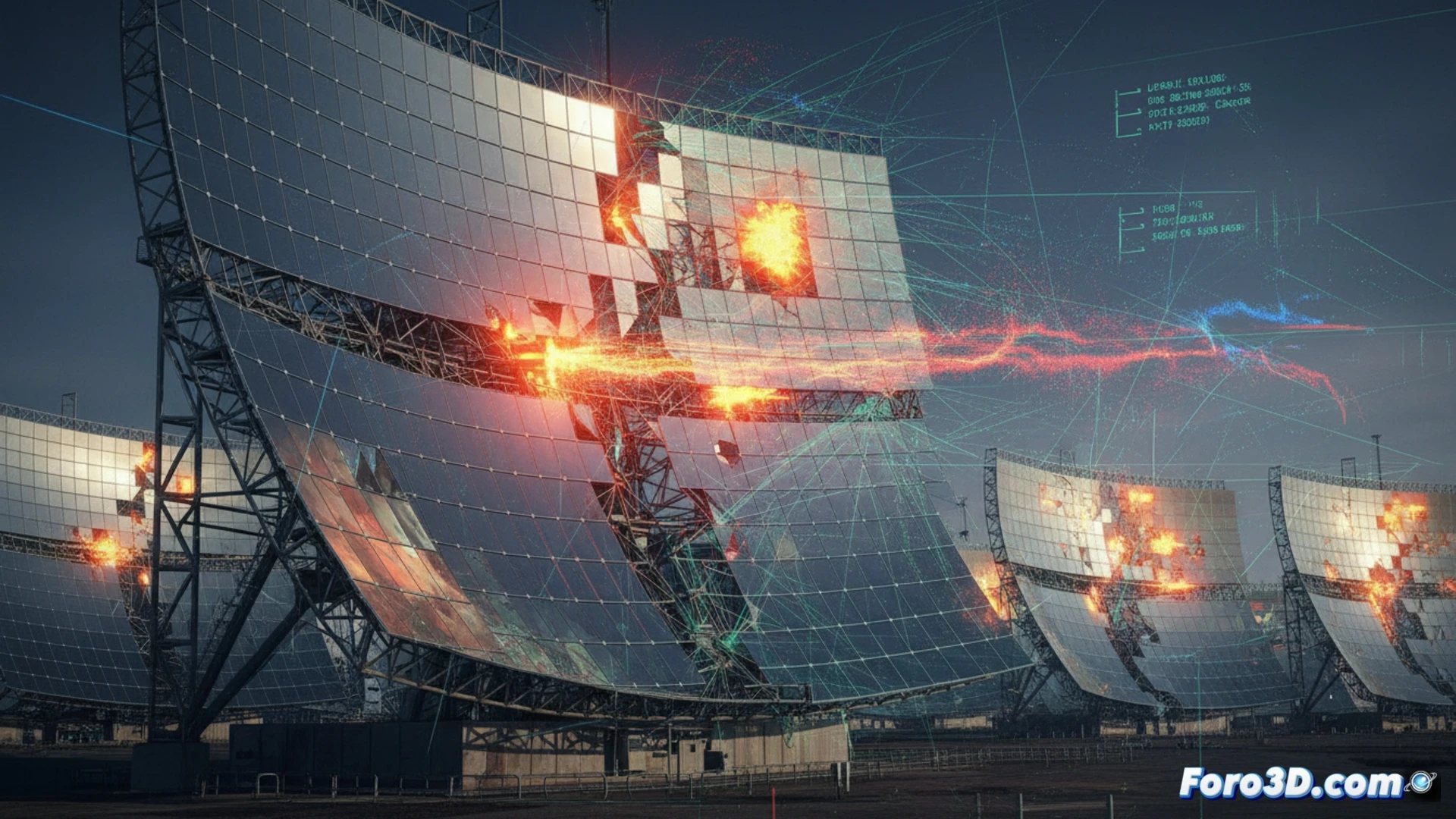
Scanning and thermal simulation pipeline in Ansys Discovery 🔥
The process began with high-precision scanning using a RIEGL VZ-2000i scanner. The resulting point cloud captured the exact geometry of the parabola and the orientation of each facet. This model was imported into Rhino 3D, where the Ladybug plugin was used to calculate incident solar radiation under real operating conditions. Subsequently, the mesh was transferred to Ansys Discovery for a transient heat transfer analysis. The simulation revealed an abrupt thermal gradient of over 150 degrees Celsius at the edge of the damaged mirror, coinciding with the path of the ray reflected by the neighboring heliostat. The model confirmed that the failure was not due to tracker misalignment, but rather a partial shadow that created a cold zone adjacent to the hot spot.
Failure visualization and the value of the digital twin 🛠️
To communicate the findings, the temperature field was exported to Twinmotion. The real-time visualization showed the heat flow as a color gradient on the mirror surface, making the thermal stress point evident. This digital twin not only resolved the controversy regarding the tracking system's responsibility but also demonstrated its usefulness as a predictive maintenance tool. Now, the model allows simulating any shading scenario to prevent future cracks, validating the use of virtual replicas in critical solar energy infrastructure.
What thermostructural simulation methodology would allow for more precise modeling of crack propagation due to thermal shock in a faceted mirror of the Odeillo solar furnace to predict its behavior in real time within a digital twin?
(PS: My digital twin is currently in a meeting, while I'm here modeling. So technically, I'm in two places at once.)