An Edge data center collapsed after catastrophic overheating. Forensic analysis revealed that the dielectric fluid's viscosity and the rack layout created dead flow zones, invisible in the previous thermal simulation. The failure was not of the hardware, but of the virtual replica that was supposed to predict it. The 3D intervention examines how a poorly calibrated digital twin can be more dangerous than not having one at all.
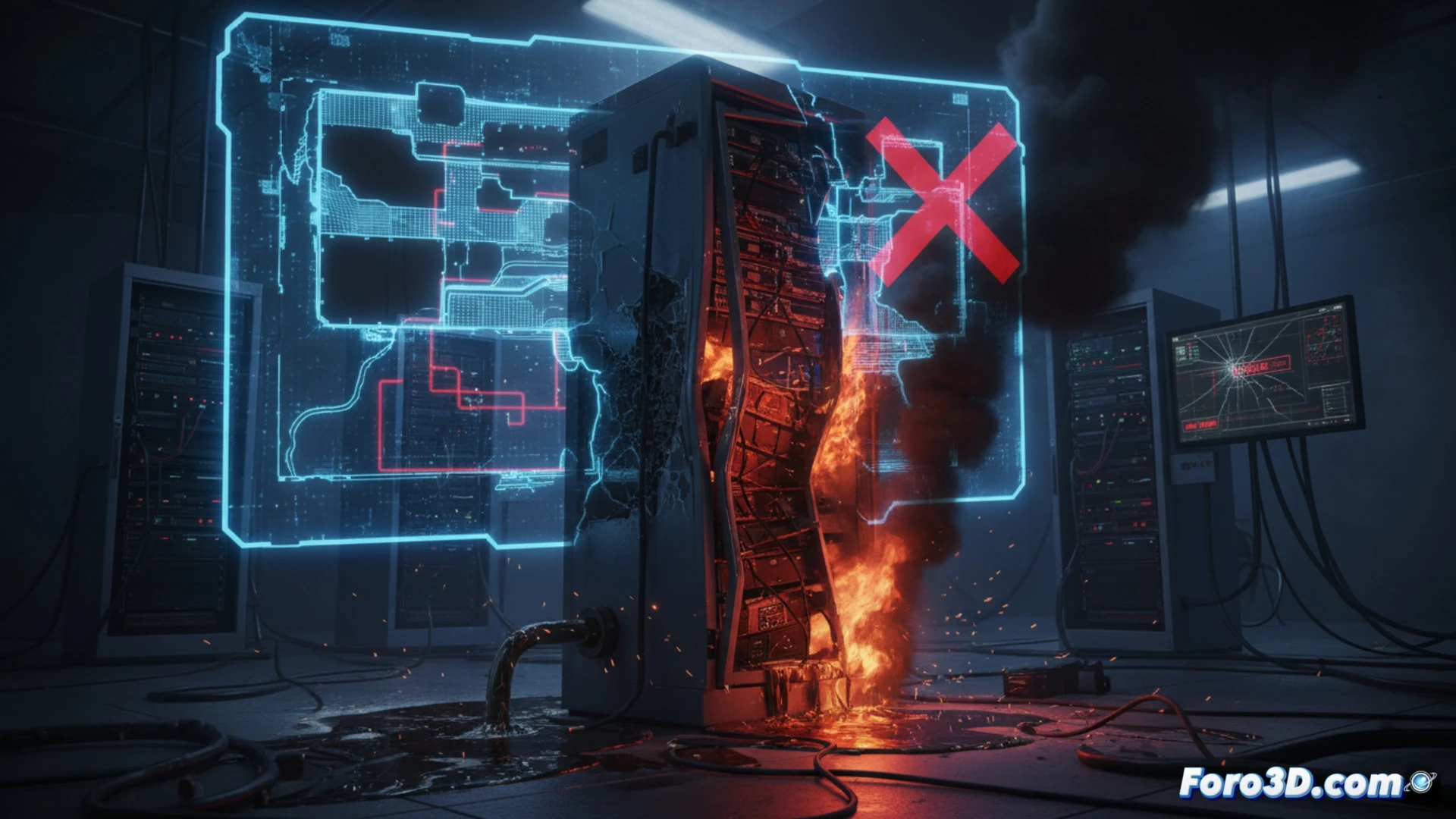
Static CFD vs. Real Fluid: The Viscosity Error 🔥
The initial simulation, performed with Autodesk CFD and validated in SimScale, modeled the dielectric fluid with an ideal constant viscosity. However, the fluid's operational reality, exposed to variable thermal loads and particle contamination, altered its rheology. This change, not reflected in the static digital twin, created recirculation zones where heat became trapped. SolidWorks modeled the physical geometry of the racks, but the CFD mesh did not capture localized turbulence. A truly living digital twin, integrating real-time temperature and pressure data from IoT sensors, would have detected the divergence between the model and real physics. The lesson is clear: simulation is not an end, but a starting point that must be constantly updated.
The False Security of Simulated Data ⚠️
The error was not technical, but one of blind trust in the model. The initial digital twin offered an impeccable visual representation, but lacked the robustness to adapt to the real conditions of the fluid. For the Edge industry, where space is critical and thermal dissipation is a constant challenge, this case demonstrates that a digital twin must be a living system, not a snapshot. The flexibility to recalculate fluid dynamics in real-time is the only way to prevent a virtual dead zone from becoming a real point of failure.
Since the data center's digital twin did not correctly simulate the variation of the dielectric fluid's viscosity under extreme load conditions, which was the real cause of the failure, what physical fidelity metrics should be mandatory in validating a digital twin to prevent a disconnect between simulation and reality from causing a thermal collapse like this one?
(PS: My digital twin is currently in a meeting, while I'm here modeling. So technically, I'm in two places at once.)