Biological containment level 4 requires nearly perfect negative pressure control. Any microscopic leak can compromise safety. To address this challenge, a digital twin of a BSL-4 laboratory has been developed, combining LiDAR scanning with Leica Cyclone and CFD simulation in Autodesk. The goal is to virtually replicate airflow and validate the enclosure's airtightness.
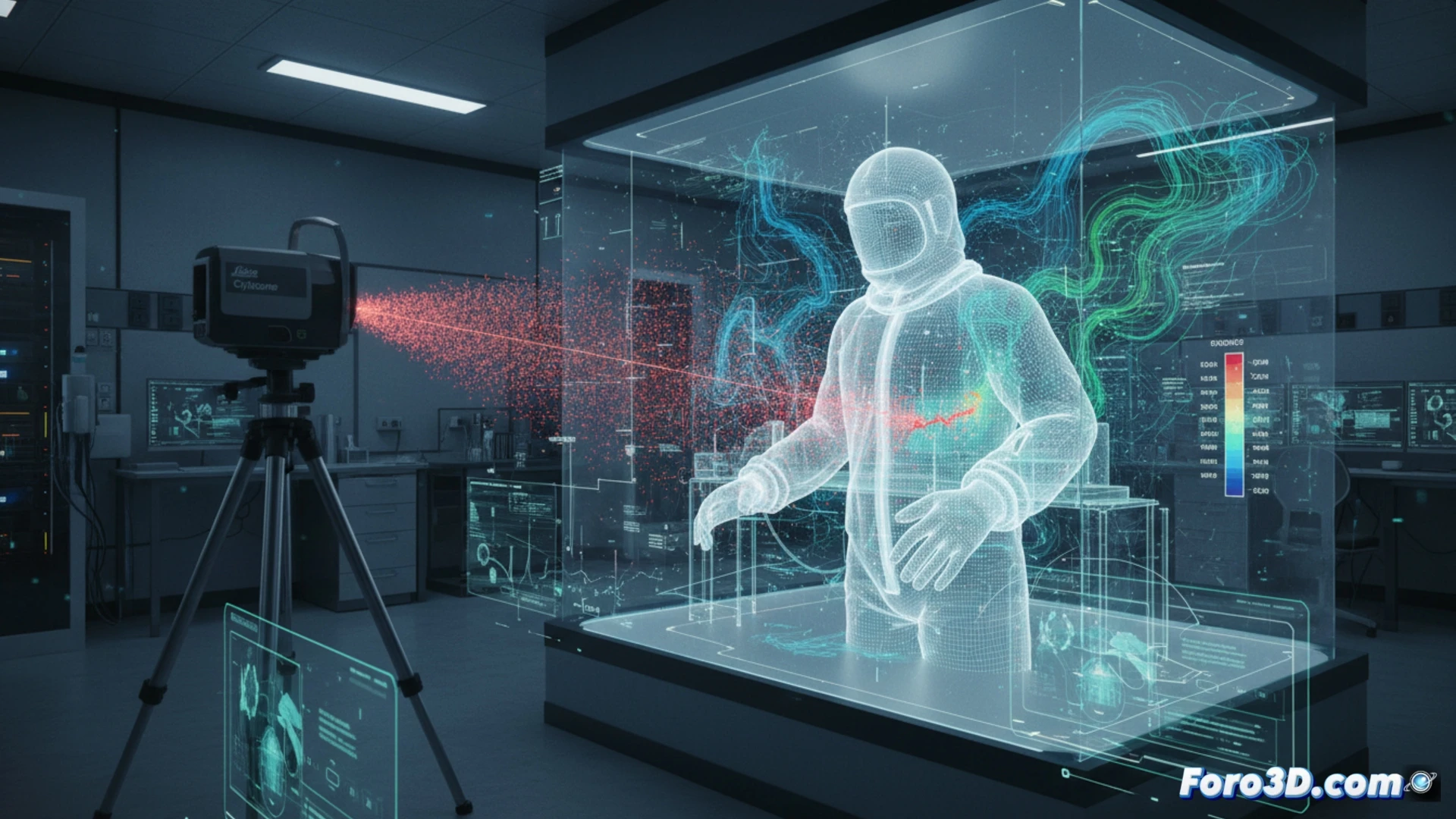
Airflow and negative pressure deviation analysis 🌀
The process begins with a high-precision 3D laser scan that captures every joint, duct, and seal of the laboratory. The resulting point cloud is processed in CloudCompare to identify geometric deviations between the CAD design and the built reality. These discrepancies are integrated into the Autodesk CFD model, where airflow is simulated under negative pressure conditions. The model reveals potential leak points that go unnoticed in visual inspections, allowing engineers to predict contamination pathways and reinforce critical seals before a real emergency occurs.
Model validation and the future of biosafety 🔬
The digital twin is validated by comparing simulation data with physical sensors installed in the laboratory. The resulting correlation demonstrates that the model is reliable for real-time monitoring of containment integrity. This approach not only optimizes preventive maintenance but also redefines safety standards in maximum containment facilities, transforming biological risk management through precise and dynamic virtual replicas.
How can LiDAR accuracy in detecting microscopic leaks in a BSL-4 digital twin be quantified when experimental validation under real extreme negative pressure conditions is practically unfeasible?
(PS: My digital twin is currently in a meeting, while I am here modeling. So technically, I am in two places at once.)