The pharmaceutical industry presents critical occupational hazards: exposure to toxic active ingredients, entrapment in encapsulators, cuts in compressors, and precision stress. Modeling these operations in a 3D environment allows anticipating dangers without exposing personnel. We analyze how to build a digital twin of a production line to visualize chemical contamination zones, simulate repetitive postures, and detect entrapment points, improving safety from the virtual design stage.
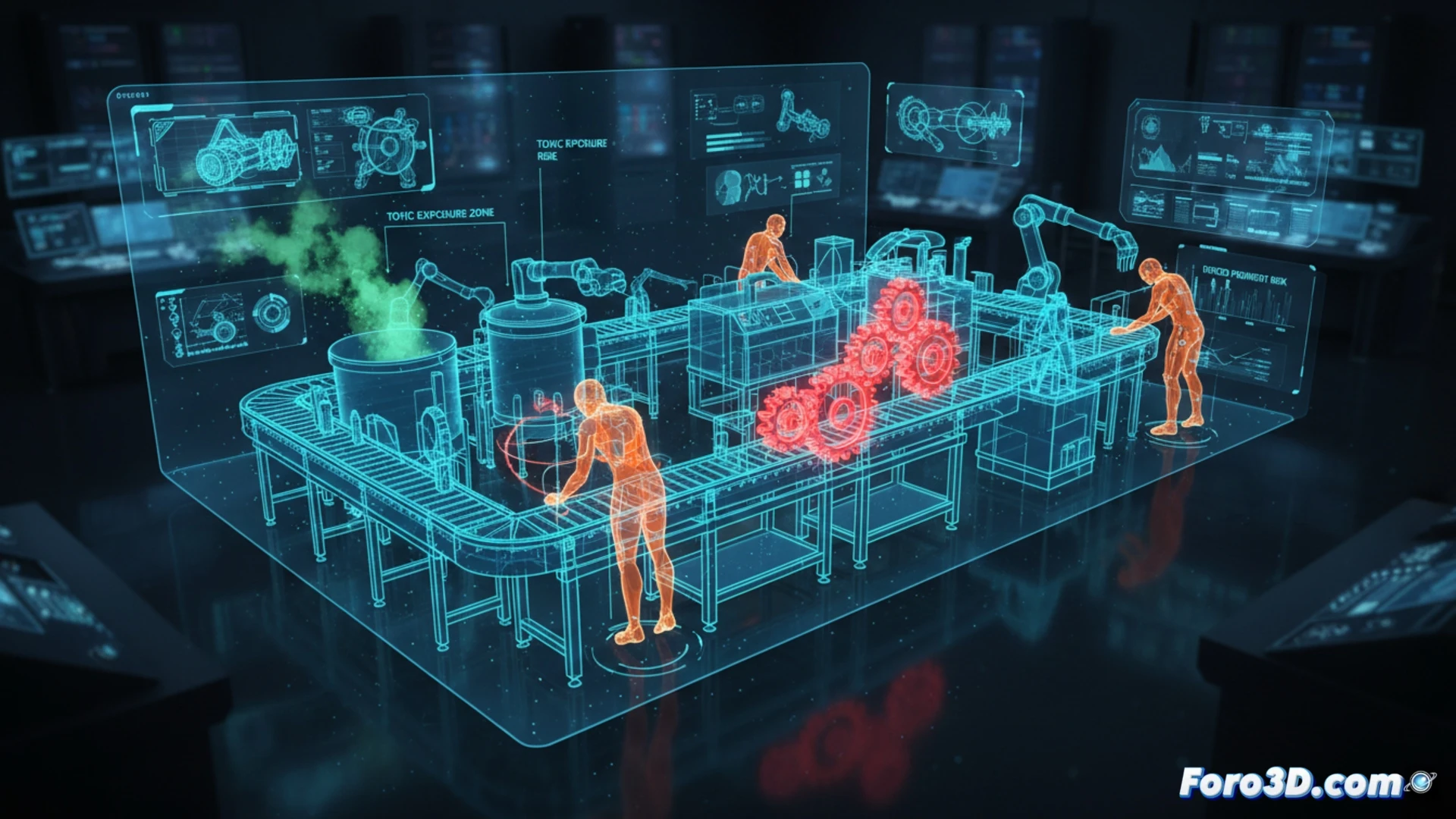
Machinery modeling and chemical exposure simulation 🧪
To faithfully represent the risks, the encapsulator and compressor are modeled in 3D with their internal mechanisms: pistons, dies, and powder feeding systems. Physical properties are assigned to materials to simulate the dispersion of toxic particles in the air, creating semi-transparent color volumes that indicate high-concentration zones. The work cycle animation allows visualizing the moments of greatest entrapment risk when the operator introduces the product or removes parts. Additionally, heat markers are integrated into the human avatar's joints to detect forced postures and repetitive movements that generate biomechanical stress. The result is a virtual laboratory where any change in the workflow is evaluated without real consequences.
Virtual precision as a shield against human error 🛡️
Simulating these processes in 3D not only identifies hazards but also retrains the operator's perception. By visualizing the toxic cloud expanding or the arm trapped in the press, the technician internalizes the safety distance and necessary reaction time. This digital twin becomes an interactive manual that reduces precision stress, as it allows practicing complex maneuvers until they become automated. Investment in simulation is not a luxury; it is the most effective barrier between error and injury.
How can a 3D digital twin anticipate and mitigate in real time the risks of entrapment in pharmaceutical encapsulators before an incident occurs?
(PS: Simulating industrial processes is like watching an ant in a maze, but more expensive.)