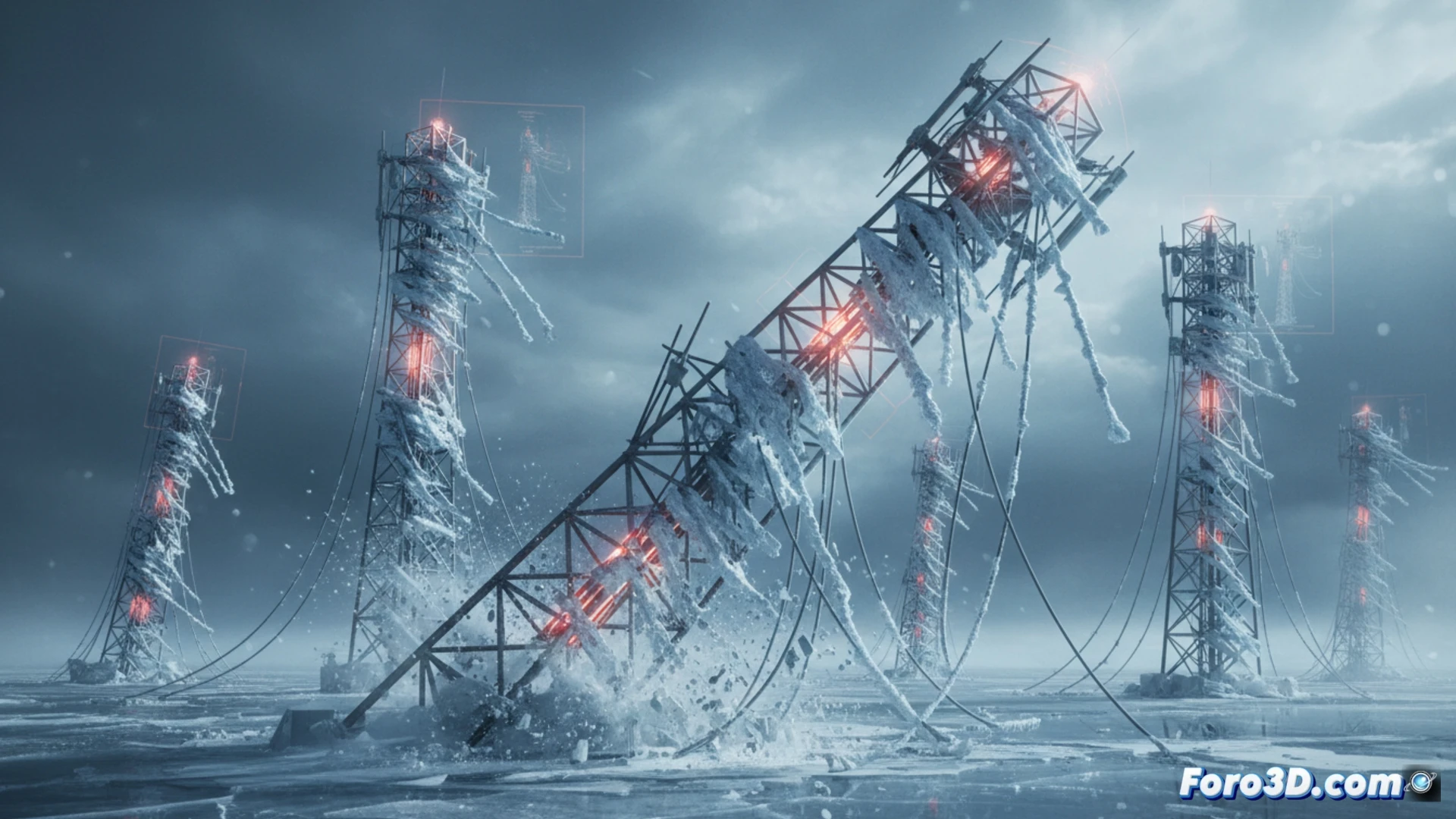
Galloping vibration is an aerodynamic phenomenon that, under conditions of asymmetric ice accumulation, can trigger the collapse of 5G masts. This technical article analyzes how the alteration of the aerodynamic profile generates stress cycles that lead to material fatigue, a critical process in fatigue simulation. Using tools such as Ansys to model cyclic stress, Creaform VXelements for 3D scanning of deformations, and Rhino for geometric reconstruction, the progressive structural deterioration is documented.
Modeling Cyclic Stress and Fatigue in Ansys ⚙️
Asymmetric ice accumulation modifies the cross-section of the mast, creating a non-symmetrical profile that induces unstable lateral forces under constant wind. This phenomenon, known as galloping, generates low-frequency, high-amplitude vibrations. In Ansys, this behavior is simulated through high-cycle fatigue analysis, where repetitive dynamic loads are applied to the base material (steel or aluminum). Results show that maximum stress concentrates at the mast base and welded joints, accelerating crack initiation. The simulation allows predicting the number of cycles until collapse, integrating 3D scanning data to adjust the actual deformed geometry.
Scanning and Reconstruction: The Key to Validating Models 🔍
Accurate documentation of deformations is essential for validating fatigue models. With Creaform VXelements, the altered geometry of the mast is captured, including ice accumulations and plastic deformations. This data is imported into Rhino to reconstruct the 3D model and compare it with the original design. This methodology allows identifying critical stress concentration points that theoretical models might overlook. The integration of real scanning with numerical simulation elevates the precision of fatigue analysis, offering a solid foundation for designing more resistant structures in extreme environments.
How can asymmetric ice accumulation on a 5G mast be accurately modeled to predict the remaining service life under galloping fatigue before structural collapse?
(PS: Material fatigue is like yours after 10 hours of simulation.)