During a storm without extreme gusts, a transmission line collapsed, leaving thousands of homes in darkness. Initial inspections suggested a fatigue failure, but 3D analysis revealed a more complex truth: the phenomenon of asymmetric ice-induced galloping had torn the insulators from their supports. The combination of LiDAR, high-speed cameras, and mechanical simulations allowed the exact mechanism of the catastrophe to be reconstructed.
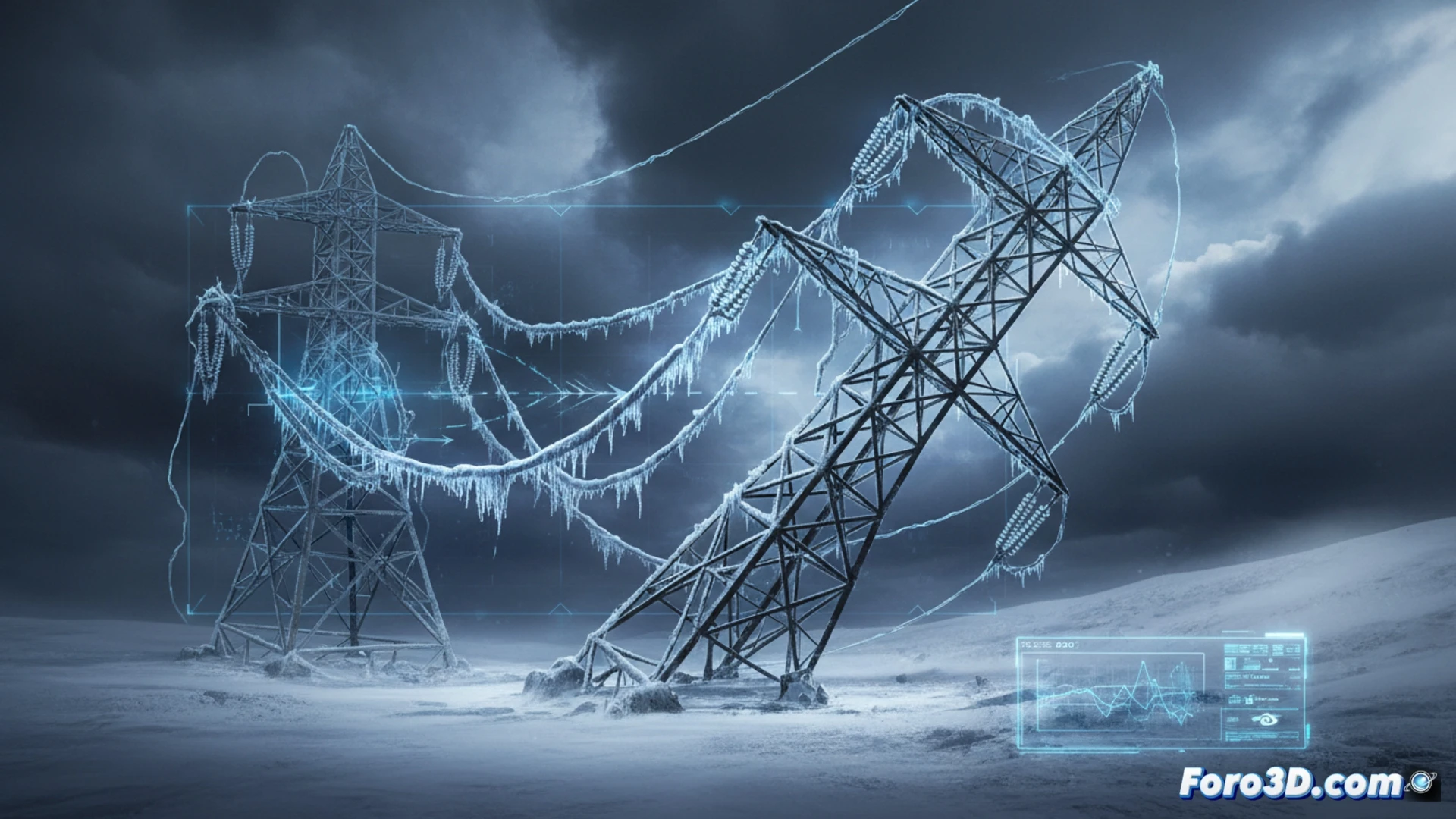
Forensic reconstruction of galloping: from point cloud to FEM model ⚙️
The forensic engineering team used CloudCompare to process the LiDAR point clouds captured after the collapse, obtaining a precise geometry of the cabling and fractured insulators. High-speed cameras, installed on nearby towers, captured the oscillation prior to failure. With this data, the aerodynamic profile of the cable was modeled in PLS-CADD, considering the asymmetric ice accumulation. The model was exported to Ansys Mechanical, where cyclic loads were simulated. The results showed that the galloping generated amplitudes of up to three meters, causing stresses on the insulators that exceeded their breaking limit. The finite element analysis confirmed that the oscillation frequency matched the natural frequency of the span, amplifying the phenomenon until catastrophic failure.
Lessons for design: ice as a critical variable ❄️
This case demonstrates that moderate storms can be more dangerous than hurricanes if ice accumulates unevenly. 3D modeling not only explains the past but also allows lines to be redesigned to withstand galloping. Incorporating anti-ice aerodynamic profiles and dynamic dampers at critical points identified by simulation is now a priority. 3D forensic technology is consolidating as an indispensable tool to prevent a silent oscillation from becoming a predicted catastrophe.
Hidden factors in terrain geometry and surrounding vegetation, detectable exclusively through LiDAR analysis, can trigger the galloping effect on high-voltage conductors even under moderate wind conditions.
(PS: Simulating catastrophes is fun until the computer melts down and you are the catastrophe.)