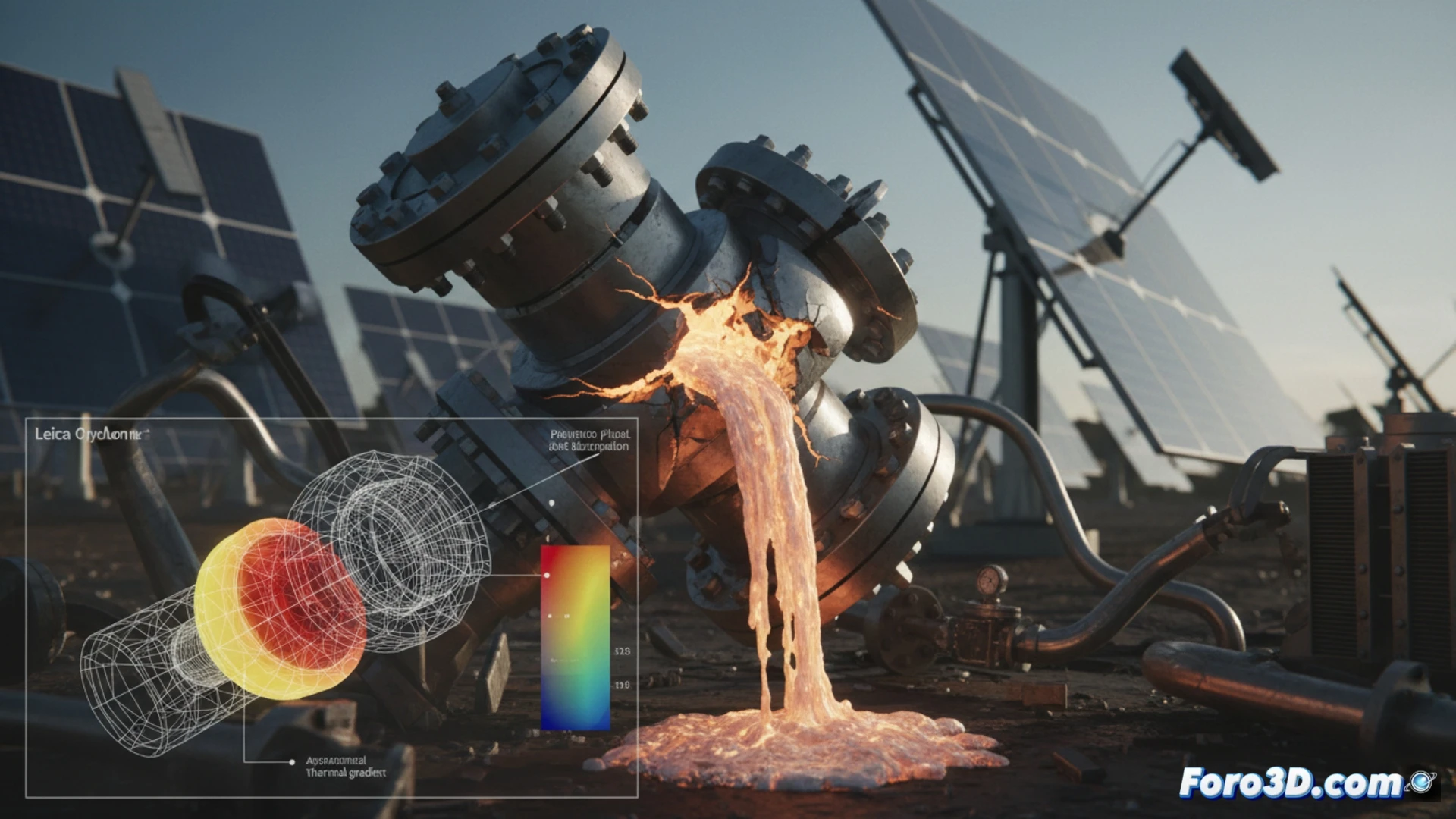
The failure of the swivel joint in a solar power tower plant triggered a massive leak of molten salt at 560°C. The forensic analysis, supported by scans from PolyWorks and Leica Cyclone, revealed localized plastic deformation in the seal. The main hypothesis points to a misalignment of the heliostats, which generated an asymmetric thermal gradient on the periphery of the component, subjecting the material to differential expansion cycles until its elastic limit was exceeded.
Modeling in ANSYS: meshing and asymmetric thermal gradient 🔥
The actual geometry of the swivel, obtained via Cyclone point cloud, was imported into ANSYS Mechanical. The hexahedral mesh was refined in the seal area and the retaining rings, with an element size of 0.5 mm to capture the contact curvature. A non-uniform thermal boundary condition was applied: a temperature profile varying sinusoidally from 560°C at the hot spot (focus of the misaligned heliostat) to 480°C at the cold spot, over a 10-minute cycle. The coupled structural analysis showed a maximum radial deformation of 1.8 mm in the seal, exceeding the design clearance of 1.2 mm by 40%, which caused the opening of the sealing labyrinth.
Lessons for fatigue simulation in critical joints ⚙️
This case demonstrates that material fatigue in rotating joints depends not only on the maximum temperature but also on the asymmetry of the gradient. The misalignment of the heliostats, although small, generated a cyclic thermal differential that acted like a hammer on the seal. For future designs, it is recommended to include in the ANSYS model a sensitivity analysis to the irradiance profile of the solar field, using data from individual heliostats, and to validate the deformation with periodic 3D scans to detect incipient wear.
As a simulation engineer, which asymmetric thermal gradient parameters did you consider critical for modeling crack nucleation in the swivel joint before the salt leak at 560°C?
(PS: Material fatigue is like yours after 10 hours of simulation.)