A massive carbon dioxide leak in a Carbon Capture and Storage (CCS) system has exposed a critical design flaw in a safety valve. The incident, which could have caused a catastrophic asphyxiation event, has been analyzed using 3D CFD simulation with OpenFOAM. The results show how CO2, denser than air, dangerously accumulates in low-lying areas, creating lethal gas pockets that the original design did not account for. 💀
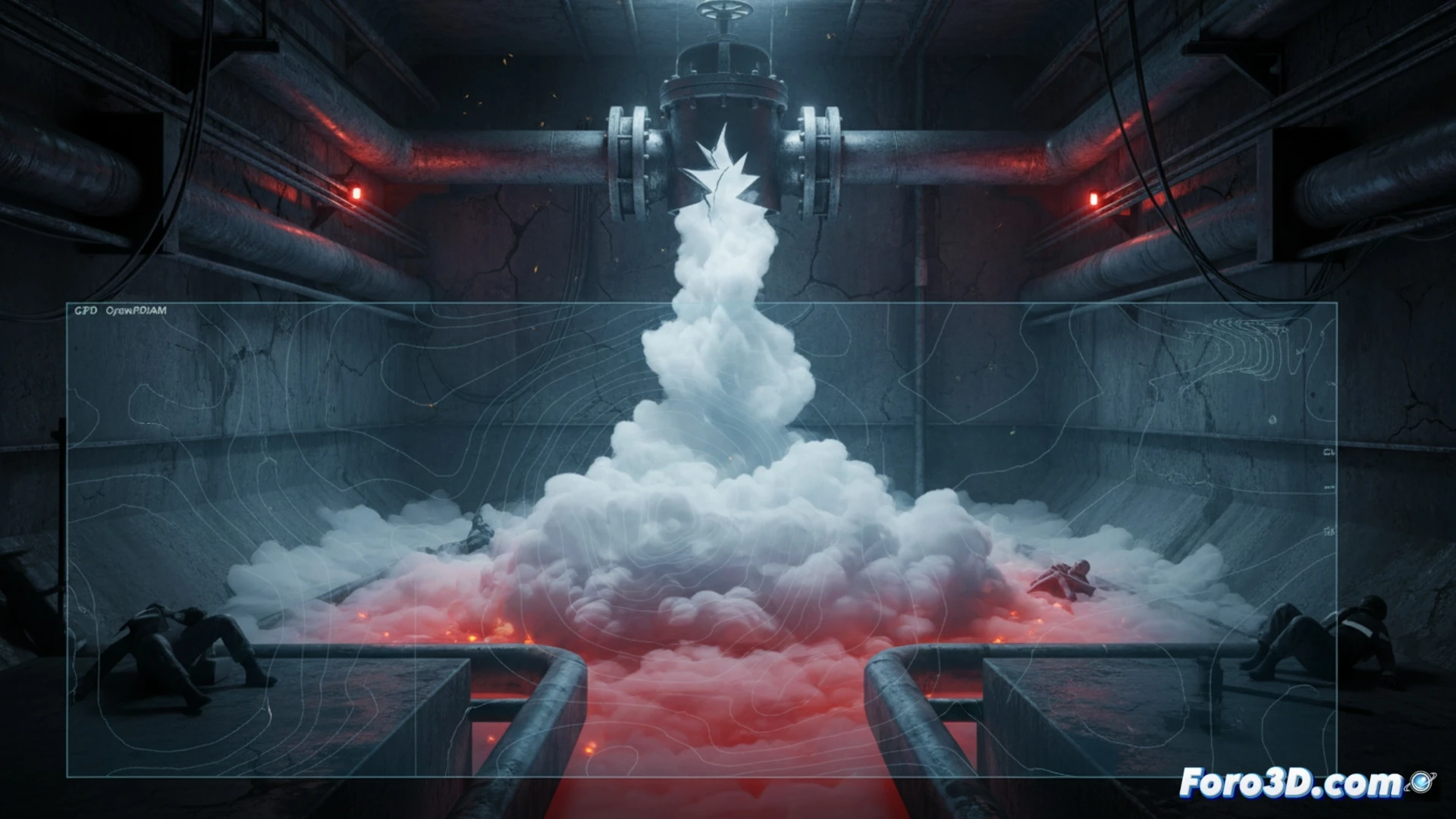
Modeling and simulation of the CO2 dispersion scenario 🧪
To reconstruct the accident, a digital twin of the plant created with AutoCAD Plant 3D was used, where the pipeline and the faulty valve were modeled. The actual geometry of the environment was captured using photogrammetry with Bentley ContextCapture, integrating point clouds of the terrain and surrounding structures. With OpenFOAM, the Navier-Stokes equations for compressible flow were solved, using a k-epsilon turbulence model and a refined mesh in areas of potential accumulation. The 600-second transient simulation revealed that at ground level, CO2 concentrations exceeded 10% by volume in just 3 minutes, a threshold considered immediately dangerous to human life.
Visualization and lessons for industrial safety 🛡️
Risk visualization was performed in Lumion, where CO2 concentration fields were integrated onto the realistic 3D model of the plant. The resulting animation clearly shows how the gas moves like a viscous fluid, occupying trenches, basements, and terrain depressions. This analysis demonstrates that CCS systems require a redesign of valves with redundancy and concentration sensors in low-lying areas, as well as forced ventilation systems. CFD simulation not only explains the failure but becomes a mandatory tool for safety certification in carbon capture facilities.
As a CFD engineer, what key parameters should I adjust in OpenFOAM to accurately model the lethal dispersion of CO2 in low-lying areas during a leak in a CCS system, and how can I validate those results with experimental data?
(PS: Simulating catastrophes is fun until the computer crashes and you are the catastrophe.)