Traditional handwriting expertise relies on the human eye and the graphologist's experience. However, when faced with a high-quality forgery, subjectivity can be an obstacle. The analysis of handwriting force, or the pressure exerted on the paper during the stroke, has become a cornerstone of the modern forensic pipeline. Thanks to 3D scanning and surface modeling technologies, we can now measure this variable with micrometric precision, revealing inconsistencies invisible to the naked eye.
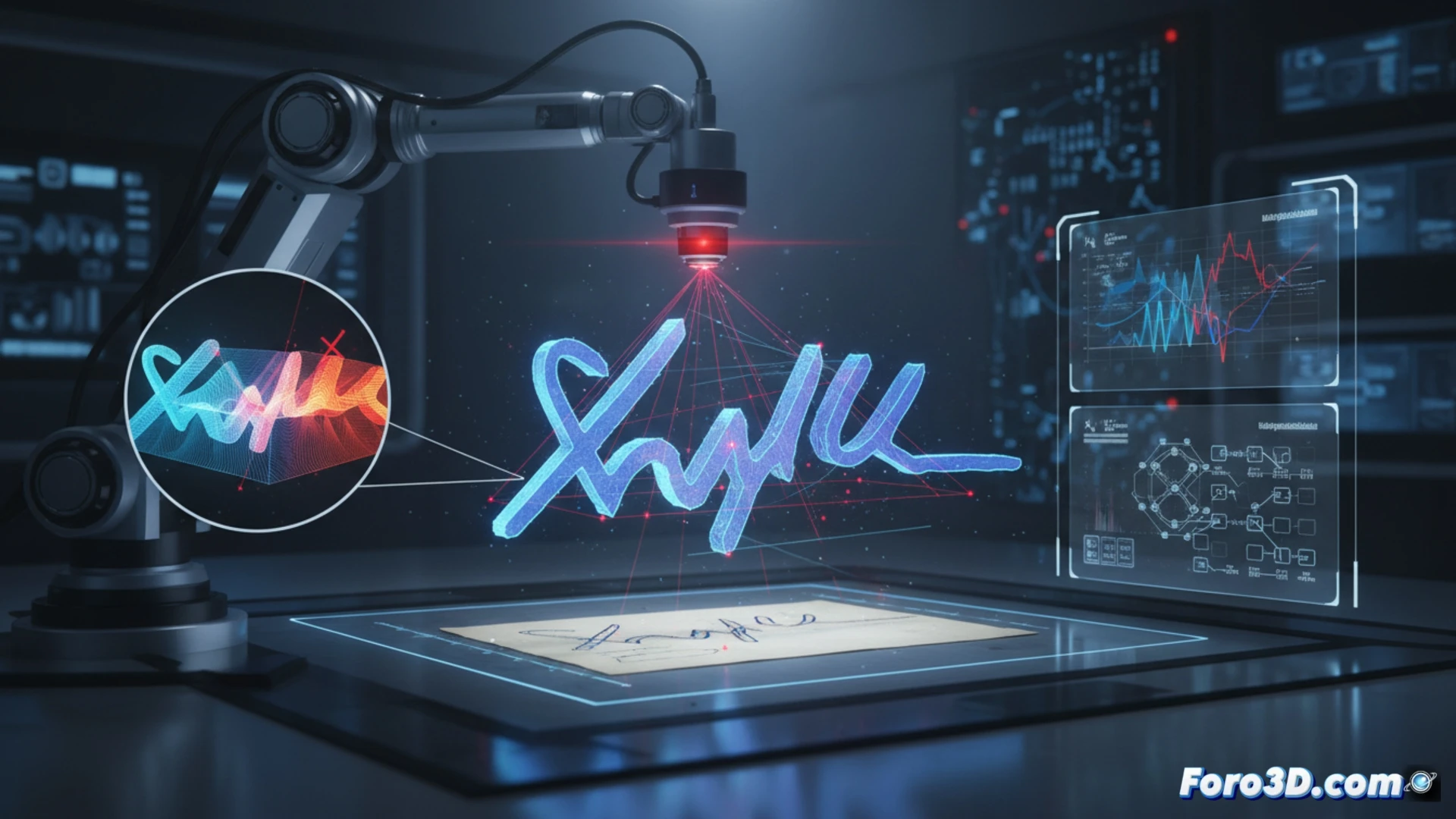
Surface scanning and stroke trajectory analysis 🖊️
3D technology allows capturing the topography of a document. A high-resolution scanner records the depth of each groove left by the pen. By generating a relief map, forensic software analyzes dynamic pressure along the trajectory. In an authentic signature, the force varies organically in curves and direction changes. In a forgery, the pressure is often more uniform or presents anomalous peaks, as the forger, while copying, focuses on the visual form and not on the biomechanics of the gesture. 3D modeling reveals instrument tilt angles that are impossible to replicate without the original author's motor training.
The death of the perfect copy in the face of digital relief 🔍
The main challenge for the expert is no longer just identifying whether the shape is correct, but proving that the movement is false. In real cases, visually identical signatures have been unmasked because the 3D model showed a homogeneous pressure zone where the original presented a smooth deceleration. This technology not only validates legal documents but redefines the standard of proof in the forensic field. The signature is no longer just an image; it is a three-dimensional kinetic fingerprint that the forger will hardly be able to deceive.
Is it possible that an artificial intelligence system trained with thousands of original signatures can detect a forgery that an expert handwriting examiner considers perfect, or does the subtlety of pressure and tremor in a 3D stroke remain an exclusive territory of the human eye?
(PS: don't forget to calibrate the laser scanner before documenting the scene... or you might be modeling a ghost)