Professional cycling faced its greatest technological challenge when an anonymous rider shattered times on a mountain pass. Suspicions of mechanical doping led to the seizure of their carbon fiber bicycle. Visual inspection and traditional metal detectors found nothing. The only option was a high-resolution forensic technique: micro-computed tomography (Micro-CT). This article details the workflow that unmasked the deception hidden within the frame's core. 🚴♂️
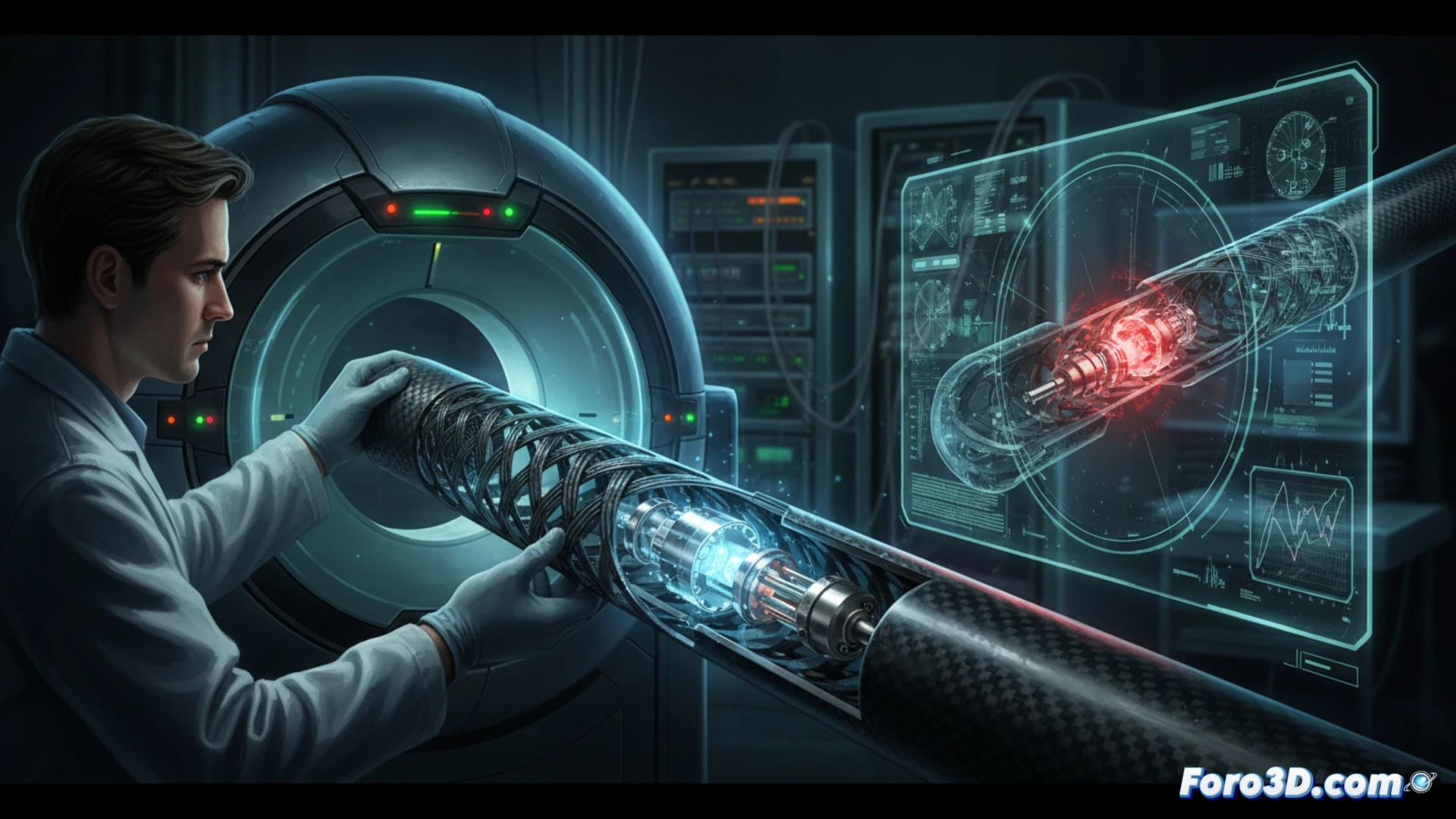
Forensic pipeline: Scanning, segmentation, and verification 🔬
The process began in the lab with a Bruker SkyScan 1272 scanner. The entire frame underwent a 360-degree rotational scan with an isotropic resolution of 10 micrometers. The result was a stack of thousands of DICOM images. This volume was imported into Volume Graphics VGSTUDIO MAX for material analysis. Using density-based segmentation algorithms, cavities with trapped air were isolated. The 3D model revealed a network of perfectly aligned cylindrical tunnels within the carbon fibers, housing a miniature electromagnetic stator and solid-state batteries. The final stage was a comparison with the manufacturer's original design in SolidWorks. The discrepancy was clear: the official CAD model contained neither those voids nor those components. Manipulation was proven without needing to destroy the part.
The silence of carbon, the truth of the voxel 🧩
This case demonstrates that technological fraud has reached an almost invisible level of sophistication. The engineers of deception managed to integrate a motor into the composite fabric itself, bypassing surface-level checks. However, materials forensic science responds with tools like Micro-CT, which turns a solid object into a three-dimensional density map. In the future, any high-performance structure, from sports prosthetics to aerospace components, must undergo this type of digital autopsy to ensure integrity and competitive ethics.
What cross-validation method between Micro-CT and carbon spectral analysis guarantees the digital chain of custody in a carbon fiber fraud, preventing ghost motor manipulation?
(PS: In the forensic pipeline, the most important thing is not to mix the evidence with the reference models... or you'll end up with a ghost at the scene.)