The Framework Laptop 16 bursts onto the market with a disruptive concept: an expansion bay system that allows physically swapping the GPU and storage. For professionals in 3D modeling and simulation, this represents a paradigm shift, moving away from planned obsolescence and offering unprecedented flexibility in a portable format. 🚀
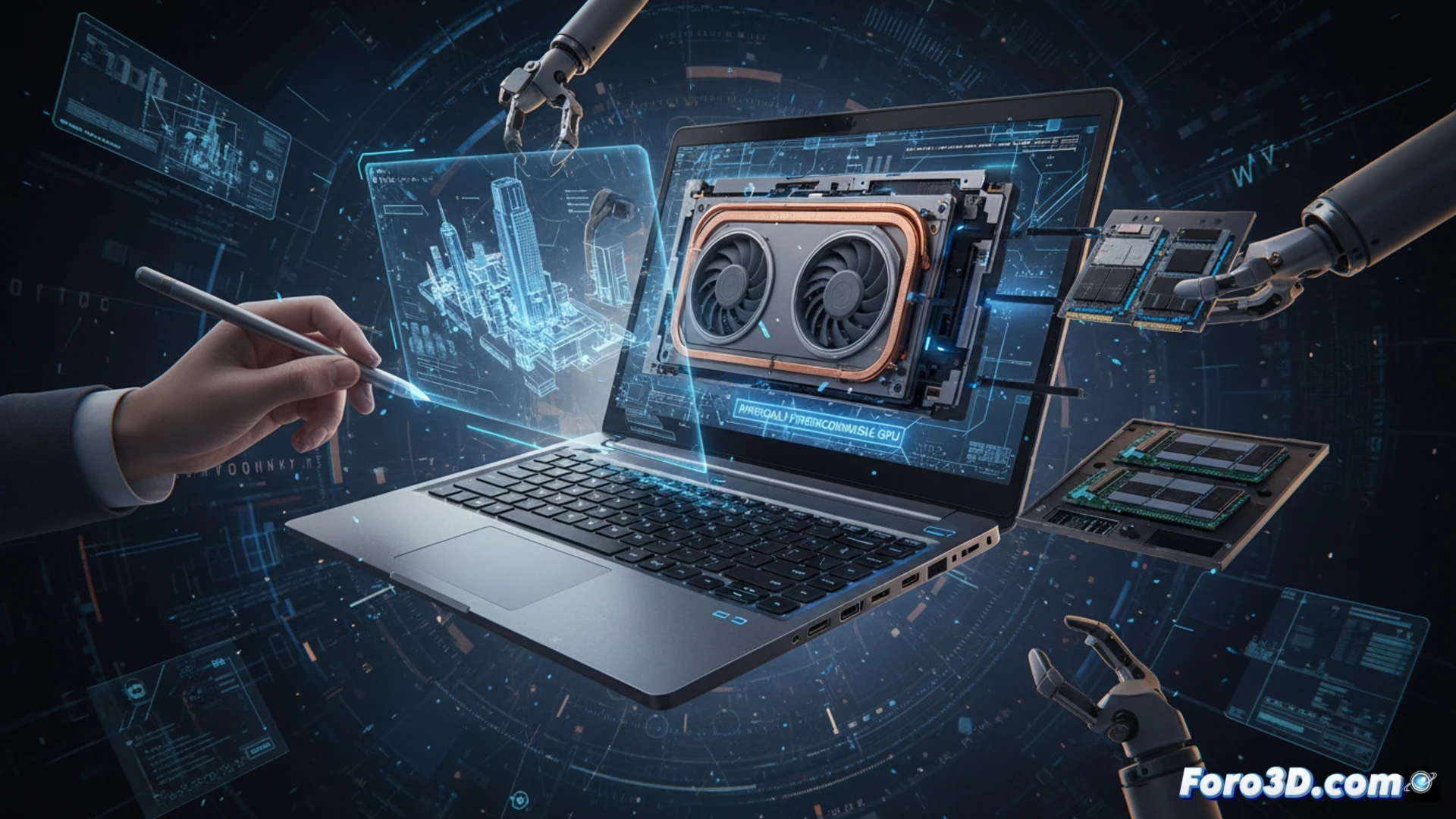
Technical analysis of the Expansion Bay system and swappable GPU ⚙️
The heart of the system is the Expansion Bay module, which houses a dedicated GPU (up to a Radeon RX 7700S) connected via a PCIe Gen 4 interface. For real-time rendering and navigating complex viewports in software like Blender or Unreal Engine, this architecture allows upgrading the graphics engine without replacing the entire motherboard. Although raw performance does not match a desktop workstation with an RTX 4090, the ability to scale the GPU in the future is a critical factor. The system also supports hot-swappable storage modules, allowing the user to double the capacity of their NVMe drives for 4K texturing projects or particle simulations without needing external tools, something unheard of in traditional laptops.
Reflection on scalability and the future of 3D hardware 💡
The true strength of the Framework 16 lies not in its current specifications, but in its promise of longevity. For a modeler investing in a workstation, the ability to change only the graphics module within two years, instead of purchasing a new laptop, represents significant savings and a reduction in electronic waste. However, the module ecosystem is still limited and the maximum performance is constrained by the chassis TDP. The key question is whether GPU manufacturers will adopt this open standard, allowing this laptop to become a truly sustainable platform for those who live by rendering and simulation.
What practical limitations does the Framework 16's expansion bay system present when handling professional GPUs or dedicated accelerators for real-time rendering?
(PS: RAM is never enough, like coffee on a Monday morning)