A massive hydrogen leak in an underground storage cavern has put the energy industry on alert. The main hypothesis points to hydrogen embrittlement in high-strength steel seals, a phenomenon that intensifies under extreme pressure cycles. To determine the exact point of failure, a multidisciplinary workflow integrating 3D reconstruction, porous flow simulation, and fatigue analysis has been employed. 🔥
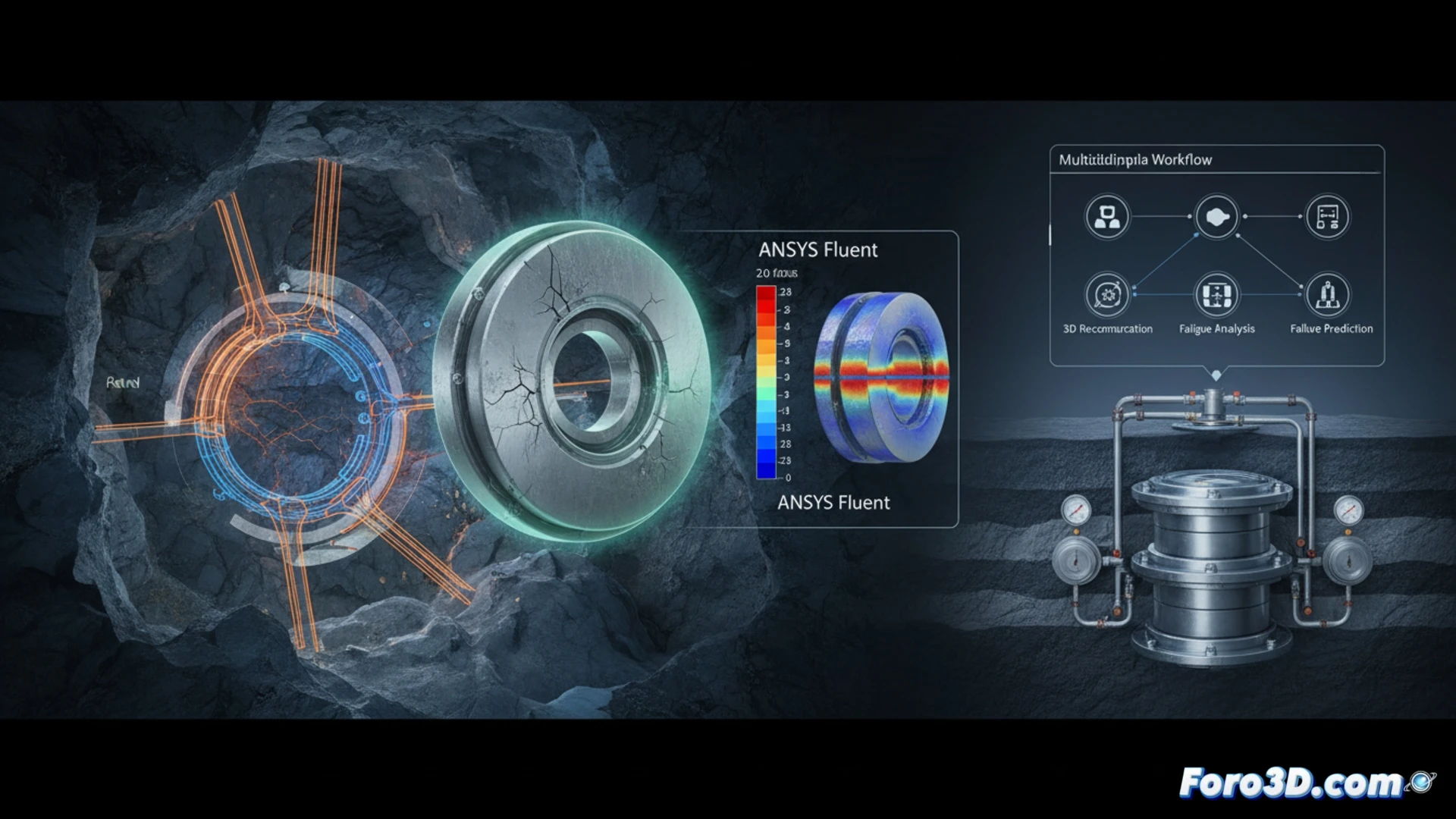
3D reconstruction and flow simulation for forensic diagnosis 🛠️
The process begins with digitizing the wellhead using Leica Cyclone, generating a millimeter-scale point cloud that captures the actual geometry of the seals and contact surfaces. This model is imported into Petrel to characterize the reservoir and the porous properties of the surrounding rock, allowing an understanding of hydrogen migration pathways. The critical step occurs in ANSYS Fluent, where a hydrogen embrittlement model is coupled with a pressure cycle fatigue analysis. The simulation reveals how hydrogen diffusion into the steel's microcracks reduces its toughness, accelerating crack propagation until a catastrophic failure in the sealing joint.
Lessons for storage infrastructure design 💡
This case demonstrates that material fatigue in hydrogen environments cannot be predicted with standard tests alone. Integrating 3D scan data with multiphysics simulations allows identifying failure modes invisible in visual inspections. For materials engineers, the lesson is clear: seal design must consider not only mechanical strength but also hydrogen diffusivity and cyclic load history. Without this approach, any storage cavern could become a silent time bomb.
Which finite element simulation parameters are critical for accurately modeling the initiation and propagation of cracks due to hydrogen embrittlement in steel seals under high cyclic pressure conditions?
(PS: Material fatigue is like yours after 10 hours of simulation.)