A pure hydrogen-fueled internal combustion engine has suffered a catastrophic turbocharger blade failure. The failure, recorded during a bench test, points to a phenomenon known as hydrogen embrittlement. 3D simulation tools, such as VGSTUDIO MAX, SolidWorks CFD, and Siemens NX, allow analysis of whether the atomic diffusion of H2 into the high-strength steel reduced the material's toughness, facilitating fracture from microparticle impact.
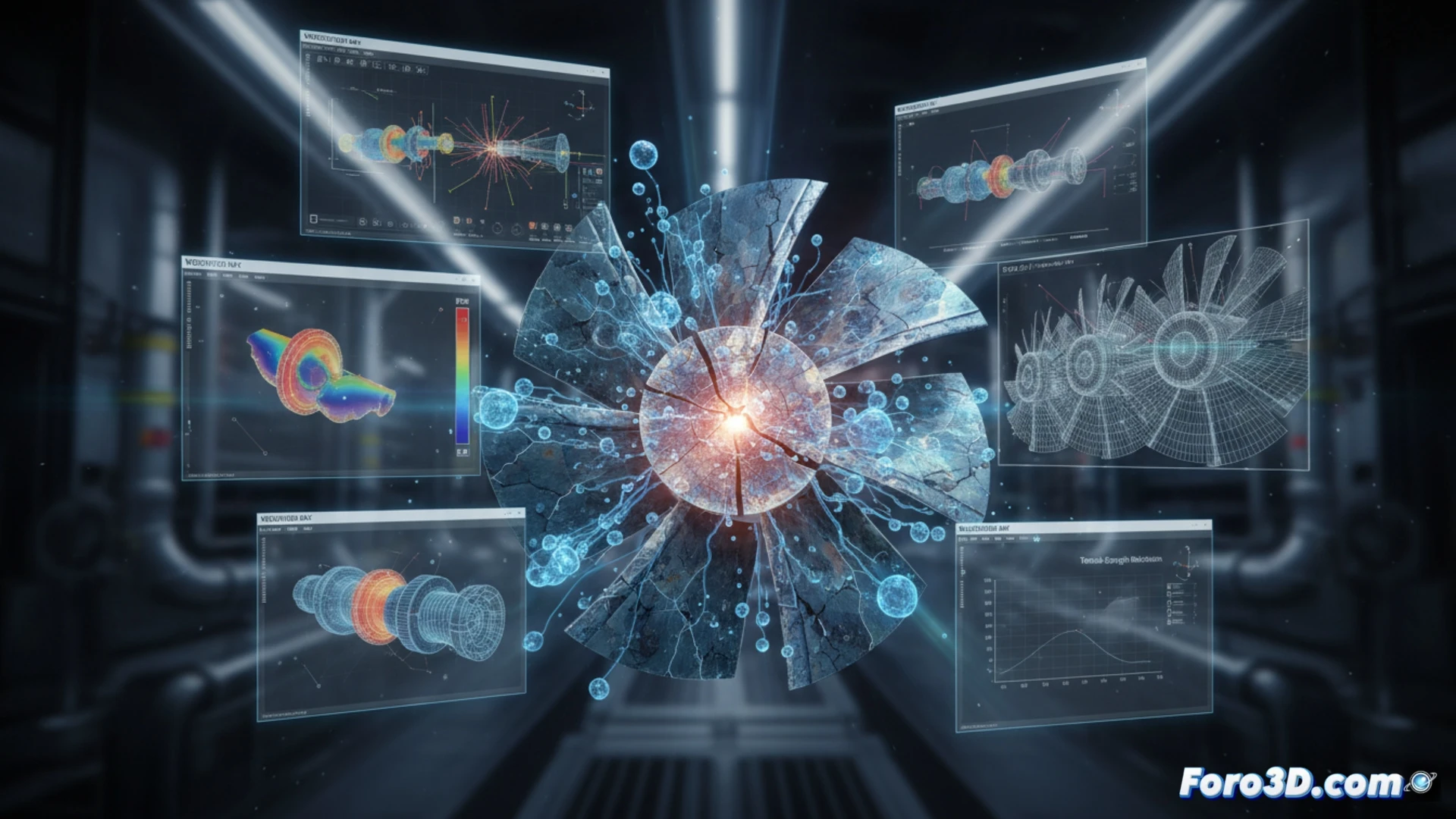
Forensic analysis: tomography, CFD, and finite elements 🔍
The investigation process begins with computed tomography (VGSTUDIO MAX) to scan the fractured geometry and detect inclusions or internal microcracks. Simultaneously, SolidWorks CFD simulates the flow of hot, high-pressure hydrogen over the blades, calculating the areas of highest gas concentration. Finally, Siemens NX performs a finite element analysis that couples hydrogen diffusion with the stress field. The results show that hydrogen accumulates at the leading edges, reducing the steel's fracture energy by up to 40%. Unlike a conventional gasoline engine, where air acts as an inert medium, here hydrogen penetrates the metal's crystal lattice, breaking bonds and generating brittleness.
Lessons for fatigue simulation in hydrogen engines ⚙️
This case demonstrates that material fatigue in hydrogen environments cannot be modeled using standard steel parameters. Atomic diffusion turns a minor impact from an oxide particle into a catastrophic fracture. For simulation engineers, the challenge is to integrate hydrogen diffusion models into high-cycle fatigue analyses, something that tools like Siemens NX already allow through user subroutines. Ignoring this phenomenon in the design of turbochargers for hydrogen engines guarantees premature failure.
As an engineer simulating hydrogen embrittlement in compressor blades, which input parameters of the diffusion and mechanical stress model do you consider most critical for accurately predicting the initiation point of catastrophic fracture in a 3D simulation?
(PS: Material fatigue is like yours after 10 hours of simulation.)