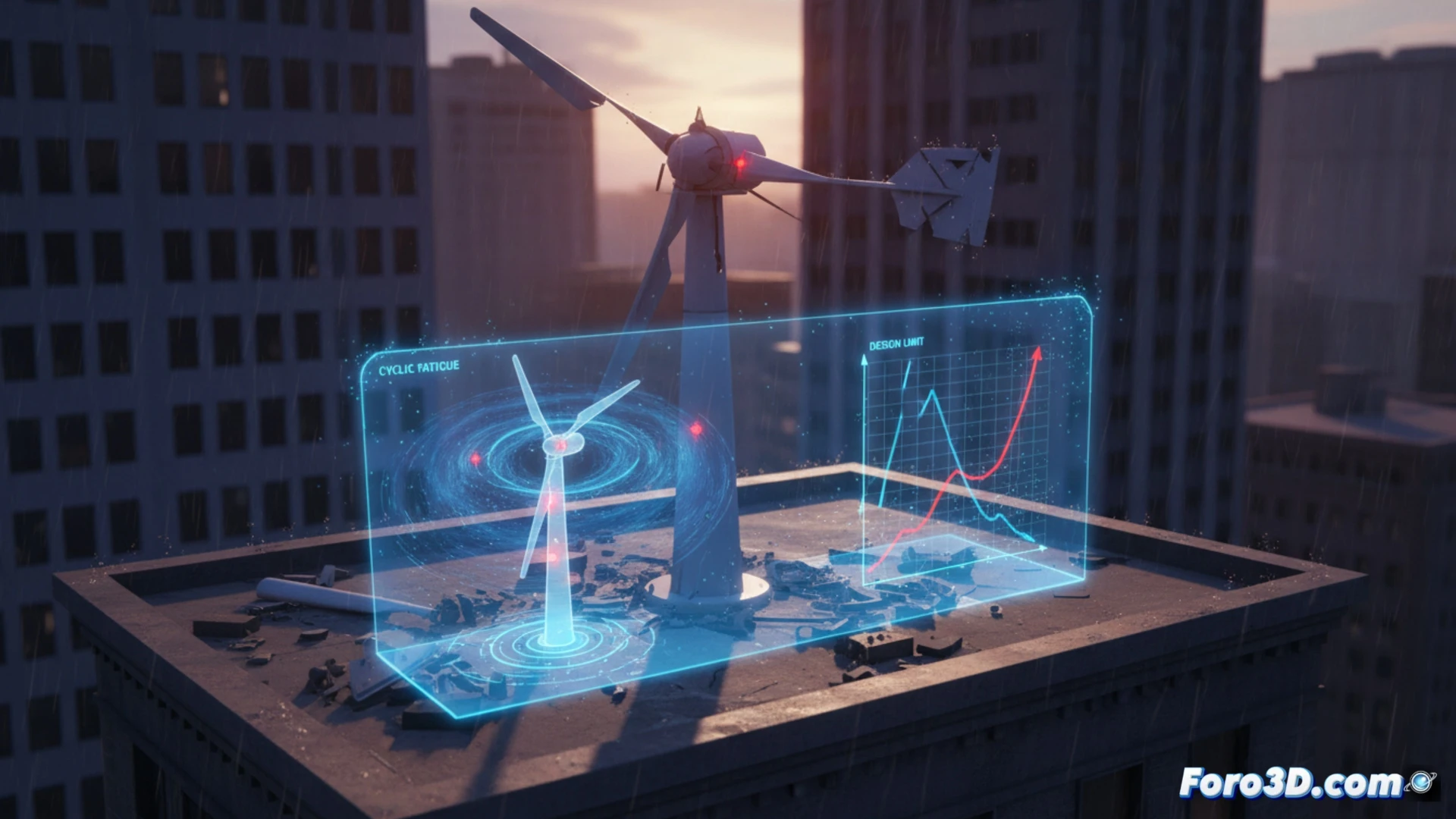
The fall of a vertical-axis wind turbine from the rooftop of a skyscraper was not a random accident, but rather the consequence of a vibratory phenomenon known as flutter. The technical expert report, supported by a forensic 3D workflow, revealed that downdrafts and turbulence generated by surrounding buildings induced cyclic loads not anticipated in the original design of the central shaft.
Forensic Flow: From Photogrammetry to Finite Element Analysis 🔍
The investigation process began with capturing the accident scene using RealityCapture, generating a high-fidelity 3D model of the fractured shaft and its immediate surroundings. This digital twin was imported into SolidWorks Simulation to perform a finite element analysis (FEA). In parallel, QBlade was used to model urban wind flow, identifying chaotic excitation frequencies. The simulation showed that the accumulated stresses on the shaft exceeded the material's fatigue limit, concentrating in the connection zone to the support. The 3D model allowed visualizing crack propagation, validating the hypothesis of flutter induced by the interaction between the building's turbulent wake and the rotor's rotation.
Lessons for Micro-Wind: The Environment as a Hidden Load 💨
This case demonstrates that vibratory fatigue in urban VAWTs cannot be predicted solely with laminar wind standards. Multidisciplinary 3D simulation, integrating computational fluid dynamics and structural analysis, becomes indispensable for certifying installations in complex environments. Ignoring the downdraft profile is to condemn the design to premature failure, reminding us that the beauty of urban renewable energy must be sustained on a foundation of rigorous forensic engineering.
Is it possible to accurately model the fluid-structure coupling in a rooftop VAWT to predict the urban flutter threshold before a catastrophic fracture occurs?
(PS: Material fatigue is like yours after 10 hours of simulation.)