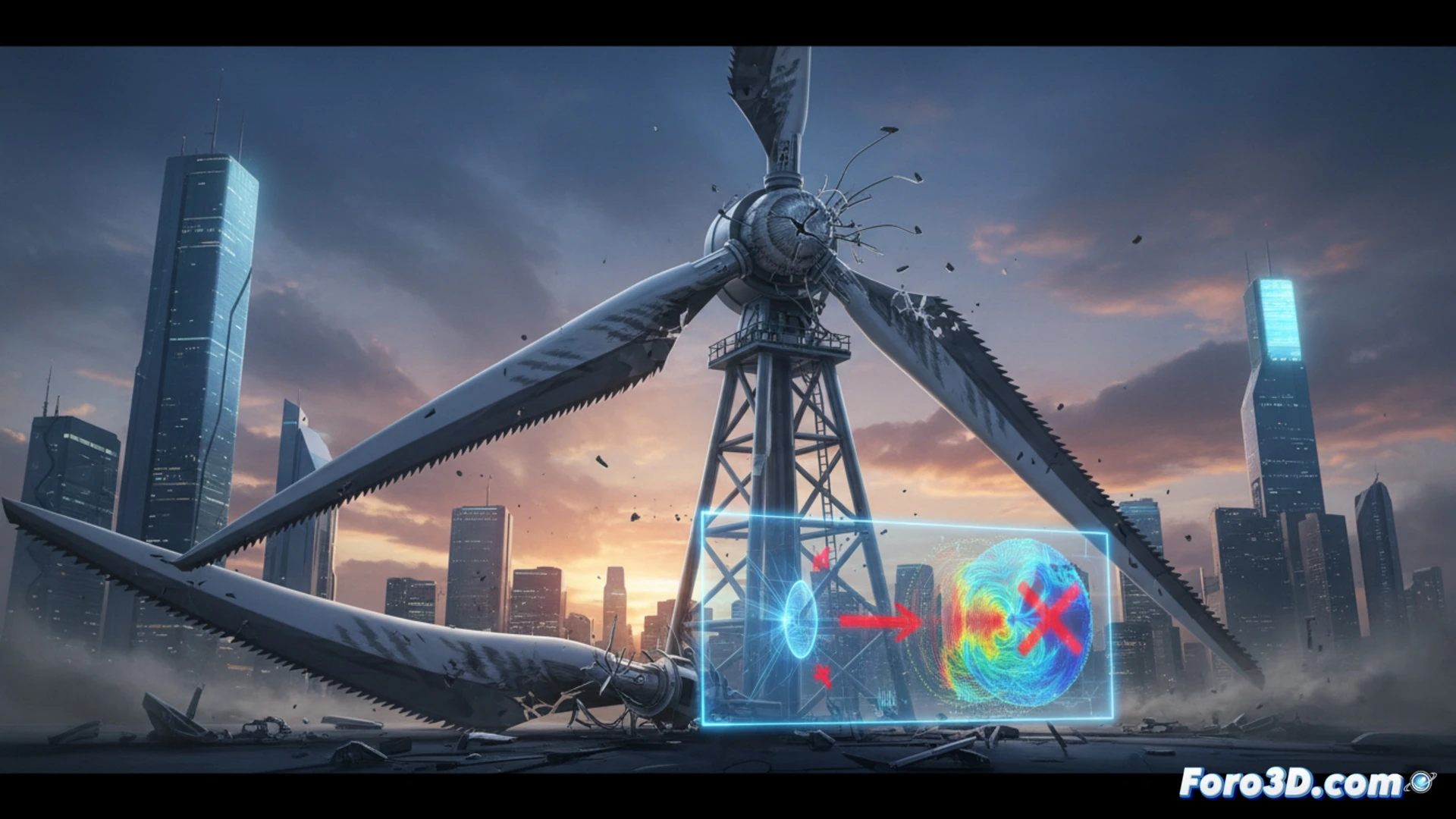
The collapse of the shaft of a silent wind turbine with a biomimetic design, inspired by the flight of an owl, has opened a critical debate in materials fatigue engineering. The incident occurred at an urban installation, where the main blade detached after months of operation. 3D forensic analysis revealed that the design paradox centered on the leading edge geometry: the serrations and fringes that reduce aerodynamic noise generated a transverse flutter phenomenon that the steel shaft could not dampen.
Forensic Workflow: From CFD to Fracture 🔧
The research team used OpenFOAM to simulate the aeroelasticity of the blade. The results showed that, at wind speeds of 8 to 12 m/s, micro-vibrations induced by the serrated edge of the blade coupled with the natural frequency of the shaft. This transverse flutter effect, absent in conventional designs, generated bending waves that cycled the steel beyond its endurance limit. Subsequently, SolidWorks Simulation modeled the shaft under cyclic loads, identifying a stress concentration at the welded joint with the hub. Finally, scanning with Artec Studio documented the fracture, showing progressive fatigue striations and a final ductile rupture, confirming that the failure was not sudden, but cumulative.
The Cost of Acoustics in Structural Fatigue ⚙️
The case demonstrates that noise reduction in urban turbines cannot be achieved by sacrificing structural integrity. The owl-edge design, effective for mitigating sound, altered the laminar flow by generating asymmetric vortex shedding. For future projects, it is recommended to integrate vibration fatigue analysis from the conceptual phase, using digital twins that couple CFD and FEM. The lesson is clear: in urban wind engineering, silent innovation must be measured not only in decibels, but in material life cycles.
As a simulation engineer, which fatigue parameters were most critical when modeling the flutter failure in the shaft of a biomimetic turbine, and how did they differ from those of a conventional turbine?
(PS: Material fatigue is like yours after 10 hours of simulation.)