One winter morning, the facade of a museum exploded without warning. The blown glass panels cascaded onto the sidewalk. The culprit was not an impact, but an extreme thermal gradient that exceeded the material's resistance. To understand how it happened, a forensic engineering team turned to 3D reconstruction, combining scanning, simulation, and visualization to identify the microcrack that started it all.
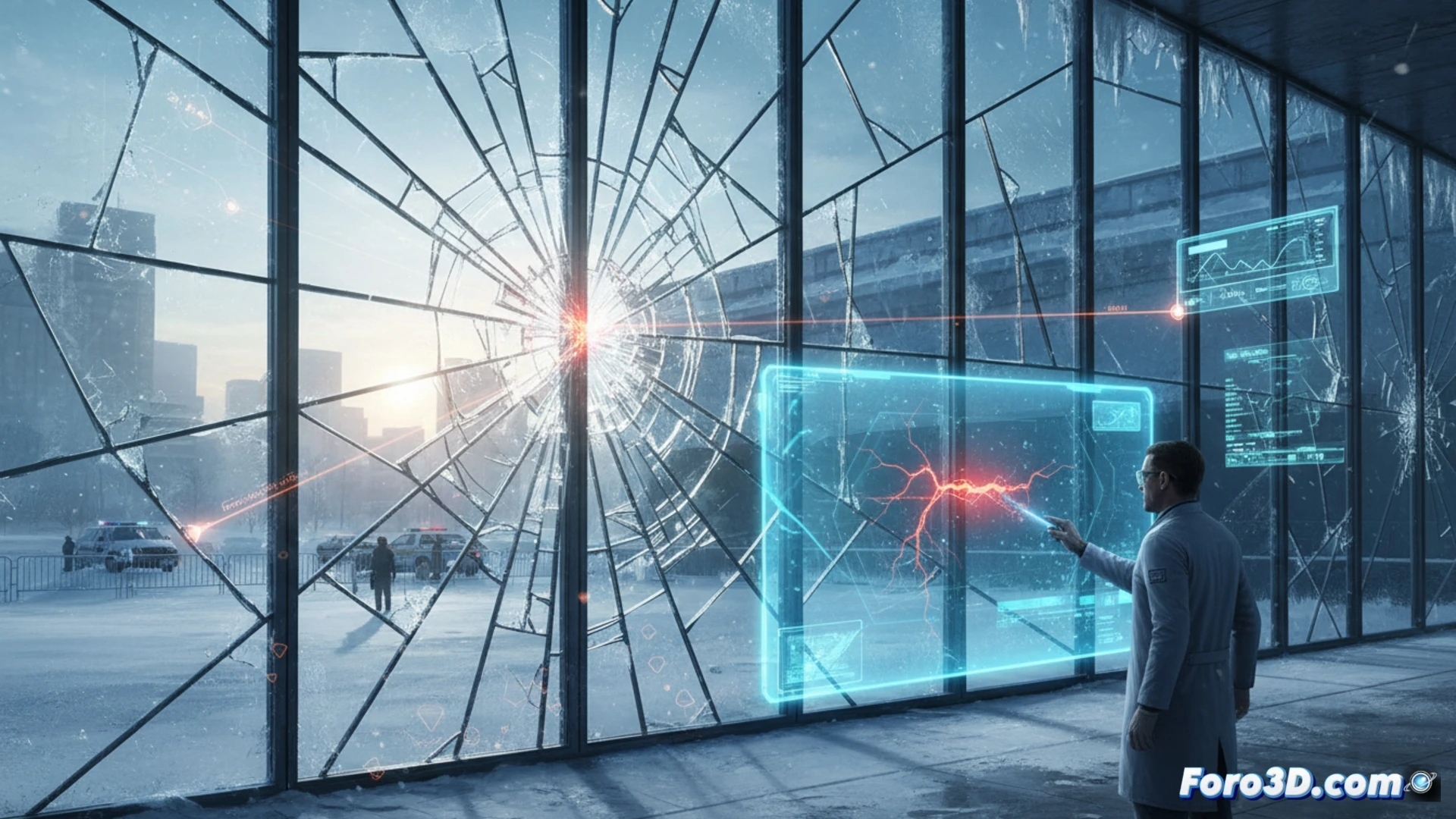
Forensic reconstruction with Geomagic Design X and simulation in Ansys 🔍
The process began with digitizing the surviving fragments using high-resolution photogrammetry, integrated into Geomagic Design X to generate a precise CAD model of the original geometry. This model was exported to Ansys, where the recorded weather conditions were applied: a 40-degree Celsius difference between the exterior face exposed to the sun and the shaded interior face. Finite element analysis revealed that tensile stresses were concentrated on a beveled edge, precisely where the glass thickness varied abruptly. There, the simulation located the fracture nucleation point, confirmed by the crack branching pattern.
3D visualization for safer regulations 🏗️
The final reconstruction, rendered in 3ds Max, allowed recreating the collapse sequence second by second, showing how the crack propagated radially from the critical point. This type of forensic analysis not only explains the incident but also forces a review of glass facade regulations. The study demonstrates that sudden temperature changes, combined with poor bevel designs, can turn an aesthetically flawless panel into a catastrophic risk. The lesson is clear: 3D simulation must be a mandatory step in material certification.
How can a 3D forensic analysis of thermal shock fracture differentiate whether the museum facade collapse was caused by a manufacturing defect in the blown glass panels or by a sudden change in ambient temperature?
(PS: Simulating catastrophes is fun until the computer crashes and you are the catastrophe.)