The recent flooding in the Ocean Spiral village has challenged materials engineers. A 47-centimeter crack in the acrylic dome threatens the station's integrity. The forensic analysis team has deployed a 3D pipeline combining underwater photogrammetry, finite element simulation, and virtual reality to determine whether the failure was caused by polymer fatigue or the impact of a marine species.
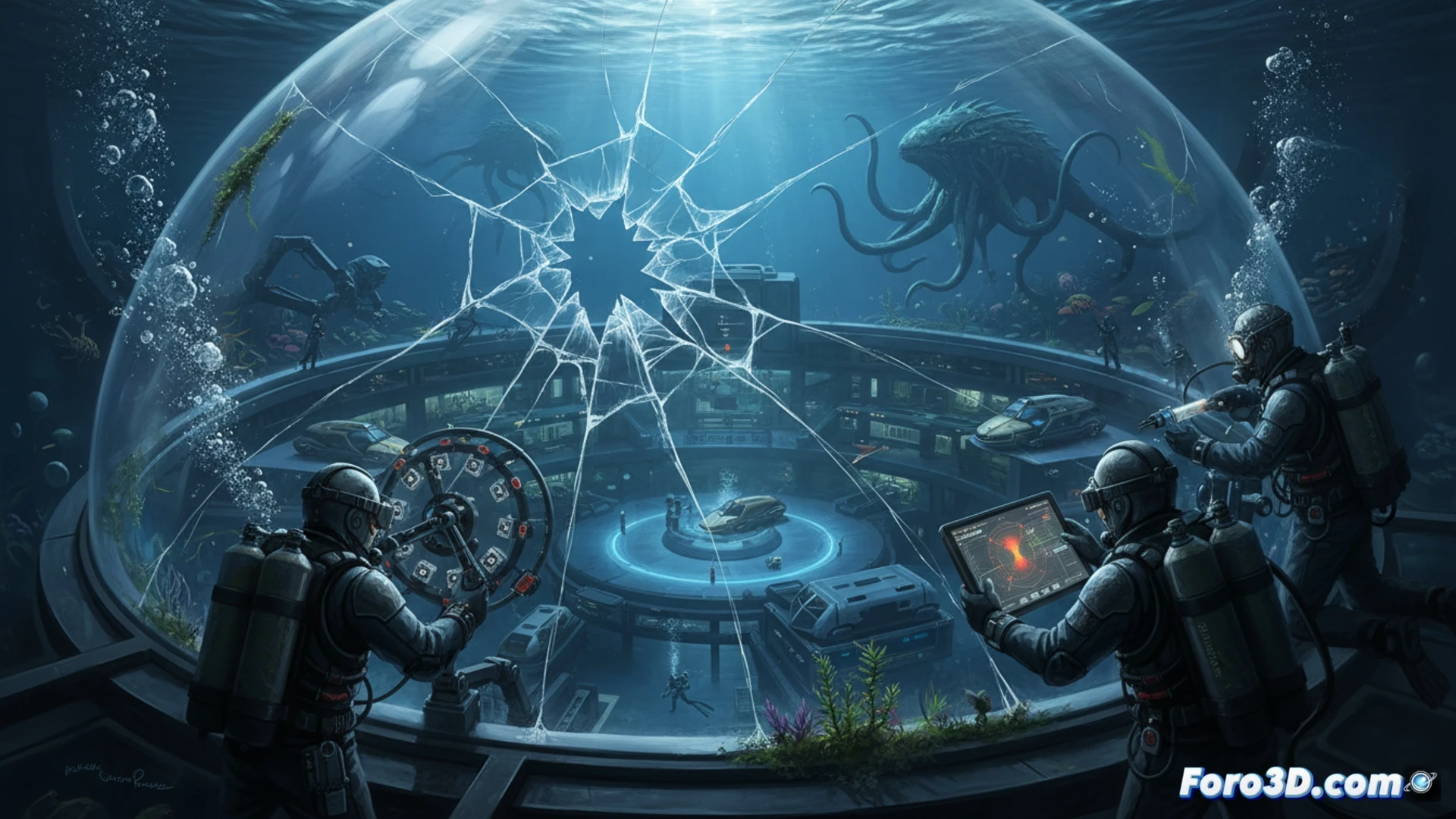
Forensic Pipeline: From Photogrammetry to Finite Element Analysis 🔬
The process begins with Bentley ContextCapture, which generates a high-resolution 3D model of the fracture pattern from underwater images. This model is imported into SolidWorks to reconstruct the exact geometry of the crack and the dome. Then, in Abaqus, two distinct FEA simulations are run: one applying cyclic pressure loads to simulate acrylic fatigue, and another modeling a high-energy point impact. Comparing the stress diagrams and crack propagation patterns allows engineers to rule out or confirm each hypothesis. The fatigue simulation shows a smooth, progressive fracture front, while a biological impact generates splintered edges and radial microcracks.
Immersive Visualization and Design Lessons 🎮
Unreal Engine 5 integrates the FEA results to recreate the crack progression and flooding in real time. This immersive visualization allows safety teams to observe how the structure behaves under different scenarios without risk. The final analysis will determine whether it is necessary to redesign the polymer or implement physical barriers against aggressive fauna. This case underscores the importance of combining numerical simulation with precise digital models to ensure watertightness in extreme underwater infrastructures.
What material properties would you assign? 🤔