A test shot at a laser fusion research center ended in catastrophe: a synthetic diamond lens exploded without warning. The 3D expert analysis, based on laser interferometry, made it possible to map the material's internal stresses and confirm that a microscopic graphite inclusion acted as the fracture initiation point. This analysis details how specialized software reconstructs the failure. 🔬
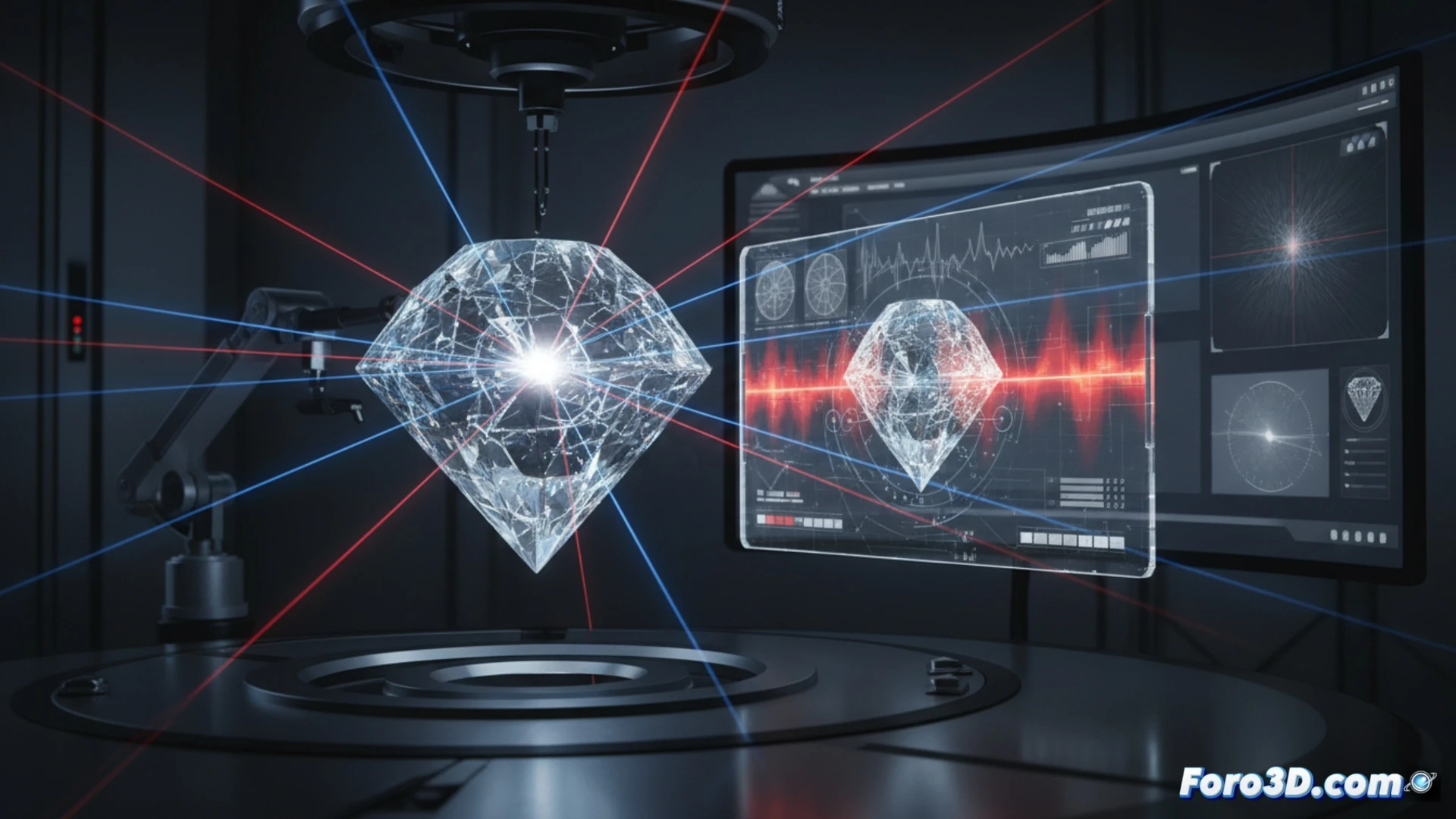
Stress mapping with laser interferometry and simulation in Zemax ⚡
The investigation combined three key tools. First, laser interferometry generated a high-resolution phase map, detecting nanometric variations in the diamond's refractive index. With this data, Zemax OpticStudio simulated the fusion beam's trajectory and calculated the zones of maximum energy absorption. MATLAB processed the residual stress matrices, identifying the graphite inclusion as a stress concentrator. Finally, KeyShot visualized the stress distribution in 3D, showing how the crack propagated from that microscopic point to total fracture. Comparison with other materials, such as silicon or sapphire, demonstrated that diamond withstands thermal stress better, but any internal defect drastically reduces its fracture threshold.
Lessons for fatigue simulation under extreme conditions 💎
This case underscores the need to integrate subsurface defect analysis into fatigue models. Traditional simulation assumes perfect materials, but the reality is that an inclusion of just a few microns can trigger catastrophic failure under cyclic loads or high-power pulses. The methodology used here, combining interferometric data with optical and mechanical simulation, sets a precedent for predicting the lifespan of critical components in laser fusion environments, where safety and precision are non-negotiable.
Which finite element simulation parameters were critical for accurately modeling the initiation and propagation of fracture in synthetic diamond subjected to the extreme conditions of the laser shot?
(PS: Material fatigue is like yours after 10 hours of simulation.)