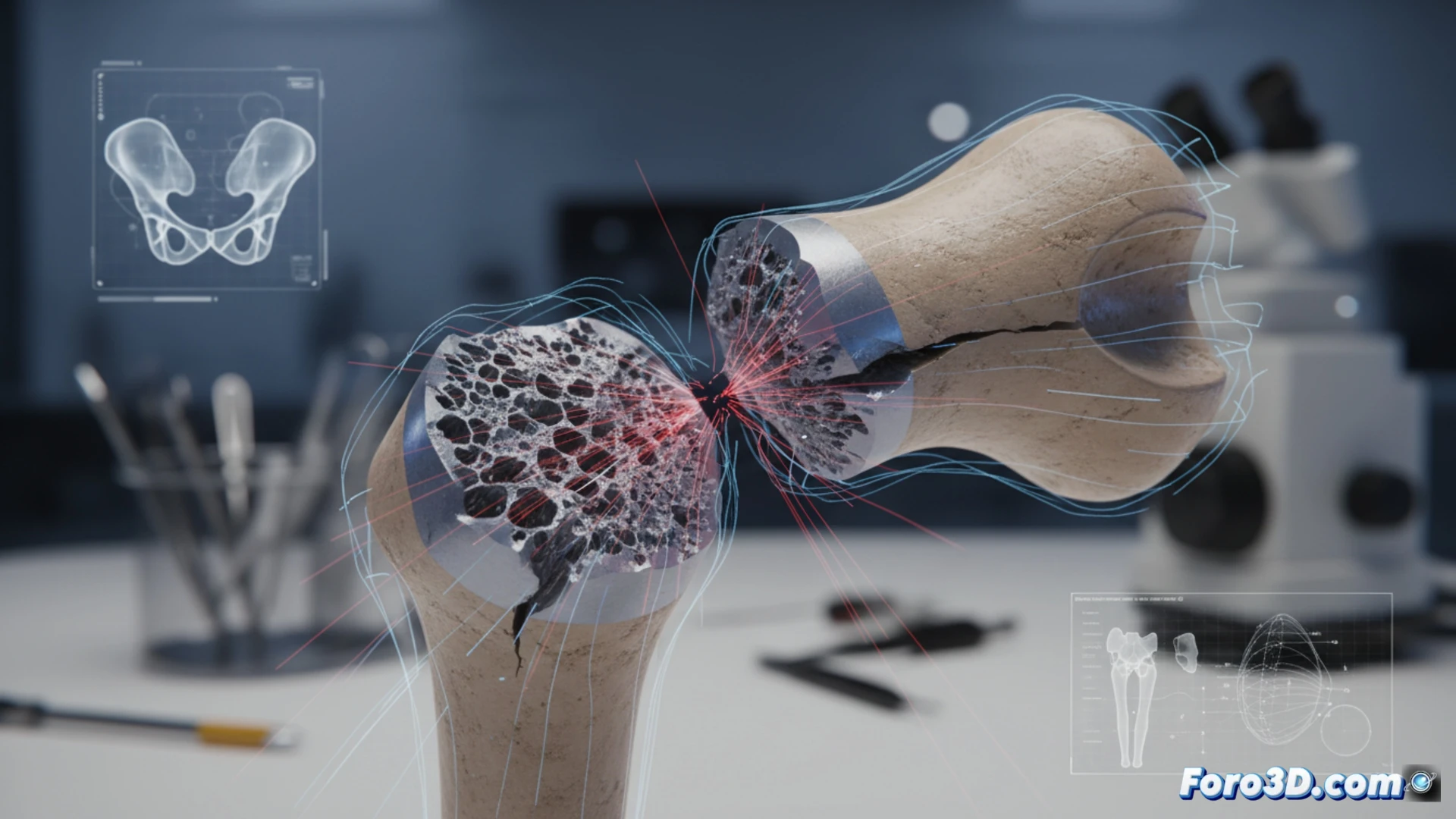
A custom hip prosthesis, manufactured using 3D printing in titanium, has failed after two years of use. The patient suffered a fracture in the joint, which has required a surgical revision. The case is now being analyzed as an in-depth technical study to determine whether the origin of the failure was excessive porosity in the sintered material or a deficiency in the simulation of impact loads during generative design.
Micro-CT and simulation: the failure diagnosis 🔬
The forensic team used VGSTUDIO MAX to process the micro-CT images of the fractured prosthesis. The analysis revealed zones of interconnected porosity in the femoral neck, precisely where the crack initiated. These cavities, typical of selective laser sintering (SLM) of Ti6Al4V titanium, acted as stress concentrators. In parallel, the original CAD model was recreated in Ansys Mechanical. The simulation showed that the generative design, optimized for cyclic loads of normal gait, did not account for an accidental loading scenario, such as a stumble or a lateral impact. The generative design software in Materialise Magics prioritized weight reduction over resistance to unforeseen peak loads.
How to prevent design from killing durability ⚙️
This case underscores a critical lesson for the 3D prosthesis niche: customization must not only adapt to anatomy but also to the patient's biomechanical risks. It is imperative to include impact loads equivalent to those of a fall or sudden movement in the simulation. Additionally, post-printing quality control with micro-CT must be mandatory, establishing maximum porosity thresholds. Tools like KeyShot can be used to present visual reports of the failure analysis to the surgeon, facilitating decision-making on implant redesign.
Is it possible to predict critical porosity through finite element simulation in the design of a 3D titanium hip prosthesis to prevent fatigue fractures after two years of use?
(PS: 3D prostheses are so customized they even have a fingerprint.)