The catastrophic failure of a large acrylic panel in a jellyfish aquarium, occurring after months of operation, prompted a forensic investigation using numerical simulation and optical metrology. The engineering team suspected that inadequate annealing during manufacturing left internal stresses that, combined with cyclic hydrostatic pressure, activated the fracture. An integrated workflow was employed: CAD modeling in Rhino 3D, finite element analysis in Abaqus, and experimental validation with GOM Inspect.
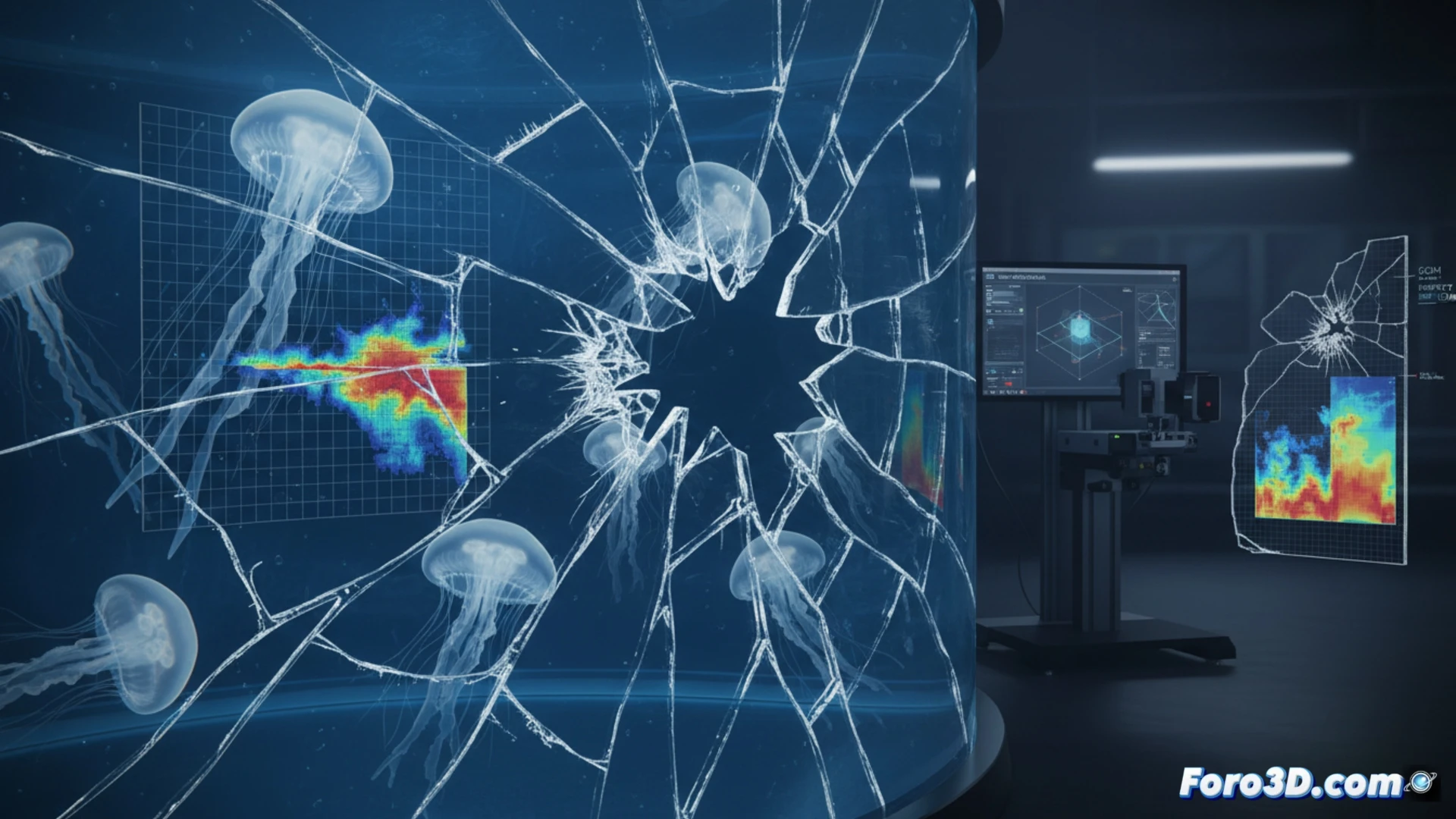
Workflow: From Rhino 3D to Abaqus and GOM Inspect 🔬
The process began with the geometric reconstruction of the panel in Rhino 3D, including the curvature radii and the fixing edges to the metal frame. The mesh was exported to Abaqus, where viscoelastic properties of acrylic (PMMA) were assigned and the thermal history of the annealing was simulated. The optical stress analysis was implemented using a birefringence model, calculating the distribution of residual stresses across the panel thickness. The results showed stress peaks of up to 12 MPa in the central zone, well above the material's yield limit. For validation, GOM Inspect was used on a digital twin of the fractured panel, comparing the predicted deformations with 3D photogrammetry measurements of the actual failure. The correlation was 92%, confirming that incomplete annealing was the root cause.
Lessons for Fatigue Simulation in Transparent Materials 💡
This case demonstrates that undetected residual stresses are a critical factor in the fatigue of structural acrylics. The combination of simulation in Abaqus with optical validation in GOM Inspect allows identifying weak points that a standard analysis overlooks. For future aquarium designs, it is recommended to include a controlled annealing step with online birefringence sensors, and to model the cyclic water load as a sinusoidal function over time to detect the activation of these stresses. Without this methodology, the risk of delayed fracture remains hidden until failure.
For the forensic analysis via simulation of the failure in the acrylic panel, which finite element methodology allows modeling with greater precision the evolution of manufacturing residual stresses and their interaction with the cyclic pressure and temperature loads of the jellyfish aquarium?
(PS: Material fatigue is like yours after 10 hours of simulation.)