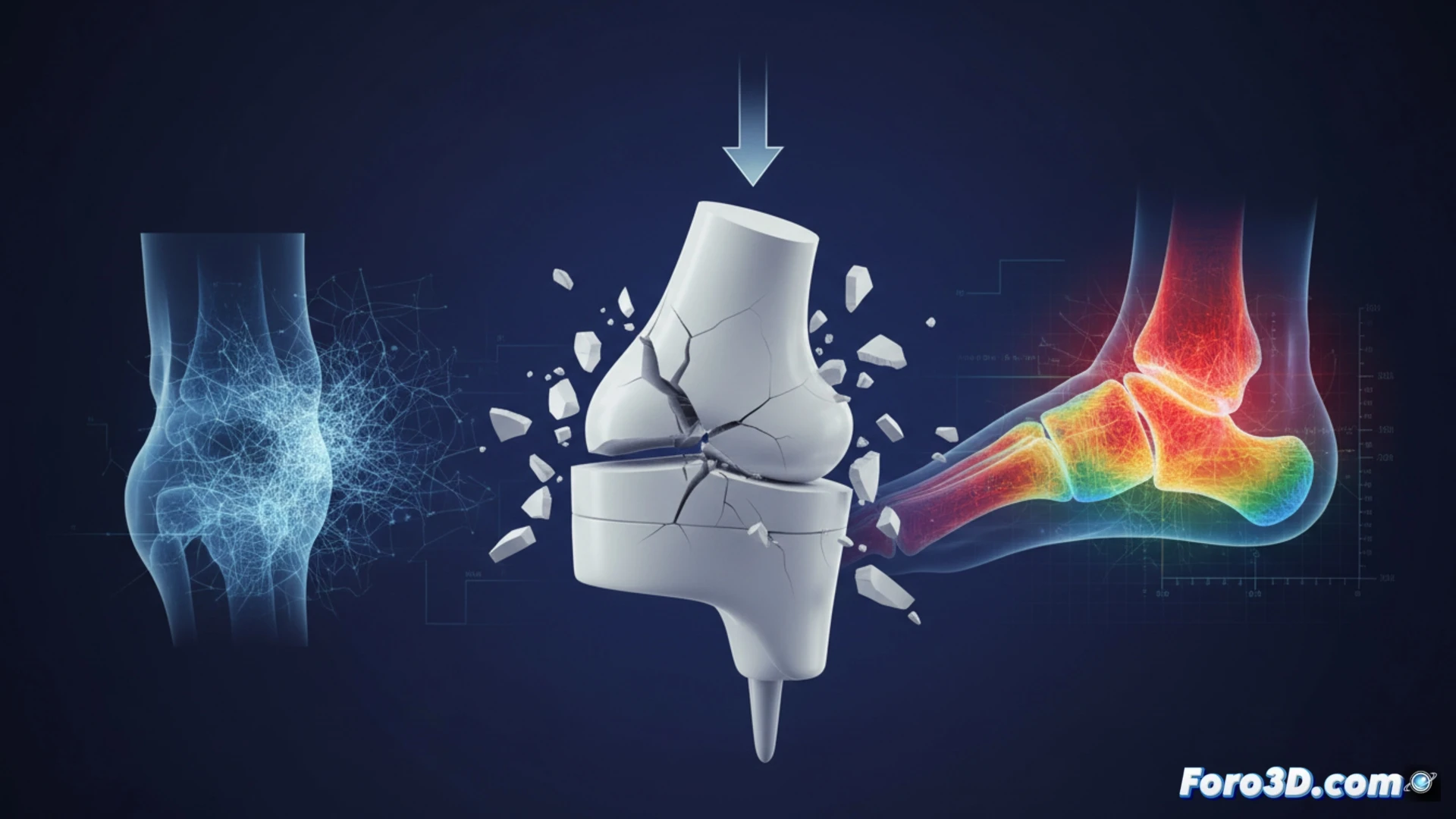
A patient with a state-of-the-art ankle prosthesis, made of high-strength alumina, suffered a catastrophic fracture after a fortuitous low-height jump. The failure, unexpected for an implant designed to withstand cyclic loads, has prompted an in-depth forensic analysis. Using micro-computed tomography (micro-CT) and finite element analysis (FEA), engineers seek to determine whether the specific orientation of the dynamic load exceeded the fracture toughness limit of the ceramic material.
Forensic workflow: from micro-CT to simulation in Abaqus 🔬
The process begins with digitizing the fractured implant using micro-CT, employing Volume Graphics software to reconstruct a high-resolution 3D model. This volumetric model allows identifying the crack initiation point and propagation surfaces. Subsequently, the geometry is imported into Materialise Mimics to segment and extract a precise mesh of the prosthesis and surrounding bone. The mesh is transferred to Abaqus (Biomechanics), where boundary conditions replicating the jump are applied: a short-duration impact load with an oblique force vector. The FEA analysis calculates the von Mises stress distribution and maximum principal stresses, revealing that the impact orientation generated a localized stress peak well above the flexural strength of alumina (400 MPa), causing immediate fragmentation.
Lessons for joint implant design 🦿
This case demonstrates that, although alumina ceramic offers excellent biocompatibility and low wear rate, its fracture toughness remains a critical point against non-physiological dynamic loads. The combination of micro-CT and FEA not only identifies the cause of failure but also allows validating and optimizing future designs. The results suggest the need to incorporate reinforcement geometries or composite coatings in areas of highest stress concentration, thereby improving patient safety during unforeseen activities.
The main failure mechanism identified in the finite element analysis that caused the fracture of the alumina ankle prosthesis during the jump was a localized stress peak well above the material's flexural strength (400 MPa), generated by the oblique orientation of the dynamic impact load. This is related to the alumina microstructure observed in the micro-CT, whose fracture toughness is limited against non-physiological loads, causing catastrophic crack propagation from the initiation point identified in the volumetric model.
(PS: If you 3D print a heart, make sure it beats... or at least doesn't cause copyright issues.)