During a high-competition regatta, a 30-meter carbon fiber mast fractured without warning, causing the loss of the vessel. The technical team recovered the fragments and applied a forensic workflow based on laser scanning with Artec Leo and advanced simulation with FiberSim and Rhinoceros 3D to reconstruct the original laminate and detect internal delaminations invisible to the naked eye.
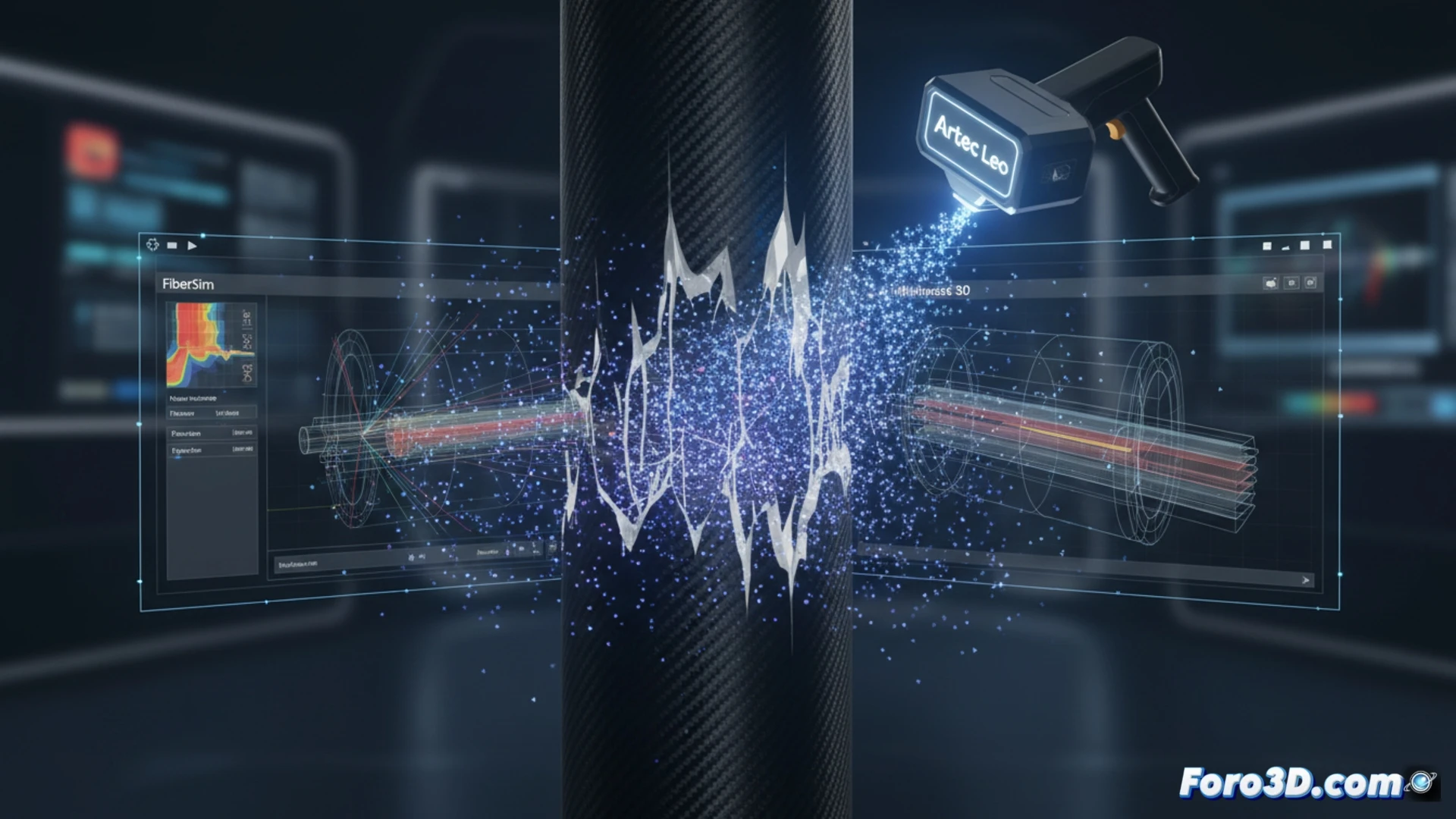
Laminate reconstruction through point clouds and meshing 🛠️
The process began with volumetric scanning of each fragment using Artec Leo, generating point clouds with submillimeter precision. This data was imported into Rhinoceros 3D to reconstruct the mast geometry and align the broken pieces. With the complete mesh, it was exported to FiberSim, where fiber orientation was simulated and stress concentration zones were identified. The analysis revealed that the fracture originated from cyclic fatigue in an area with previously undetected delamination, confirmed by cross-referencing the scan data with the finite element model.
Lessons for composite material design 📐
This case demonstrates that combining 3D scanning and fatigue simulation allows not only the reconstruction of catastrophic failures but also the prediction of weak points in future laminates. The ability to detect internal delaminations from fragment geometry opens a crucial forensic pathway for the nautical industry. In an environment where every gram of carbon counts, understanding how and why a mast fails is as valuable as designing a new one.
What methodology was used to correlate the anomalies detected in the 3D scan of the mast with the simulated dynamic loads and determine the exact sequence of fracture propagation?
(PS: Material fatigue is like yours after 10 hours of simulation.)