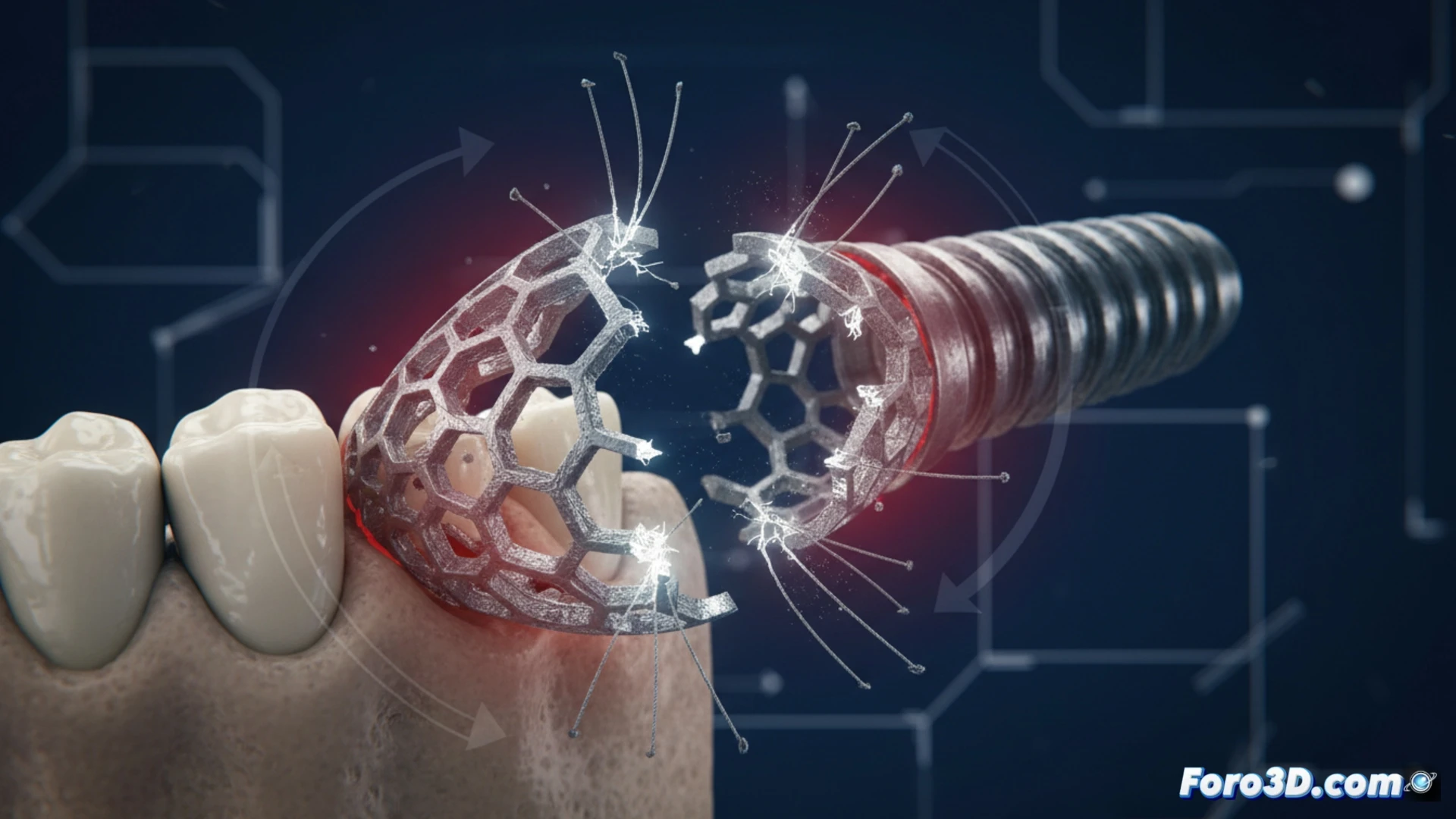
The catastrophic failure of a 3D-printed titanium mandibular implant during chewing has reopened the debate on the limits of generative design. The part, optimized to minimize weight and material, exhibited a cyclic fatigue fracture in the strut region of the lattice structure. Initial forensic analysis suggests that the topology optimization software may have reduced the diameter of the internal supports below the safe threshold to withstand the repetitive loads of the jaw.
Forensic workflow: From tomography to mechanical simulation 🔬
The research protocol began with a micro-CT scan of the fractured implant, processed in VGSTUDIO MAX to perform a porosity inspection and accurately measure the thickness of the broken struts. This digital reconstruction was exported to Ansys Mechanical, where cyclic masticatory loads of up to 120 N were applied at a 30-degree angle. The simulation revealed that the stress concentration at the lattice junctions exceeded the fatigue limit of Ti6Al4V, confirming that the Materialise Magics optimization had removed critical material. Blender was used to remesh the damaged geometry and generate a clean model for finite element analysis.
Lessons for parametric design in medical implants ⚙️
This case demonstrates that computational efficiency should not take precedence over biomechanical safety. Generative design, by seeking maximum weight reduction, can overlook service life under cyclic fatigue. The technical recommendation is to implement a dynamic safety factor in optimization algorithms, ensuring a minimum strut diameter of at least 0.4 mm for titanium in oral applications. Furthermore, every prosthesis must be validated with a 10-million-cycle fatigue simulation in Ansys before manufacturing, using realistic load data obtained from masticatory sensors.
Is it possible to accurately predict the fatigue life of a mandibular implant generated by extreme generative design using only numerical simulations without prior physical testing?
(PS: Material fatigue is like yours after 10 hours of simulation.)