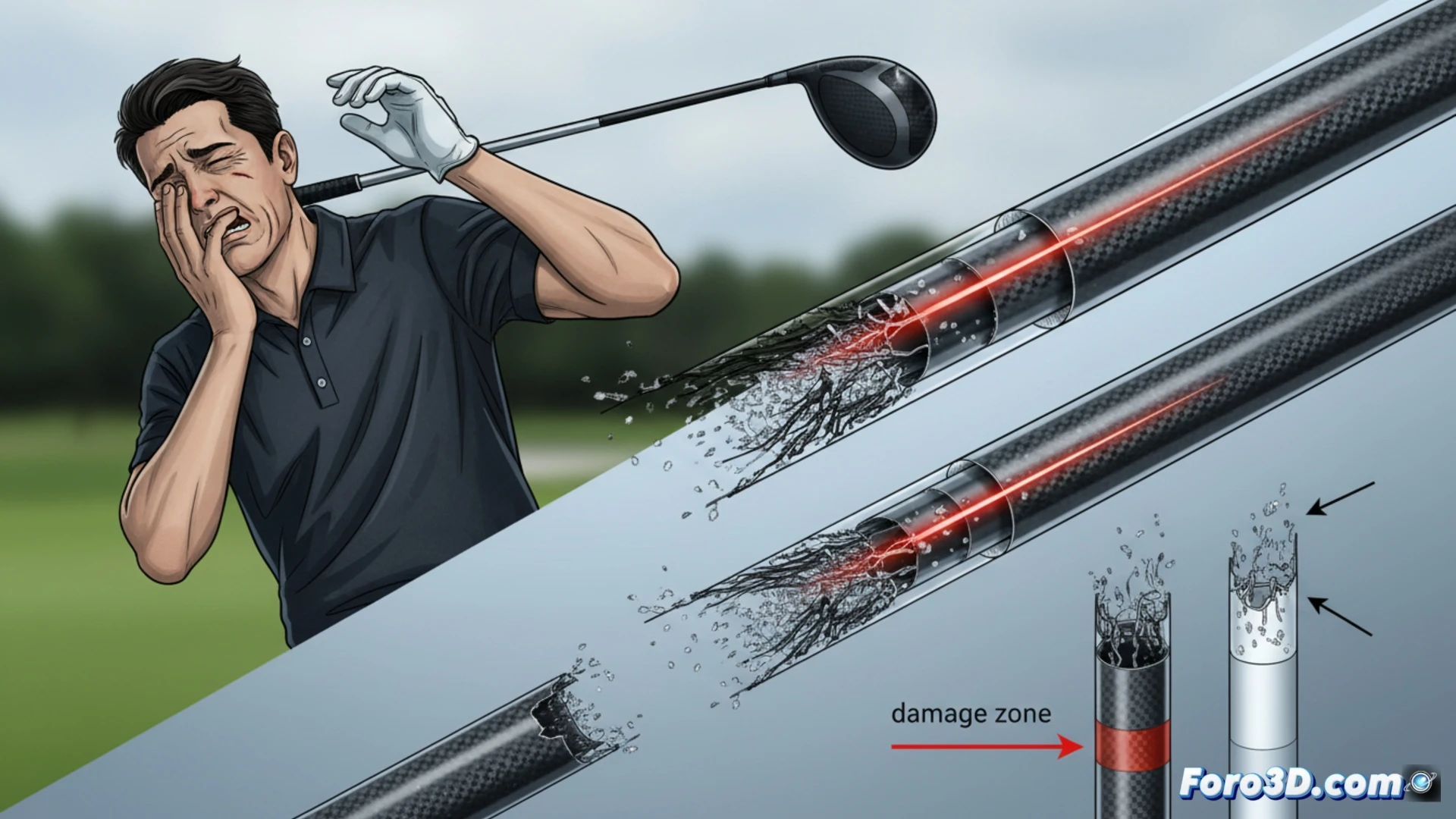
A golfer suffered an injury when the shaft of their carbon fiber club fractured during a swing. At first glance, the club appeared to be in perfect condition. However, a forensic analysis using Micro-CT and Volume Graphics VGSTUDIO MAX software discovered a silent internal delamination. Simulation with Abaqus confirmed that the failure originated from a prior low-energy impact that broke the resin matrix, leaving no visible external marks.
Technical Analysis: Hidden Delamination and Failure Propagation 🔬
The Nikon CT scan produced a high-resolution point cloud of the fractured shaft. By processing the data in VGSTUDIO MAX, areas of delamination between the carbon layers, invisible to the human eye, were identified. The simulation in Abaqus modeled the crack from a prior impact point, demonstrating how energy concentrated in the damaged matrix. Under the stress of the swing, the crack propagated rapidly, causing the total fracture. Blender was used to generate a 3D visualization of the process, showing the layer-by-layer failure sequence.
Lessons for Safety in Sports Equipment 🏆
This case demonstrates that visual inspection is insufficient for detecting internal damage in composite materials. The combination of Micro-CT and finite element simulation allows for predicting catastrophic failures before they occur. For the sports industry, this implies rethinking quality control and fatigue protocols. A seemingly harmless impact can be the start of a dangerous fracture, and only advanced non-destructive inspection can prevent it.
What material properties would you assign?