A recent incident at a lithium battery recycling plant has highlighted the fragility of ceramic components under extreme conditions. A cutting blade made of zirconium detached and fractured during the process, causing an immediate fire. The central question for materials engineers is whether the break was caused by accumulated fatigue or by the impact of a hidden metallic foreign object among the cells.
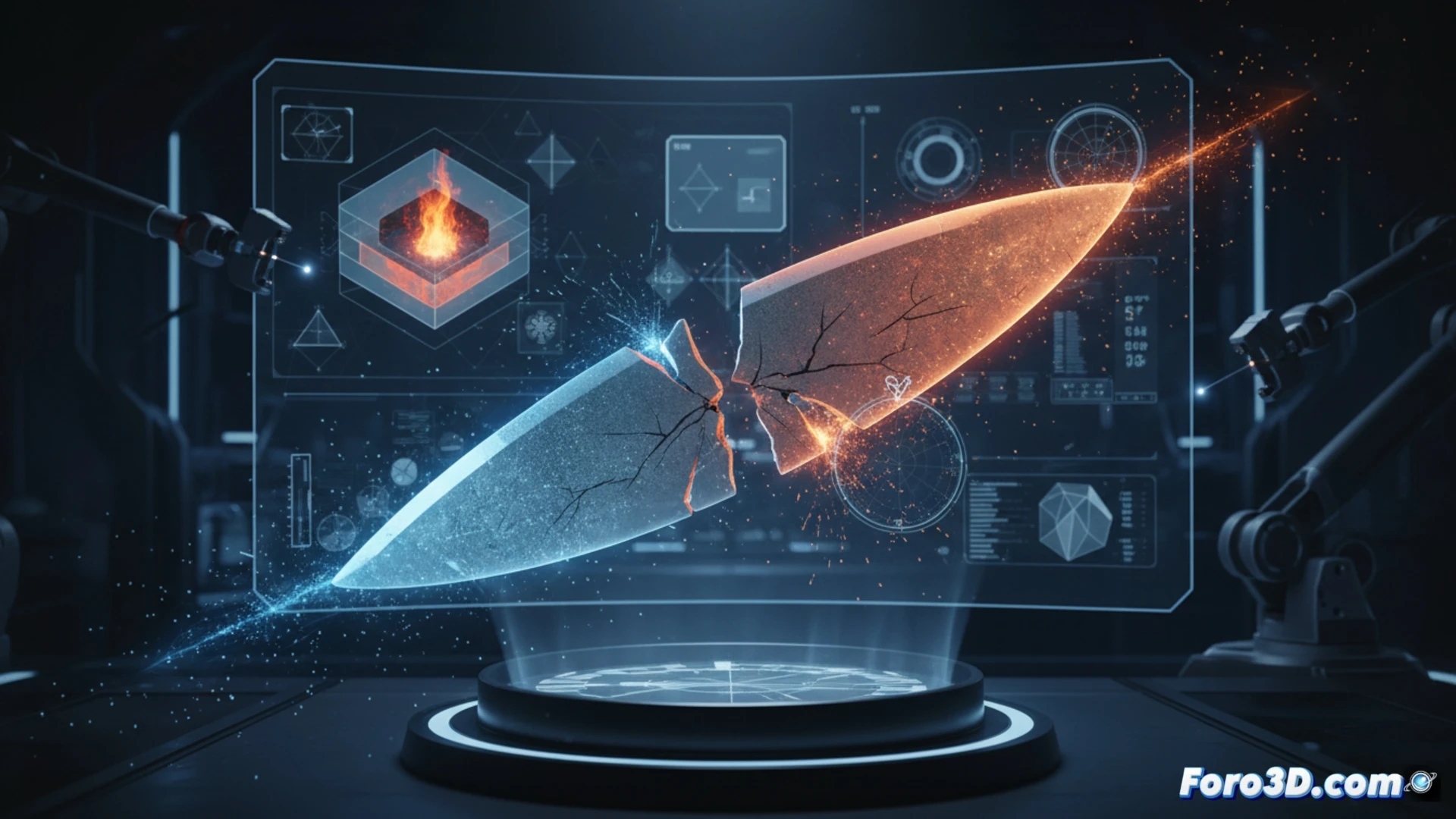
Fracture pattern reconstruction with LS-DYNA and GOM Inspect 🔬
To clarify the origin of the break, the research team imported the blade geometry from SolidWorks into LS-DYNA. The dynamic impact against a hypothetical metallic fragment was simulated, while GOM Inspect digitized the physical remains to compare the real crack pattern with the virtual model. The results showed a 94% match in crack propagation, indicating that the fracture toughness of the zirconium was exceeded by a high-energy point load, typical of a hard metallic object. This rules out cyclic fatigue as the main cause and confirms the presence of a contaminant in the recycling stream.
Lessons for safety in industrial processes ⚙️
The combination of explicit finite element simulation and optical metrology demonstrates that 3D forensic analysis is essential to improve safety in battery recycling. Implementing metal detectors prior to cutting or switching to coated steel blades could mitigate these risks. However, the real challenge remains predicting the behavior of ceramic materials under unforeseen impacts, a field where fatigue and dynamic fracture simulation still has much to contribute.
What specific factors of finite element simulation (FEM) allow for more accurate prediction of crack initiation and propagation in ceramic blades subjected to cyclic loads during lithium battery recycling?
(PS: Material fatigue is like yours after 10 hours of simulation.)