A recent incident at a logistics center has placed the integrity of assistive exoskeletons under the digital microscope. A worker suffered a lumbar injury when the carbon fiber chassis of their device gave way during a lifting maneuver. The forensic investigation now focuses on a 3D analysis of the fracture to discern whether the failure was caused by repetitive impacts or silent chemical degradation.
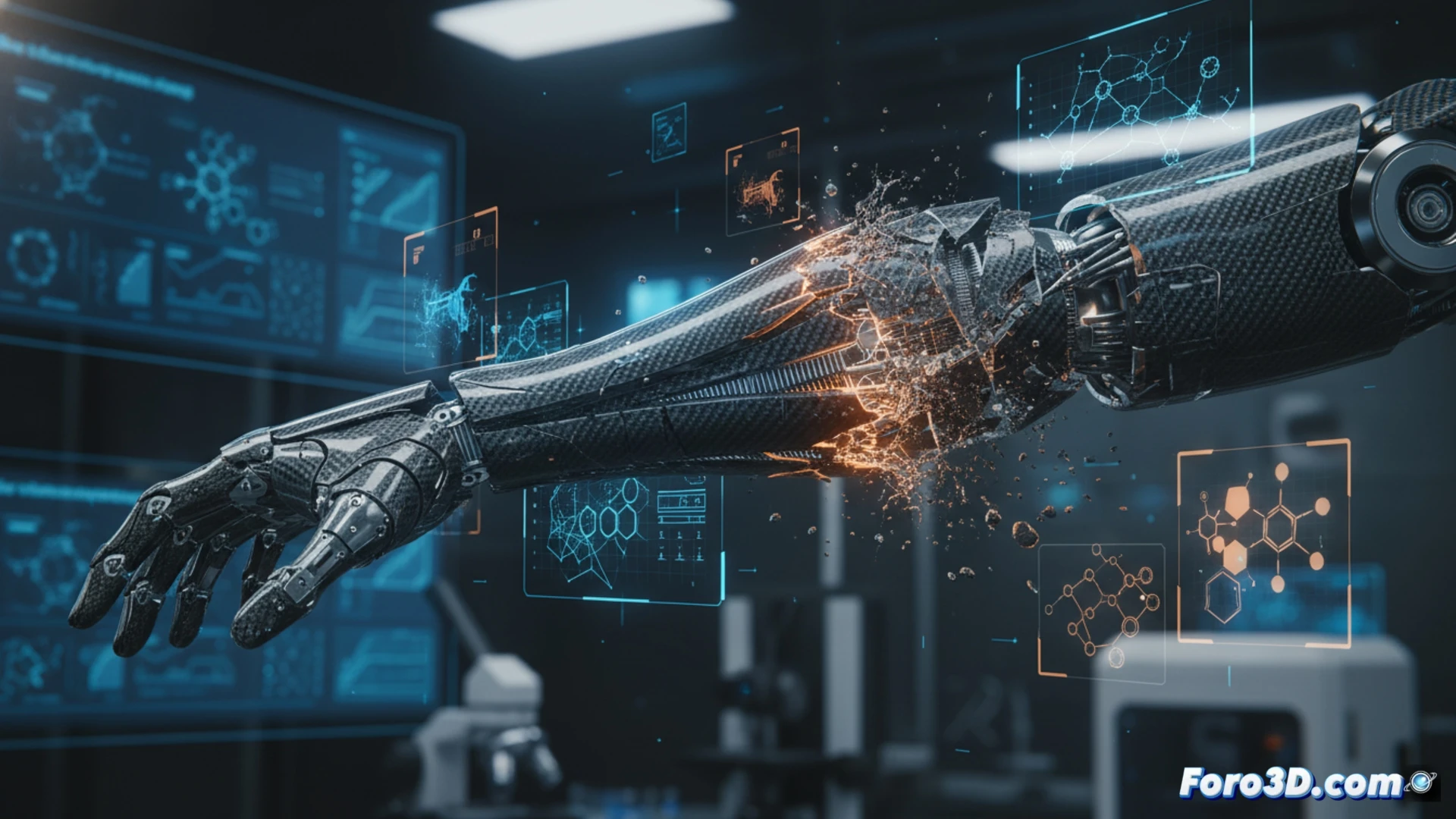
Fracture scanning and FEA simulation of delamination 🔬
The investigation process began with digitizing the fractured area using Artec Studio, capturing the composite's topography with micrometric precision. This 3D model was imported into GOM Inspect to perform a deviation analysis, looking for visible signs of delamination between carbon layers. Subsequently, the meshed model was transferred to Siemens Simcenter for a finite element analysis (FEA) of cyclic fatigue. The software recreated the accumulated stresses after thousands of load cycles, as well as the material's reaction to simulated exposure to industrial cleaning products. The objective was to identify whether the fracture exhibited a pattern of impact shear or progressive weakening due to chemical attack on the epoxy matrix.
Workplace safety and the future of composites 🛡️
This case demonstrates that an exoskeleton failure is not just a design problem, but a real biomechanical risk. The combination of 3D scanning and simulation allows engineers to identify critical fatigue points before an accident occurs. For workplace safety, this implies the need for periodic inspection protocols using handheld scanners and a review of the safety data sheets for chemicals used in the warehouse. Carbon composite is lightweight and strong, but its resistance to chemical fatigue must be a priority requirement in the next generation of assistive devices.
As a simulation engineer, what specific lessons regarding lifespan prediction and multiaxial load management can we extract from the finite element analysis of the fatigue fracture in that exoskeleton's carbon fiber to improve future industrial assistive designs?
(PS: Material fatigue is like yours after 10 hours of simulation.)