The failure of a lightweight modular bridge during a rescue operation exposed a critical vulnerability in aramid fiber connectors. The reverse engineering pipeline, using RealityCapture, nonlinear Ansys, and CloudCompare, revealed that prolonged exposure to solar radiation degraded the Kevlar surface, initiating progressive failure under vehicular load. This case demonstrates how fatigue simulation can predict failures in composite materials exposed to extreme environmental conditions.
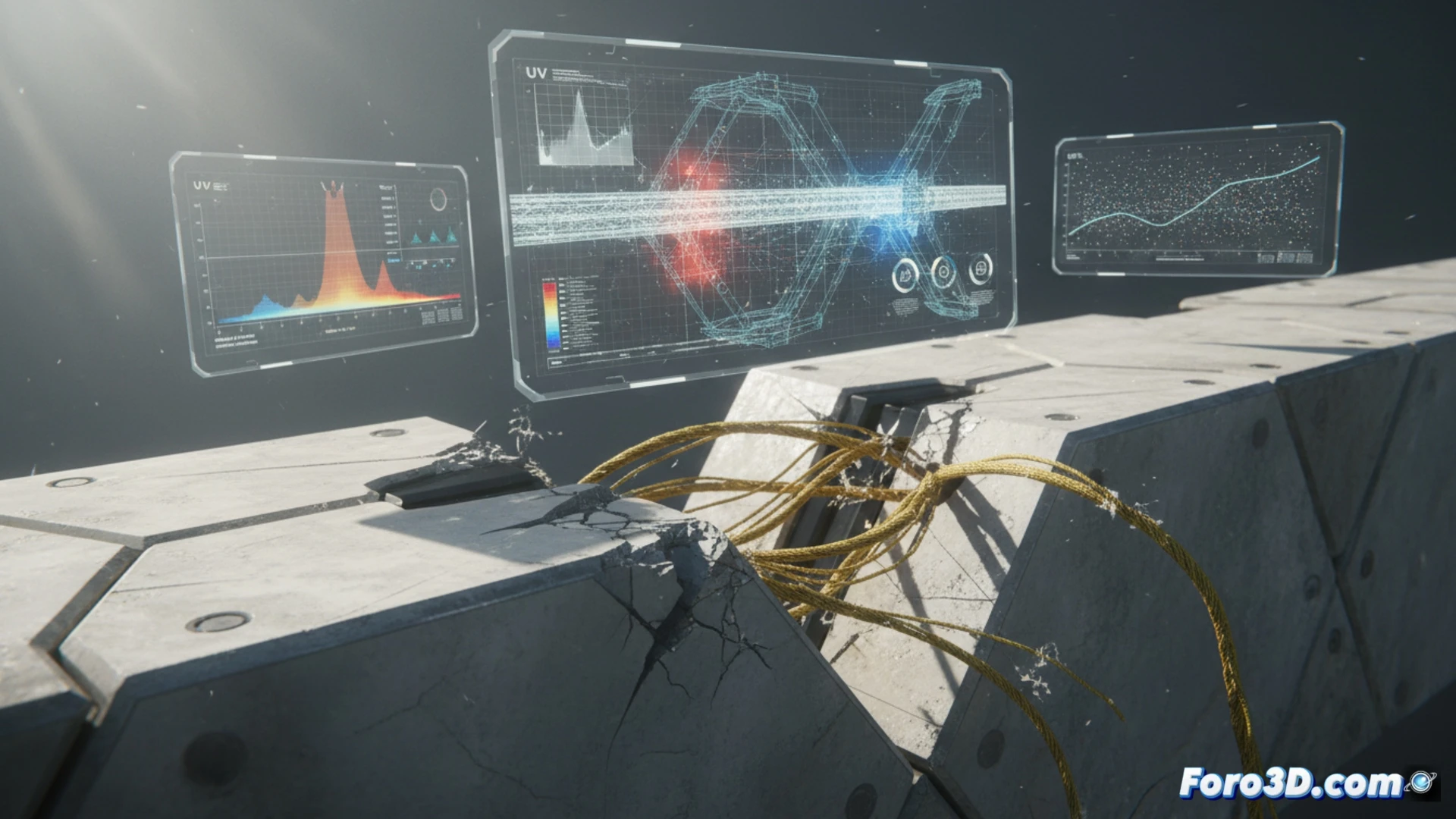
Workflow: From Point Cloud to Nonlinear Fracture 🔧
The process began with photogrammetric capture of the collapsed bridge using RealityCapture, generating a high-density point cloud to document the fracture surfaces. This geometry was imported into Ansys, where a nonlinear analysis with a progressive damage model for aramid fiber was applied. Surface degradation was parameterized by reducing the elastic modulus in the outer layers, simulating the effect of UV rays. Comparing the original point cloud with the simulation in CloudCompare allowed quantifying the cross-section loss and validating the crack initiation point.
Lessons for Composite Structure Design 📐
This analysis confirms that environmental fatigue, specifically UV radiation, can reduce Kevlar tensile strength by up to 30% before any mechanical loading. Integrating tools like CloudCompare for morphological analysis and Ansys for nonlinear simulation provides a robust method for predicting failures in rescue components. For future designs, the use of UV protective coatings and periodic validation through 3D scanning to detect microcracks before they compromise structural integrity is recommended.
Can UV fatigue degradation in aramid fibers be predicted using acceleration models that consider thermal hysteresis and accumulated irradiance in modular bridge connectors?
(PS: Material fatigue is like yours after 10 hours of simulation.)