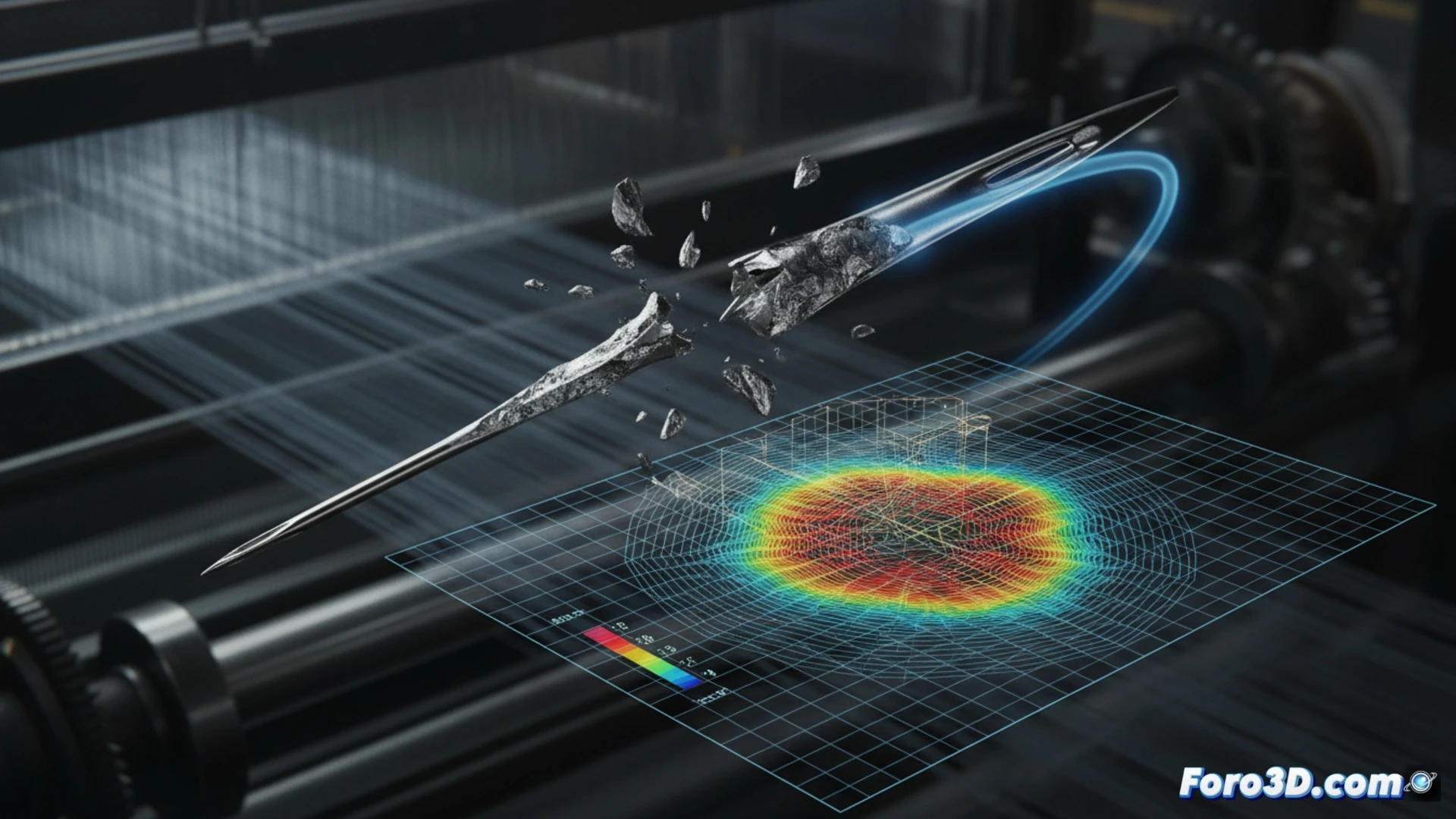
An incident on a high-speed carpet production line triggered industrial safety alarms. A hardened steel needle fractured catastrophically, projecting a fragment toward an operator. To determine the root cause, a forensic workflow was applied that combined 3D electron microscopy with finite element simulation, seeking to recreate the fragment's trajectory and validate whether the harmonic vibration of the loom exceeded the material's toughness limit.
Fracture reconstruction with ZEISS ZEN and validation in ANSYS 🔧
The analysis began with capturing the fracture surface using scanning electron microscopy (SEM) with the ZEISS ZEN software in its 3D module. This process generated a high-resolution topographic model that revealed fatigue striations and cleavage marks, indicating a progressive failure. This digital model served as the input geometry for ANSYS Mechanical. There, the dynamic loads recorded by the loom's sensors were applied, modeling the system's resonance frequency. The finite element simulation calculated the stress distribution in the needle, confirming that the amplitude of the harmonic vibration generated a cyclic stress peak that exceeded the steel's fracture toughness, initiating the crack at the point of highest stress concentration.
Lessons from the fragment trajectory and failure visualization 🎯
The 3D reconstruction not only determined the cause but also allowed visualizing the ballistic trajectory of the fragment. Using Maya, the fracture sequence was animated, from crack propagation to the detachment of the metal piece. This visualization was key to validating the ANSYS results and communicating the risk to design engineers. The case demonstrates that the combination of high-precision 3D microscopy and fatigue simulation is indispensable for preventing catastrophic failures in high-speed textile machinery.
Is it possible to predict, through 3D finite element simulation, the service life of a loom needle subjected to harmonic vibration, considering the variable load history and the material's non-linear fatigue properties?
(PS: Material fatigue is like yours after 10 hours of simulation.)