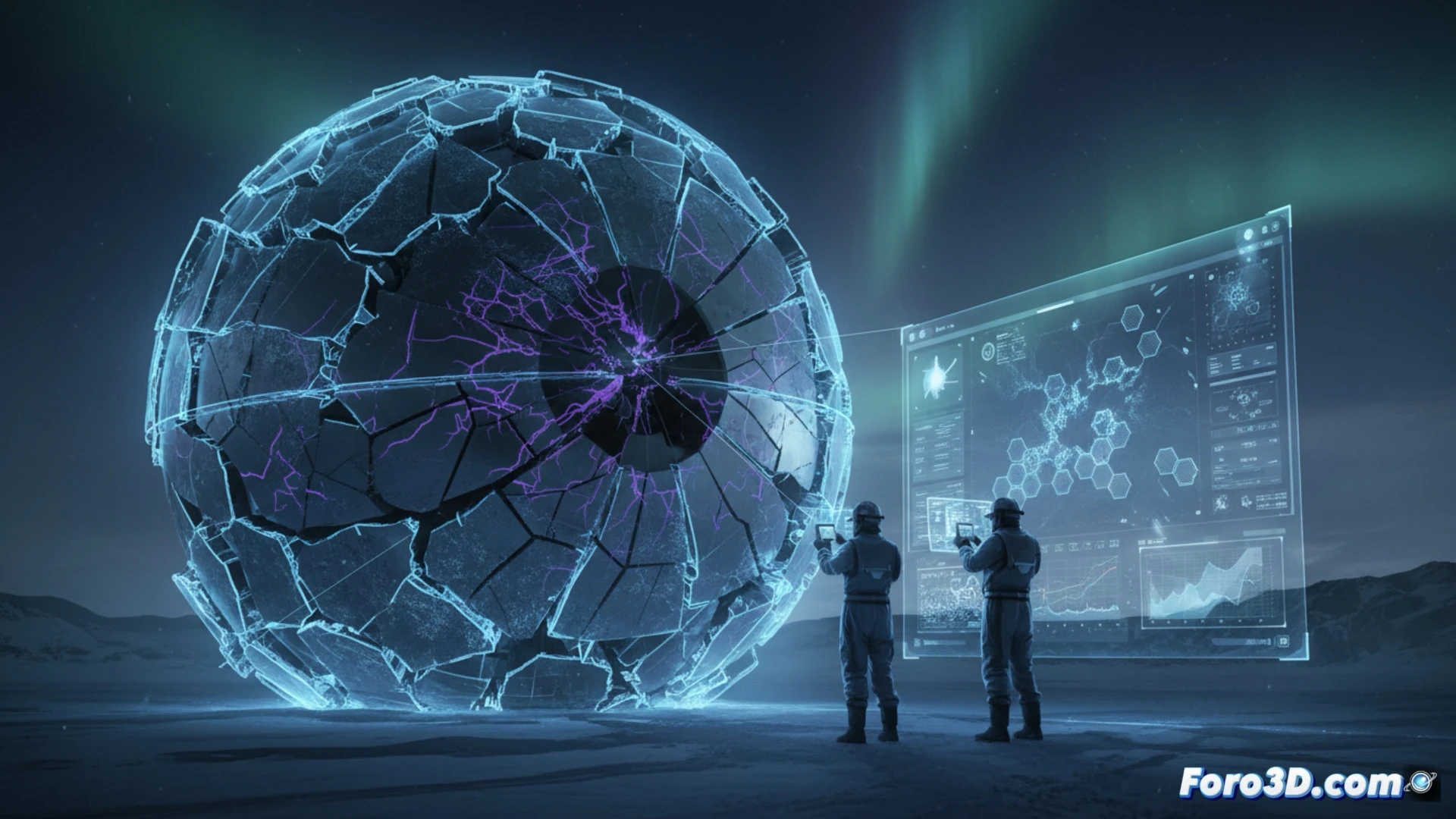
A Liquefied Natural Gas (LNG) storage sphere recently collapsed due to a catastrophic crack. The incident, linked to the phenomenon known as Death Light, represents a low-temperature embrittlement failure. To document the residual deformation of the structure and analyze the root causes, engineers turned to long-range laser scanning and micro-photogrammetry, combining reality capture with numerical simulation.
Deformation Documentation and Inverse Modeling 🔍
The investigation process began with FARO Scene to record the point cloud of the collapsed sphere, capturing plastic deformations and crack propagation lines. Subsequently, this data was imported into Geomagic Design X for reverse engineering. This software allowed converting the scan into a precise CAD model of the deformed geometry. This model not only documents the final failure state but also serves as a real boundary condition for stress analysis. Micro-photogrammetry, applied in the fracture zone, provided high-resolution texture to identify the brittle fracture pattern.
Thermal Simulation and Fatigue of Cryogenic Steel ⚙️
Using the deformed CAD model as a basis, COMSOL Multiphysics simulated the fatigue process. The analysis coupled cryogenic heat transfer with structural mechanics to recreate the thermal gradient that induces differential steel contraction. By correlating actual deformation data with simulated thermal stresses, the Death Light hypothesis was validated. This approach allows predicting the crack initiation point and optimizing future cryogenic tank designs to prevent embrittlement failures.
What material properties would you assign?