The mechanical failure of a titanium mesh used in cranial reconstruction has reopened the debate on the limits of additive manufacturing in biomedical implants. Research points to two main causes: the formation of a bacterial biofilm that degrades the surface and, critically, the internal porosity generated during the selective laser sintering (SLM) process. We analyze the technical workflow with Materialise Mimics, VGSTUDIO MAX, and Ansys Biomechanics to understand how to prevent these failures. 🧠
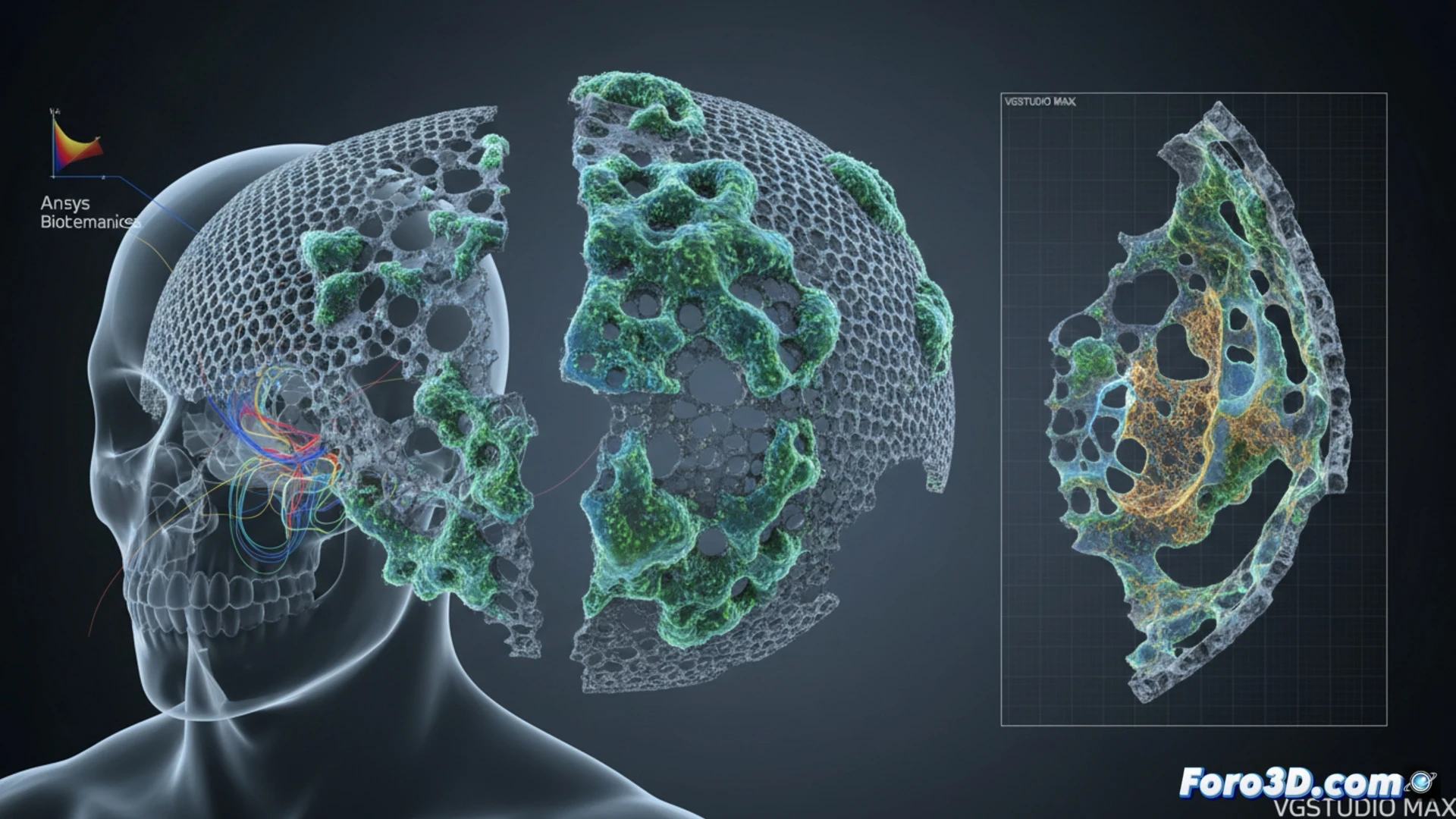
Technical workflow: design, simulation, and verification 🔬
The process begins in Materialise Mimics, where the patient's CT scan is segmented to generate a 3D model of the cranial defect. Based on this, the titanium mesh is designed with a lattice structure optimized for osseointegration. Subsequently, the STL file is exported to VGSTUDIO MAX, X-ray metrology software. Here, a porosity analysis is performed using high-resolution computed tomography, identifying internal micropores larger than 100 microns that act as stress concentrators. Finally, Ansys Biomechanics executes a finite element analysis that simulates the physiological loads of the skull, predicting fatigue failure points. The discrepancy between simulated and actual porosity reveals that the laser sintering process introduced defects undetected in the design phase, facilitating crack propagation.
Porosity control: the balance between osseointegration and strength ⚖️
Controlled porosity is desirable for bone integration, but unwanted porosity from the SLM process is lethal for implant reliability. A bacterial biofilm can colonize these micropores, aggravating localized corrosion and accelerating fracture. The technical lesson is clear: it is essential to integrate micro-computed tomography verification (such as that from VGSTUDIO MAX) as a mandatory post-manufacturing step, not just as an optional quality control. Only then can it be ensured that the actual porosity of the implant matches the design and simulation parameters of Ansys, avoiding surgical failures that compromise the patient's life.
How does the controlled porosity of laser sintering affect biofilm formation in titanium cranial implants, and what are the critical parameters to avoid mechanical failure in complex reconstructions?
(PS: If you 3D print a heart, make sure it beats... or at least that it doesn't cause copyright issues.)