The fracture of a transmission shaft in flight represents one of the most critical failure modes in helicopters. Distinguishing whether the origin was progressive fatigue induced by torsional vibrations or a manufacturing defect embedded in the material is vital for accident prevention. This article breaks down the forensic workflow that combines VGSTUDIO MAX, SolidWorks Simulation, and photogrammetry with Pix4D to analyze the fracture surface and internal stress fields.
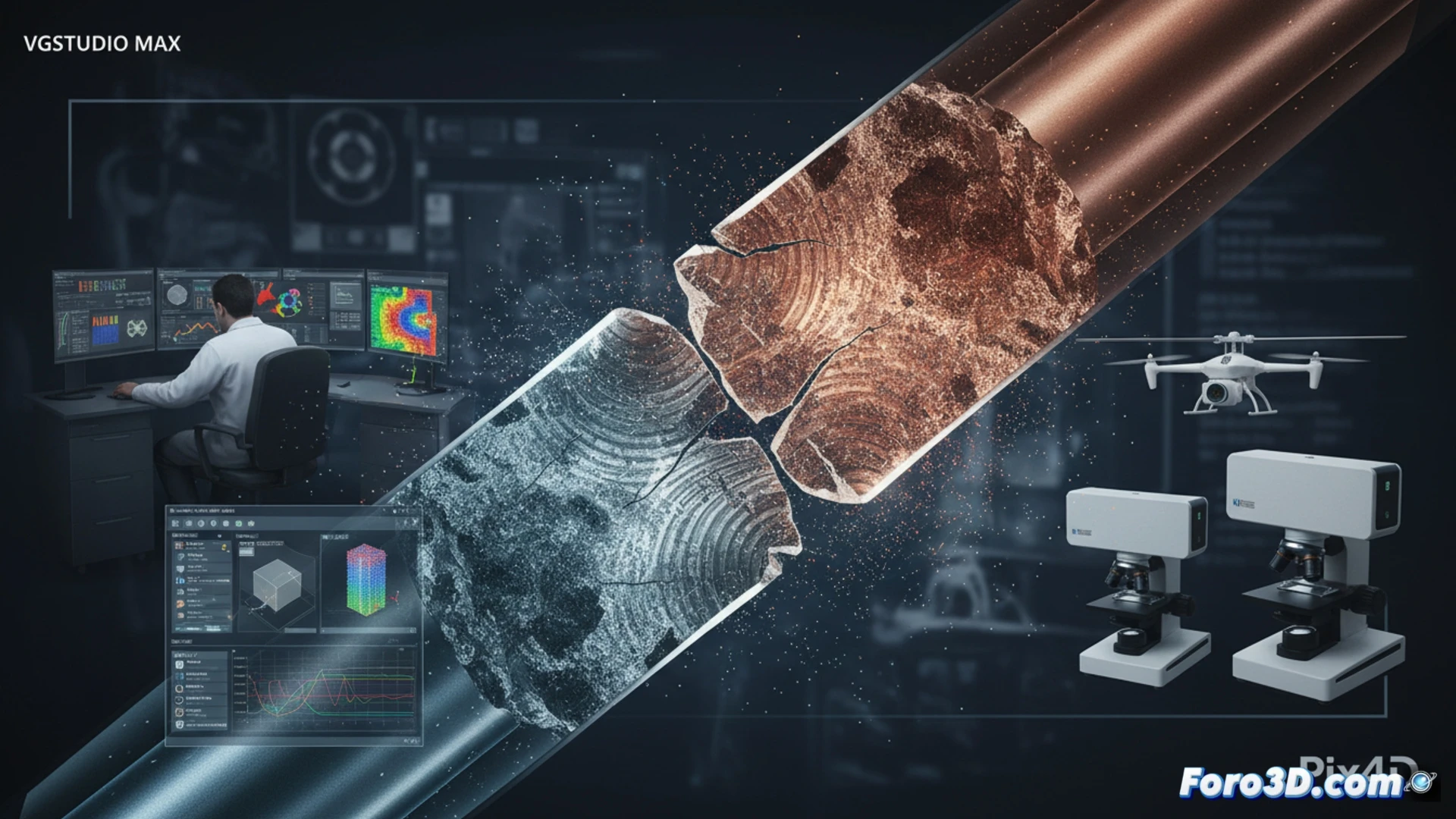
Workflow: from micro-CT to stress map 🛠️
The process begins with the acquisition of volumetric data of the fractured shaft using micro-computed tomography, processed in VGSTUDIO MAX. This tool allows for a complete volumetric inspection and the generation of a 3D mesh of the fracture surface with micrometric resolution. Digital fractography identifies beach marks, fatigue striations, and the failure initiation zone. Subsequently, this model is exported to SolidWorks Simulation, where the torsional and vibratory loads recorded in flight are applied. The structural simulation calculates Von Mises stress maps and stress concentration factors, allowing a comparison of numerical predictions with the physical marks observed in the 3D scan.
Vibration versus inclusion: the forensic key 🔍
The differentiation between vibration fatigue and manufacturing defect lies in the morphology of the initiation point. Torsional vibrations generate a pattern of concentric striations and a smooth, homogeneous propagation zone. In contrast, an inclusion or internal porosity shows an irregular geometry and angular edges in the 3D fractography. By overlaying the SolidWorks simulations with the volumetric slices from VGSTUDIO MAX, it is confirmed whether the localized stress peak coincides with a pre-existing defect or with the natural vibration frequency of the shaft, thus establishing the root cause of the accident.
How can 3D digital fractography accurately distinguish vibratory fatigue marks from casting inclusions on the fracture surface of a helicopter transmission shaft?
(PS: Material fatigue is like yours after 10 hours of simulation.)