Fractal Design has achieved a milestone in the SFF market with its Terra chassis, combining brushed aluminum panels with real walnut wood inserts. But beyond its minimalist aesthetics, 3D modeling professionals wonder if this 10.4-liter case can house the hardware necessary for rendering under sustained load. We analyze whether its design is a functional work of art or a thermal trap for high-end GPUs. 🖥️
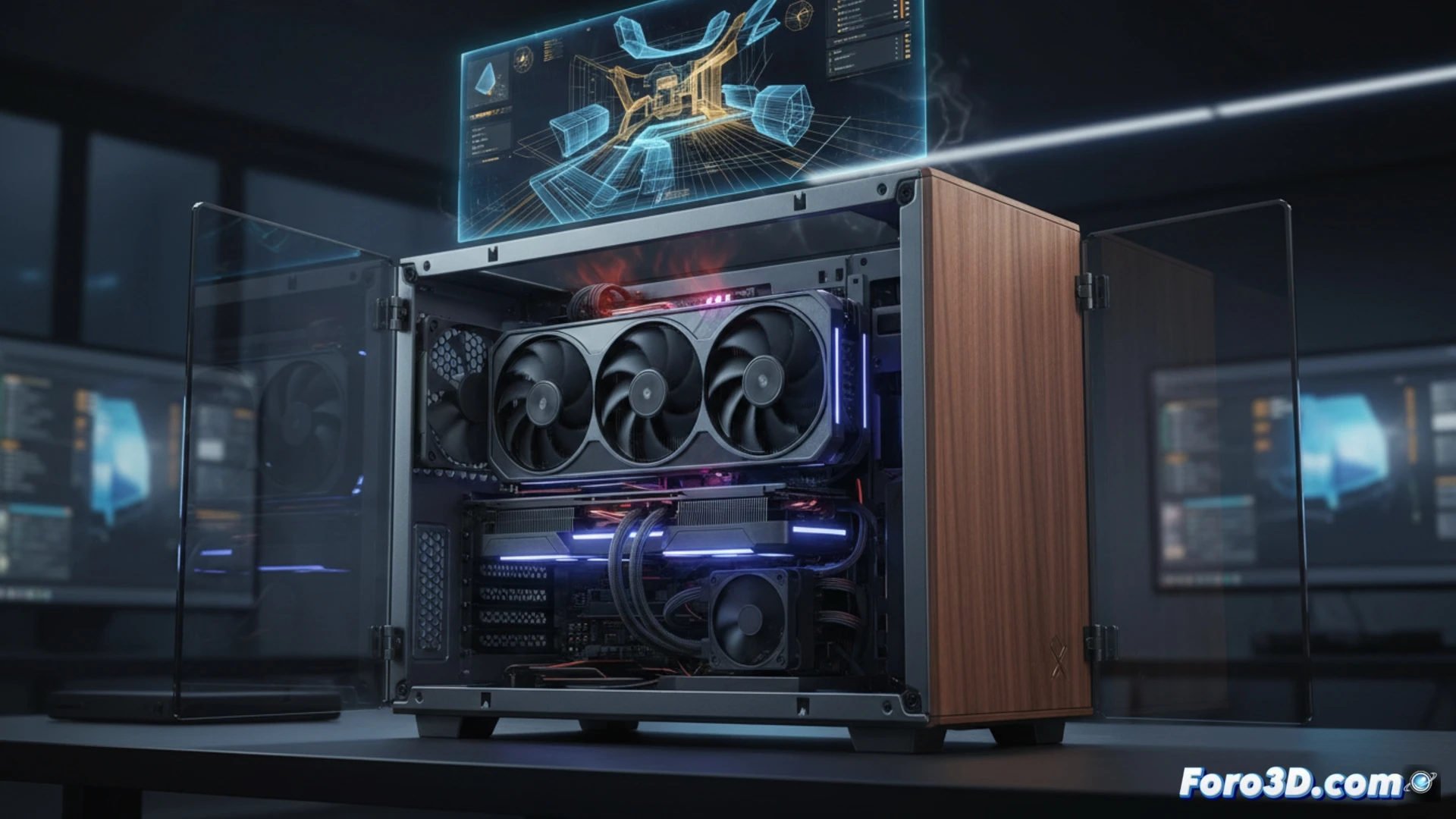
Thermal management and hardware limitations for SFF workstations 🌡️
The true challenge of the Terra lies in its internal volume. With a maximum of 322 mm for the GPU and 77 mm for the CPU cooler, options are drastically reduced. For an RTX 4080 or 4090, which require massive heatsinks, space is tight. The NVIDIA Founders Edition fits, but third-party models like the ASUS Strix are incompatible. In rendering tests with Blender, the vertical airflow with a single 120 mm fan (mounted at the bottom) proves insufficient to keep GPU temperatures below 80 degrees Celsius after 30 minutes of load. The CPU, limited to low-profile coolers like the Noctua NH-L12S, suffers thermal throttling on processors with 65W TDP or higher. Compared to the Cooler Master NR200, which supports 240 mm radiators and 155 mm coolers, the Terra sacrifices thermal performance for portability. The DAN Cases A4-H2O, with support for a 240 mm AIO, offers better heat management, though with less storage space.
Minimalism versus productivity: Is the sacrifice worth it? ⚖️
The Fractal Terra is a statement of intent: it prioritizes design over expandability. For a 3D workflow combining light modeling and short renders, it is viable. However, for prolonged CPU or GPU rendering sessions, fan noise and elevated temperatures are an unavoidable reality. The real wood and aluminum are a visual luxury, but they do not solve the laws of physics. If your priority is raw performance under load, the NR200 or the A4-H2O offer a better balance. The Terra is perfect for the artist who values desktop aesthetics as much as final results, but not for those seeking maximum thermal performance in a compact space.
How does the thermal management of the Fractal Terra, with its aluminum and wood panel design, affect sustained GPU and CPU performance during extended 3D rendering sessions?
(PS: If the computer smokes when opening Blender, you might need more than a fan and faith)