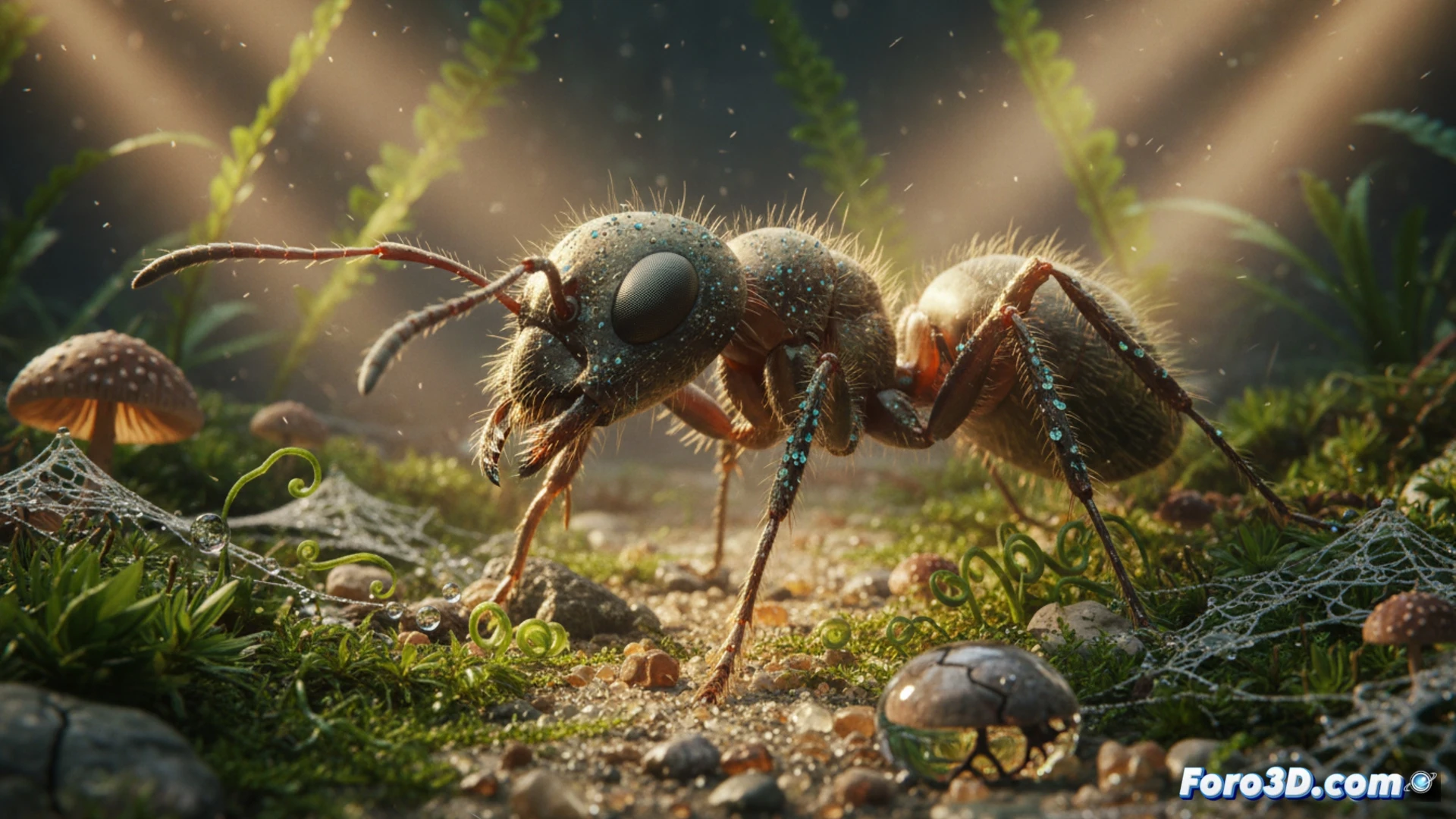
Empire of the Ants has arrived to redefine the limits of photorealism in Unreal Engine 5. This title not only bets on the epic scale of a battlefield but reduces it to the size of an ant. The result is a technical marvel that demonstrates how Nanite and Lumen can work together to render organic details at a microscopic level, from an insect's scales to the texture of a moss leaf. For indie developers, this project is a masterclass on how to squeeze the potential of UE5 without sacrificing performance. 🐜
Technical Workflow: ZBrush, Substance Painter, and UE5 🛠️
The modeling of the fauna in Empire of the Ants was primarily done in ZBrush, leveraging digital sculpting to capture the exact anatomy of the insects. Once the high-poly was created, the models were retopologized for UE5. The real magic happens in Substance Painter, where organic textures were painted with almost histological detail. The technical trick here is the use of subtle roughness and displacement channels that, combined with Nanite, allow the engine to render millions of polygons without LOD instances. For an indie, the key is to use Nanite in high-density mode only for the main assets (the player character and key enemies) and leave background objects (leaves, branches) with more simplified geometry that still benefits from mesh streaming.
Lumen Lighting in Dense Environments: Tips for Developers 💡
Lumen shines especially in dense natural environments, but its reckless use can saturate the GPU. In Empire of the Ants, global illumination was optimized by reducing the number of indirect light bounces in scenes with heavy vegetation. A practical tip for indies is to use Lumen in Production quality mode only for cinematic sequences, and switch to a Performance mode during gameplay. Additionally, combining Lumen with a precomputed lighting system (baked lighting) for static objects like a tree trunk or the ground helps save resources. The result is a world that feels alive, with soft shadows and natural reflections, without the framerate plummeting when moving the camera through the foliage.
How does Empire of the Ants manage to capture microscopic photorealism in Unreal Engine 5 without sacrificing performance in scenes with high vegetation density and insect detail?
(PS: 90% of development time is polishing, the other 90% is fixing bugs)