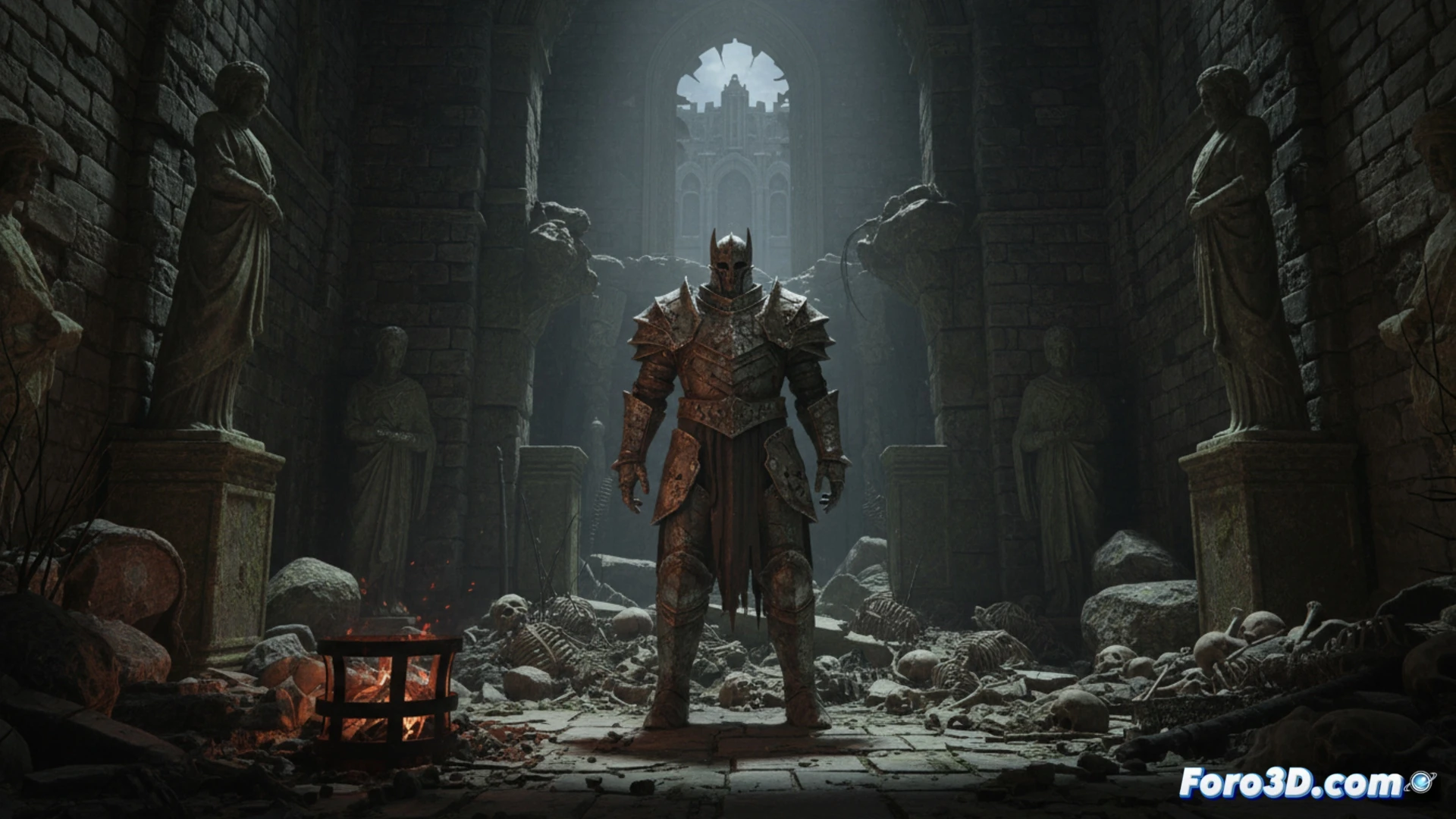
The development of Mortal Shell, an independent title that visually competes with major productions, demonstrates how a small team can achieve high-fidelity aesthetics without an AAA budget. The key lies in the strategic combination of photogrammetry for environments and organic materials, complemented by detailed digital sculpting in ZBrush for hard surfaces like metal and stone. This workflow, implemented in Unreal Engine 4, generates an oppressive and realistic atmosphere that defines the game's identity.
Workflow: From capture to lighting in UE4 🎮
The process begins with the photogrammetric capture of real terrains and materials, using Quixel Megascans as a base for high-resolution textures. For the most iconic elements, such as armor and stone architectures, the team turned to ZBrush to sculpt microscopic details that pure photogrammetry cannot capture in a single asset. Subsequently, these models are retopologized and textured in Maya before being imported into Unreal Engine 4. There, dynamic lighting and post-processing are adjusted to create hard shadows and a heavy atmosphere, optimizing performance without sacrificing visual detail. The use of Megascans not only speeds up production but also guarantees material coherence that reinforces the feeling of a real and decaying world.
The balance between indie detail and performance ⚙️
The great lesson of Mortal Shell for independent developers is that realism does not require a massive team. Megascans photogrammetry provides a cinematic-quality base for terrains and materials, while manual sculpting in ZBrush allows adding the unique character needed for an action game. This hybrid approach, executed within Unreal Engine 4, demonstrates that the key lies in knowing when to delegate to real assets and when to sculpt by hand to maintain artistic identity. The result is a world that feels tangible and oppressive, proving that modern technology is within reach of any studio with vision.
As a small team, what technical and optimization limitations did you face when integrating high-resolution photogrammetry models into Unreal Engine 4 to achieve the oppressive realism of Mortal Shell without sacrificing performance on last-generation consoles?
(PS: optimizing for mobile is like trying to fit an elephant into a Mini Cooper)