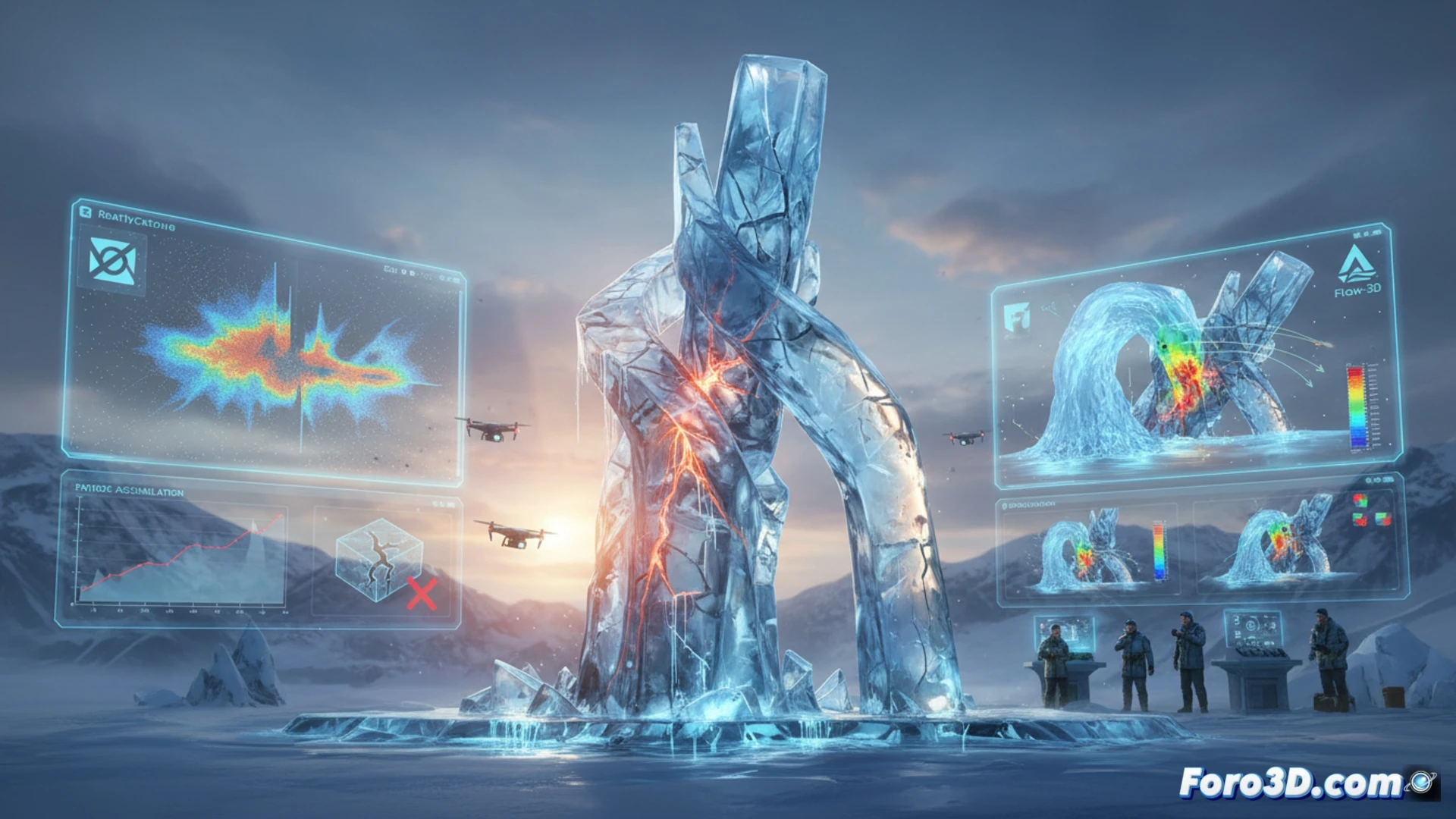
The collapse of a 5-meter ice sculpture during a festival has been analyzed using 3D simulation techniques. The failure occurred after several hours of sun exposure, at which point the piece's center of gravity shifted dangerously. Thanks to photogrammetry with RealityCapture and fluid dynamics simulations in Flow-3D, it was possible to demonstrate that the original design was structurally unfeasible under changing environmental conditions.
Structural fatigue analysis in ephemeral materials with Flow-3D and Blender 🧊
The forensic process began with the digital capture of the pre-collapse state using high-precision photogrammetry. The resulting model was imported into Rhinoceros 3D to reconstruct the original geometry and export it to Flow-3D. There, the differential melting of the ice was simulated, calculating the redistribution of masses and the displacement of the dynamic center of gravity. It was discovered that a poorly calculated internal cavity generated a progressive imbalance that exceeded the material's stress limit. Blender was used to visualize the areas of greatest thermal and structural stress, allowing the identification of the exact point of fracture initiation.
Lessons for forensic engineering of temporary structures 🔍
This case demonstrates that ephemeral materials like ice require a dynamic, not static, fatigue analysis. The combination of photogrammetry with multiphysics simulations allows predicting failures in temporary monuments exposed to solar radiation or temperature changes. For forensic engineers, the methodology used here is directly applicable to sand sculptures, inflatable structures, or ephemeral installations, where the time and climate variables are critical for structural integrity.
Would you validate with destructive testing?