The recent failure of the life support system in a high-altitude tourism capsule has brought attention to the premature degradation of polymer seals. A stratospheric balloon lost critical pressure, and forensic analysis points to the hatch seal. The main hypothesis is that UV radiation, intensified at 30 km altitude, degraded the polymer of the vacuum seal before its estimated life cycle. To verify this, a workflow integrating reality capture and nonlinear simulation has been developed.
Methodology: From point cloud to finite element model in Abaqus 🛠️
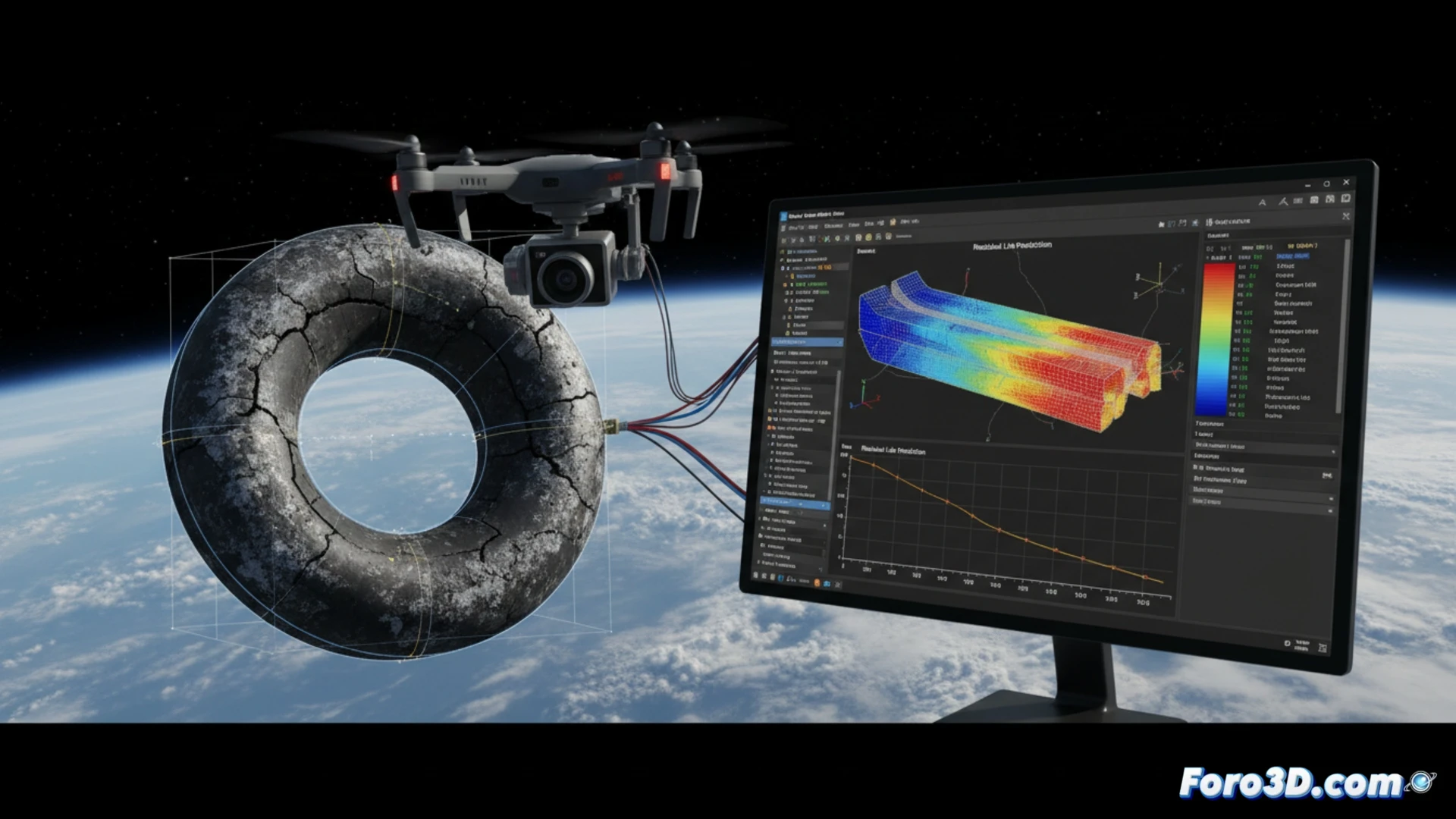
The process begins with high-resolution photogrammetry of the damaged seal. Using Agisoft Metashape, a dense mesh of the polymer geometry is reconstructed, capturing microcracks and surface deformations invisible to the human eye. This mesh is imported into Siemens NX to generate a parametric CAD model, where the theoretical service life of the material is assigned. The critical step is the transfer to Abaqus: a viscoelastic material model with UV degradation is applied, simulating the loss of mechanical properties such as Young's modulus and tensile strength. The fatigue simulation reveals that the photodegradation rate was 40% higher than predicted, causing microcracks that led to a catastrophic leak at 8 hours of flight, compared to the 50 hours estimated in the design plans.
The digital twin as a barrier against silent failures 💡
This case demonstrates that a digital twin of the seal, fed by real photogrammetry data and simulation in Abaqus, can predict failures before they occur under extreme conditions. The discrepancy between the service life calculated in Siemens NX and the UV simulation results highlights an error in standard degradation models. For the fatigue simulation niche, the lesson is clear: ultraviolet radiation must be a mandatory parameter in any polymer analysis for aerospace or high-altitude applications. Not doing so is assuming a risk that, as we have seen, can cost a mission.
How can photogrammetry be integrated with finite element analysis to model the propagation of microcracks induced by ultraviolet radiation in elastomeric vacuum seals, considering non-homogeneous material degradation?
(PS: Material fatigue is like yours after 10 hours of simulation.)