Security in museum galleries depends on the ability to detect any movement or intrusion. However, architecture, display cases, and large-format works inevitably create areas of visual shadow. Blind spot analysis using digital twins allows security teams to simulate vision trajectories and optimize sensor placement, ensuring that no single point remains uncovered within the exhibition space.
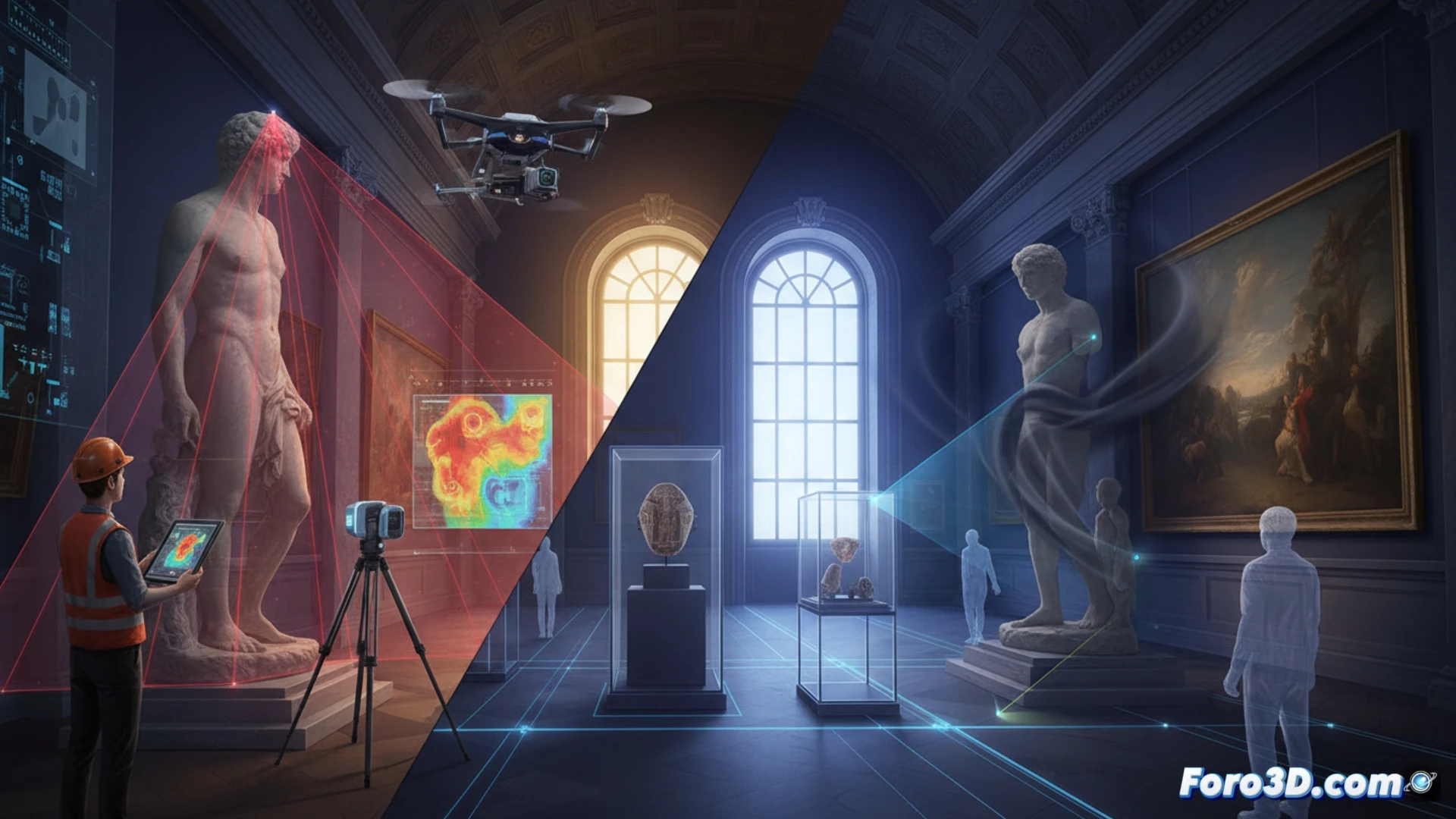
3D Reconstruction and Eye Trajectory Simulation 🎯
The process begins with a terrestrial laser scan (TLS) that captures the precise geometry of the room, including columns, pedestals, and door frames. Simultaneously, a photogrammetry session is conducted with a high-resolution camera to texture the model. Once the digital twin is generated in software such as RealityCapture or CloudCompare, virtual observation points are introduced that replicate the height and field of view of the real surveillance cameras. Through ray intersection analysis, the software calculates which polygons fall outside the visual cone of each sensor. The result is a risk heat map that indicates exactly where additional cameras or strategic mirrors should be installed to eliminate blind spots.
Beyond Security: Visibility as a Curatorial Tool 🖼️
This analysis is not only useful for preventing theft or vandalism. It also allows exhibition curators to understand how the public will perceive the pieces. A blind angle can mean that a work of art remains hidden behind a column or that an informational sign is not legible from the entrance. By simulating the visitor's path, museographic elements can be relocated to ensure a fluid and complete visual experience. 3D technology thus becomes a dual tool: defensive for security and constructive for exhibition design.
How the combination of laser point clouds and photogrammetric models can identify blind spots in museum galleries where architecture creates coverage shadows for traditional security sensors
(PS: In scene analysis, every scale reference is a small unsung hero.)