The discovery of the gecko Cnemaspis rishivalleyensis in India (2023) represents a milestone in evolutionary biology. Its coloration pattern, which mimics mosses and lichens, is an ideal case study for scientific visualization. Using photogrammetry and 3D modeling techniques, we can deconstruct and analyze this camouflage mechanism, creating digital replicas that allow studying the interaction between the animal's texture and its environment.
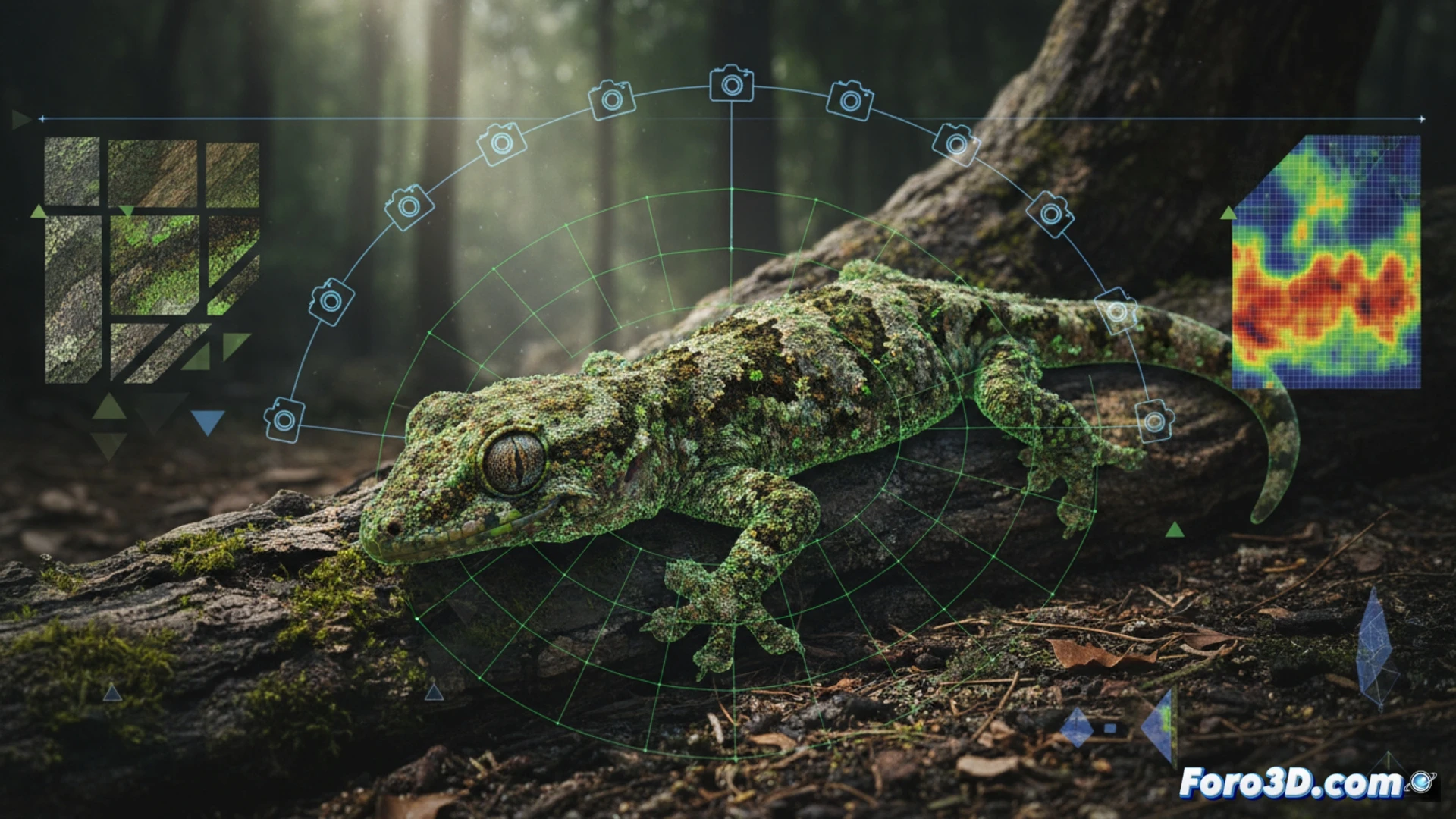
Digital reconstruction and spectral texture analysis 🧬
The technical process begins with capturing multiple images of the specimen and the bark of the host tree in the dry forest. Using photogrammetry software, we generate a high-resolution polygonal mesh that preserves the microtopography of the gecko's scales. The next step is texture mapping (PBR) where albedo, roughness, and normal maps are extracted. The key to the study lies in the spectral comparison: by overlaying the gecko's texture with that of real mosses and lichens collected from the same habitat, the reflectance patterns are validated. This allows simulating, in a realistic rendering environment, how the coloration breaks the animal's outline from the visual perspective of a predatory bird.
From science to art: the value of the digital model 🎨
Beyond taxonomic documentation, the 3D model acts as a virtual laboratory. We can modify lighting conditions or the background to test hypotheses about the effectiveness of camouflage at different times of the day. For science communicators, this resource allows generating animations where the gecko disappears on a digital log, intuitively explaining natural selection. The result is a tool that merges scientific precision with visual narrative, ideal for publications and interactive museums.
How can the challenge of capturing the cryptic coloration of the gecko Cnemaspis rishivalleyensis using photogrammetry be solved without the natural camouflage of its pattern distorting the 3D reconstruction of the model?
(PS: at Foro3D we know that even manta rays have better social connections than our polygons)