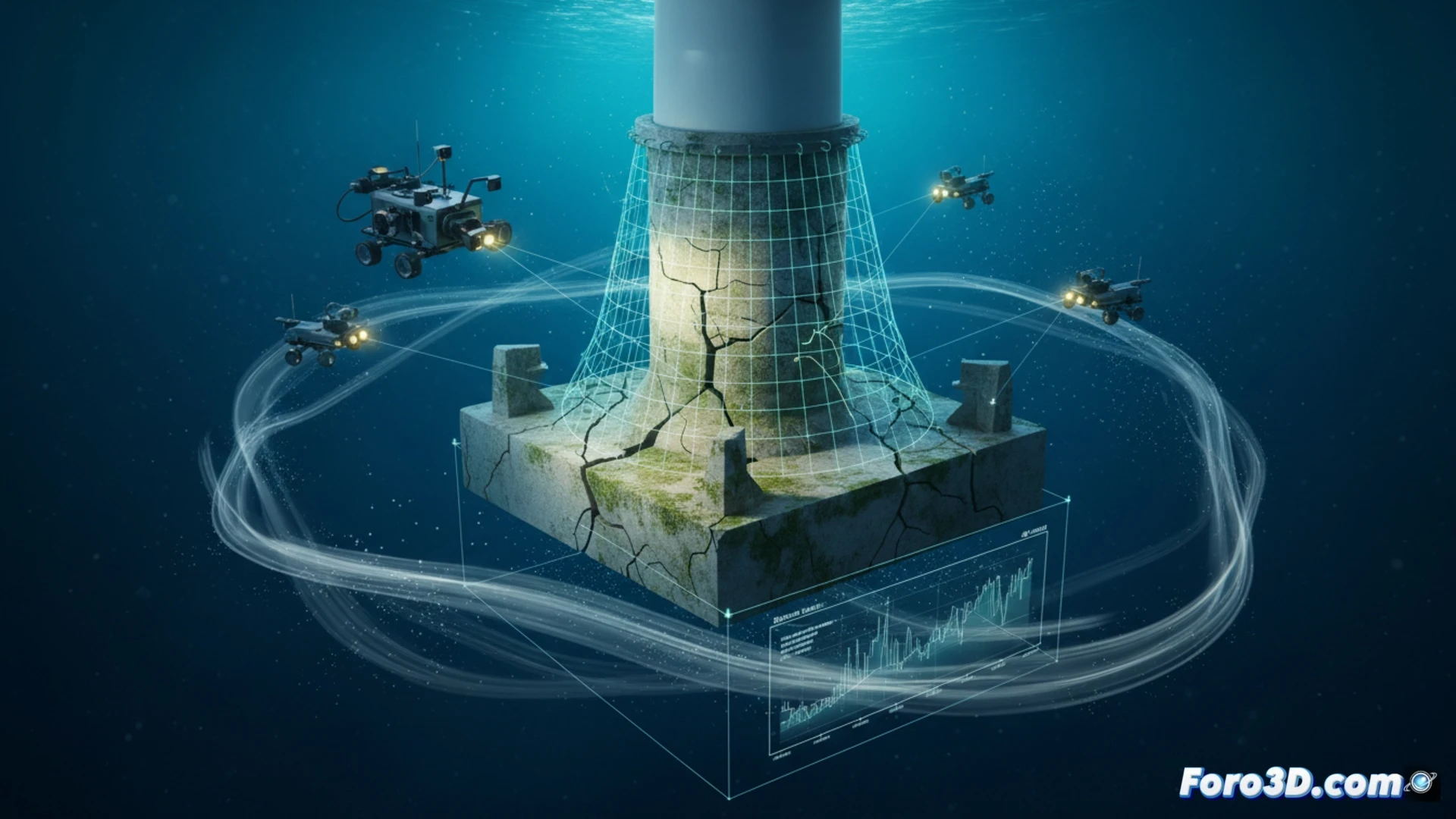
A critical failure in the anchoring system of a floating wind turbine has put the offshore industry on alert. The concrete structure detached from its original position, forcing a team of engineers to conduct a forensic inspection using underwater photogrammetry. The main objective was to determine whether material fatigue was accelerated by sea currents not recorded in the initial design models, a scenario that tests the limits of structural simulation.
Digital Reconstruction and Dynamic Load Simulation 🌊
The process began with capturing thousands of underwater images of the concrete base. These were processed in Bentley ContextCapture to generate a precise point cloud of the damaged element. Subsequently, Rhino with Grasshopper was used to create a parametric model replicating the detected cracks and deformations. The key piece of the analysis was OrcaFlex, where data from unmapped currents were input. This software allowed simulating the history of dynamic loads on the concrete, correlating stress peaks with the fatigue zones observed in the 3D reconstruction. Finally, 3ds Max was used to visualize the failure sequence and present the results in an understandable way for the maintenance team.
Lessons for Offshore Engineering ⚙️
The study's conclusion revealed that material fatigue was not a manufacturing defect, but a direct consequence of the cyclic action of underestimated currents. This incident demonstrates the need to integrate underwater photogrammetry as a routine inspection tool in floating wind farms. To prevent future failures, it is recommended to update OrcaFlex models with real-time oceanographic data and reinforce anchors with optimized geometries using Grasshopper, capable of better dissipating unforeseen loads.
Can underwater photogrammetry applied to anchor monitoring in floating wind turbine bases detect fatigue microcracks in concrete before they become a critical failure?
(PS: Material fatigue is like yours after 10 hours of simulation.)