A new study has solved one of the great mysteries of Southeast Asian archaeology: the function of the stone jars on the Plain of Jars in Laos. Thanks to the analysis of a three-meter vessel containing the skeletal remains of at least 37 individuals, it is confirmed that they functioned as containers for secondary burials. The bodies decomposed, and then the clean bones were deposited in these monumental urns.
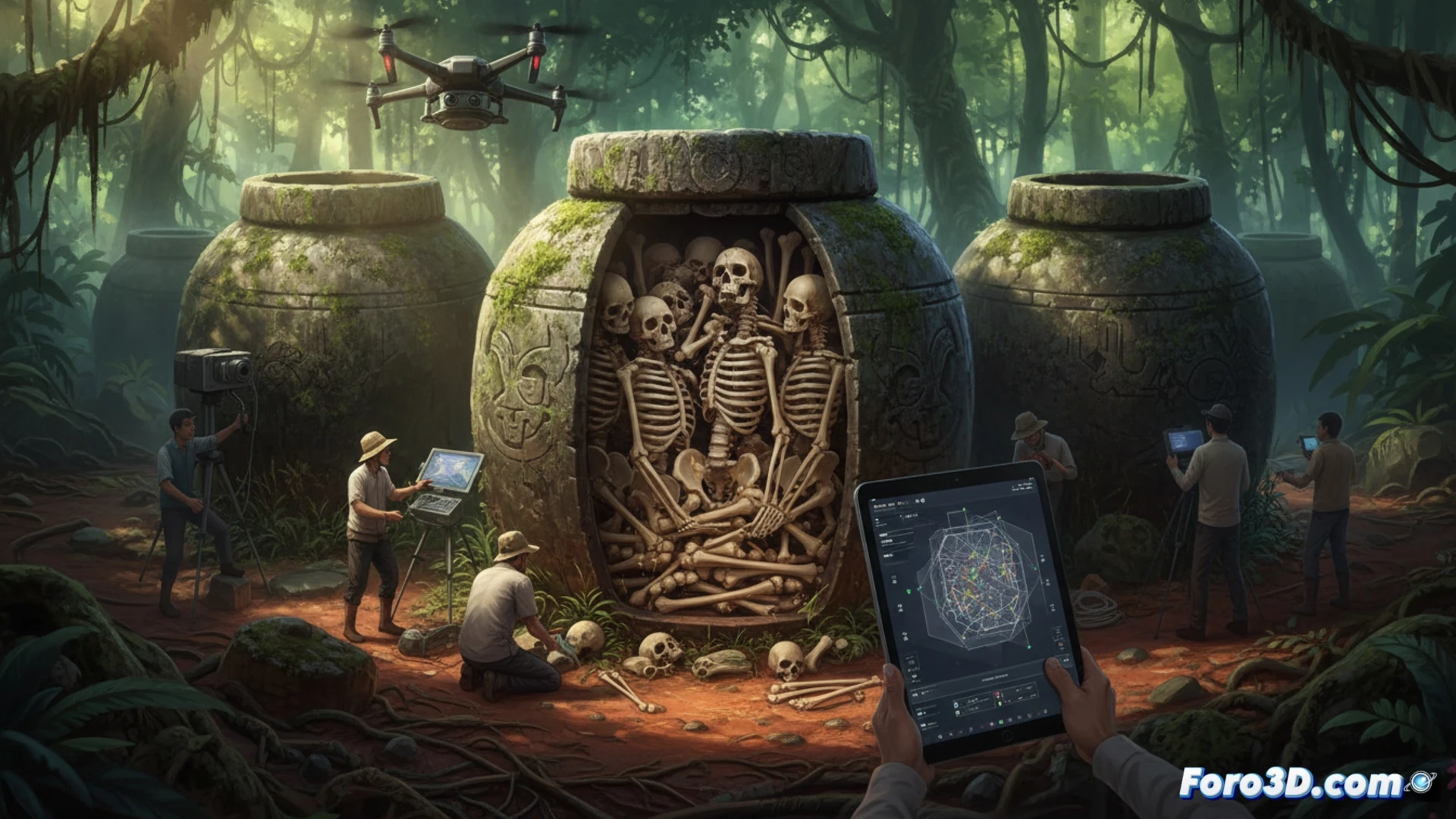
3D scanning and dating of the ritual landscape 🏺
The application of digital techniques has been key to deciphering this mystery. Researchers used photogrammetry and laser scanning to document the morphology of the jars and the interior of the bone deposits without moving the pieces. This non-invasive recording allowed them to model in 3D the arrangement of the remains and correlate them with carbon-14 dating. The result revealed a critical time gap: the bones date from between the 9th and 13th centuries, while the jars are much older. This suggests a ritual recycling of the landscape, where medieval communities reused these pre-existing structures as family pantheons.
Virtual reconstruction of a forgotten ritual 🔍
3D technology is not only useful for preserving heritage but also for reinterpreting history. Through virtual reconstructions, archaeologists have been able to simulate the secondary burial process: from the exposure of the bodies to the placement of the clean bones inside the jars. This digital approach allows us to visualize how the vessels were opened and reopened over generations, functioning as true community pantheons. The Plain of Jars ceases to be an enigma and becomes an example of how scientific analysis and 3D documentation can recover the memory of lost civilizations.
Just as photogrammetry has revealed that the jars of Laos served as funerary urns, what other archaeological mysteries of Southeast Asia could be solved by applying this 3D modeling technique?
(PS: If you dig at a site and find a USB drive, don't plug it in: it could be Roman malware.)