The recent detachment of a solar panel on an orbital station during a routine maneuver has brought attention to material fatigue in space. Thanks to orbital photogrammetry, captured from an auxiliary satellite, engineers have been able to reconstruct in 3D the fracture zone of the fastening bolts. This analysis, performed with Agisoft Metashape Professional, allows the identification of microcracks caused by the constant thermal cycles that structures in orbit experience.
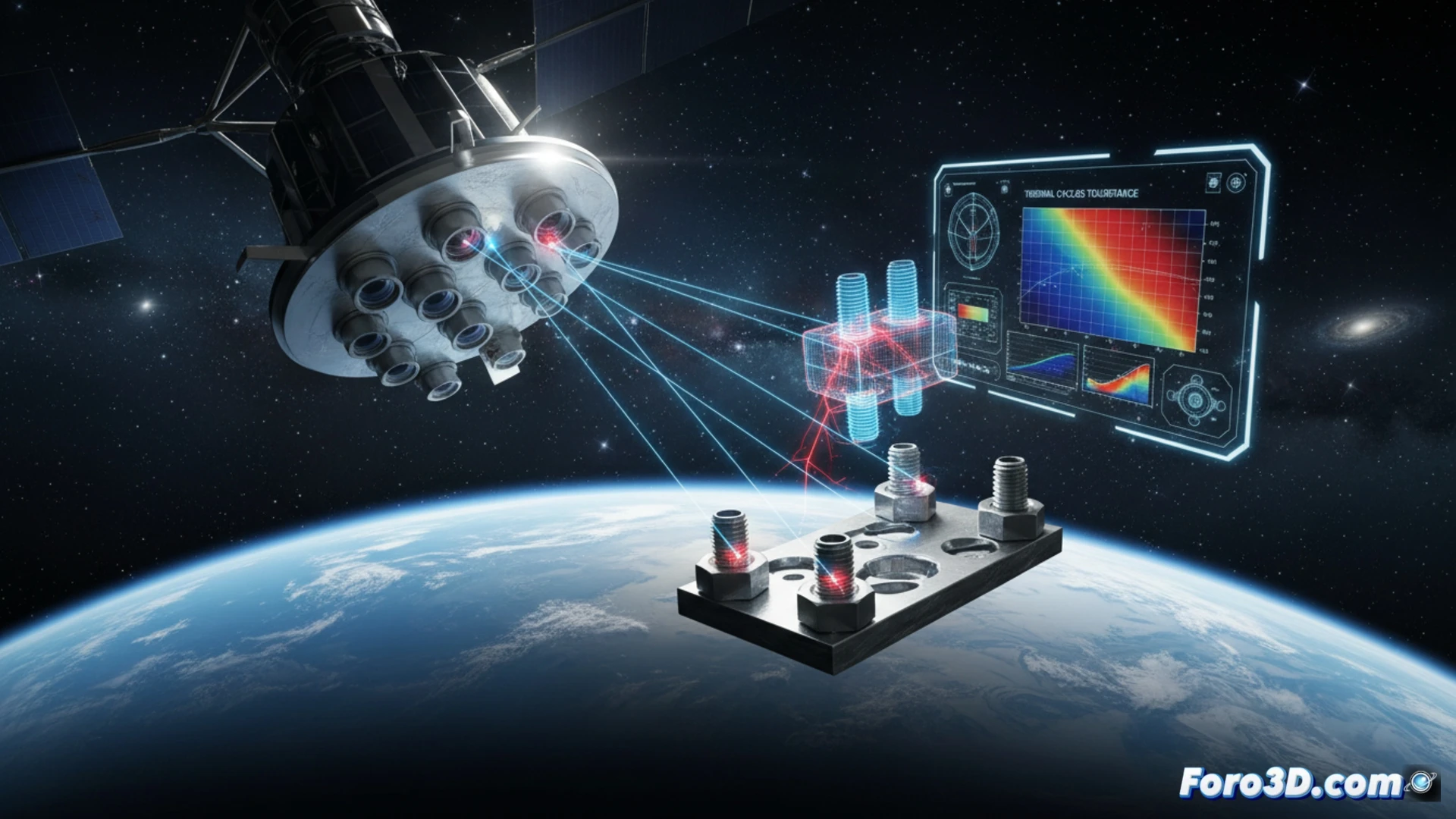
Technical workflow: from satellite imagery to simulation 🛰️
The process begins with capturing high-resolution images from a nearby satellite, which are processed in Agisoft Metashape to generate a dense point cloud and an accurate 3D model of the damaged panel. This geometry is exported to Ansys SpaceClaim, where it is cleaned and prepared for finite element analysis. Subsequently, Siemens NX runs the fatigue simulation, evaluating the accumulated stress on the bolts due to extreme temperature variations, which can range from -150°C to +120°C. Finally, Unreal Engine 5 visually recreates the failure scenario, allowing teams to observe the crack progression in real time.
Failure prevention in orbital infrastructure 🔧
This workflow not only explains the current failure but establishes a remote inspection protocol to prevent future detachments. The combination of orbital photogrammetry with advanced engineering software allows detecting signs of fatigue before a catastrophic break occurs. In a context where space debris is a growing threat, these techniques become essential tools for the safety and longevity of stations and satellites in service.
How can orbital photogrammetry detect micro-deformations in space bolts before they fail due to thermal fatigue, and what advantages does it offer over traditional inspection methods such as thermography or onboard strain sensors?
(PS: Material fatigue is like yours after 10 hours of simulation.)